How to Speed UP Your Blog Loading Time Beginner’s Guide
This is the case even if your website takes FOREVER to load. If it takes longer than three seconds for your blog to load, then it is loading TOO SLOW and you are losing readers as a result. Every every second matters! The PageSpeed Insights tool offered by Google is an excellent resource that can be used to determine how quickly or slowly your website loads. If the loading time of your blog is excessively long, the following advice will help you speed up the loading time of your Blogger blog in no time at all.
Why is blog loading time important?
My site used to be a little faster than usual, which was fairly surprising. On a PC, sites would load in roughly nine seconds, and on a mobile device, pages would load in a sluggish 14 seconds. Yikes. This is still extremely slow and, more crucially, does not provide a positive user experience, which Google values highly when it comes to SEO. Google wants its users to be happy. As a result, it will only rank quality material that consumers find valuable in the top spots of its search engine.
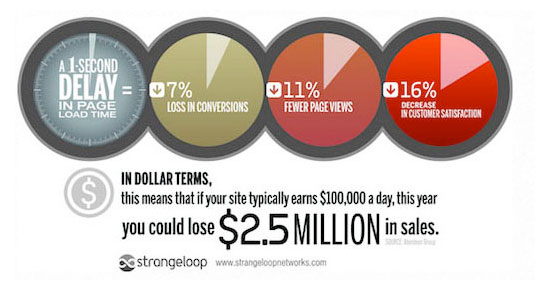
If users leave your blog within seconds of accessing it, this tells Google that your content isn’t very helpful and/or that the user experience isn’t quite what it should be. According to a StrangeLoop case study involving Amazon, Google, and other major sites, a one-second delay in page load time can result in a 7% drop in conversions, an 11% drop in page views, and a 16% drop in customer satisfaction.
Google and other search engines have initiated a practice of downgrading slower websites in their search rankings. Consequently, these websites receive fewer visitors. This means that they are less likely to attain high visibility, unlike websites that offer content readers find engaging and that promptly addresses their queries, resulting in a satisfying experience. This underscores the importance of learning how to enhance the loading speed of your blog. The issue with a sluggish site extends beyond readers merely not accessing your content; it translates to a missed opportunity for increased traffic that accompanies higher Google rankings.
While SEO components such as crafting exceptional content and establishing authority, often through backlinks, are indeed pivotal in Google’s estimation, it’s undeniable that if your content takes longer than three seconds to load, more than half of your site’s visitors won’t engage with it. Instead, they are likely to click away to a competitor’s site. This scenario is far from ideal when the objective is to generate revenue from your website. To compound matters, having a mobile loading speed of 14 seconds, particularly when over 70% of your traffic originates from mobile users, is a precarious situation.
As someone relatively new to the intricacies of SEO, I faced two options:
- Invest in professional assistance to expedite the loading speed of my blog, an approach that could be financially burdensome.
- Endeavor to streamline the process as much as possible while preserving the integrity of my blog.
Given budget constraints, I opted for the second choice. Thankfully, the task of enhancing my blog’s loading speed turned out to be less daunting than I had initially anticipated. I’ve distilled the procedure into five straightforward steps, which I’ll outline below, particularly with newcomers in mind.
Core Web Vitals: The New Speed Standard
Google utilises Core Web Vitals to determine if a visitor is satisfied after visiting your page, and page speed is a major factor in user experience. Google, for example, will look at page speed to see if your users are frustrated by your slow load time and leave within seconds. Understanding how Core Web Vitals works will help you enhance your Core Web Vitals and speed up your WordPress site.
Largest Contentful Paint, First Input Delay, and Cumulative Layout Shift are the three aspects that make up Core Web Vitals. The length of time it takes for your page to load from the first click of a link to the majority of the information is measured in LCP. LCP varies from other performance metrics like TTFB in that it assesses page speed from the perspective of the user. You’ll get a full analysis of the site aspects that are affecting your LCP whether you check it using Google PageSpeed Insights or Google Search Console.
LCP Range:
- 0 to 2 seconds – Good
- 3 to 4 seconds – Needs improvement
- 5 to 6 seconds – Poor
FID, or First Input Delay, is the second Core Web Vital. This metric determines how long it takes a user to interact with your page. Selecting a menu, filling out a form, or using the search box to get their desired goods are all examples of interactions. This is a crucial Core Web Vital to work on if your website is very interactive.
FID Range:
- 0 to 100ms – Good
- 200ms to 300ms – Needs improvement
- 400ms to 500ms – Poor
CLS (Cumulative Layout Shift) is a metric that determines how aesthetically stable a website is while it loads. In other words, if images on your page shift around while it loads, you have a CLS issue that needs to be addressed. Because it is perplexing to have a page element relocate to a new location once the page has fully loaded, Google considers this a Core Web Vital.
CLS Range:
- 0 to 0.1 – Good
- 0.1 to 0.25 – Needs improvement
- 0.25 to 0.3 – Poor
Choose a high-speed blog host
After switching from Bluehost to hostinger.com, I got a better PageSpeed Insights score.
When I first started writing, I went with the first blog host I heard about from other bloggers: Bluehost. Bluehost isn’t a poor hosting business by any means: they’re a well-known brand, so you can rest assured that your website will be safe in their hands, and they’re reasonably priced. They are, nevertheless, well-known for their poor page loading speeds.
In fact, website development experts Tool Tester determined Bluehost to be the slowest of all the hosts they examined after conducting thorough speed testing. While web hosting wasn’t entirely to blame for my slow page loading speed at first, it did play a role because, after switching to a quicker host, I was able to reduce my loading time by 5 seconds. All I did was change my host and that was it.
Is Your Blog Fast Enough? How to Test Your Site Speed
Hopefully, you’ve come to the conclusion that the faster your blog loads, the better. But how can you determine whether or not your site is loading quickly enough? You can quickly and easily check your web page load performance with our free WordPress speed test tool.
This is a nice alternative to Google Analytics’ site performance report because it provides additional information and actionable recommendations for improving the speed of your WordPress site. All you have to do now is type in your blog’s URL and click the Submit button. This page speed testing tool tells you everything you need to know about your page’s speed, including how long it takes for it to load.
Why is my website slow?
You’ve run a site speed test and discovered that your load time is quite slow. (I’ll explain how to run a site speed test later in this post if you don’t know how to do one.) There could be a variety of reasons for your site’s slow loading time. It might be anything from the time it takes for your server to load to the size of your images to the amount of redirects you have. That means there are a slew of things you can do to boost page speed. We’re going to look at 20 of them.
However, you must have a goal in mind before you begin debugging to increase website performance. Let’s look at what constitutes a good load time to give you a target to aim for.
What is a good page load time?
It’s a good idea to set a goal for where you want your site’s speed to be before you start working on it. If you don’t know what an acceptable page speed is, this can be challenging. The optimum practise, according to Google, is three seconds. Unfortunately, most sites aren’t even close, according to the conclusions of its recent benchmark analysis. In a study of 900,000 mobile ad landing pages from 126 countries, Google discovered that 70% of the pages took roughly seven seconds to display the visual information above the fold. None of the industries they studied came close to their recommended best practise of three seconds on average.
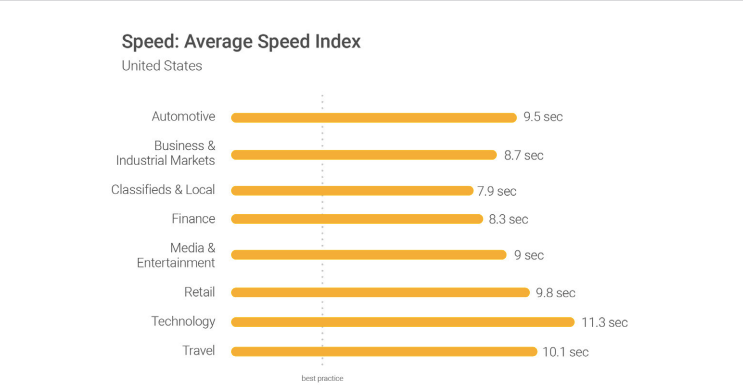
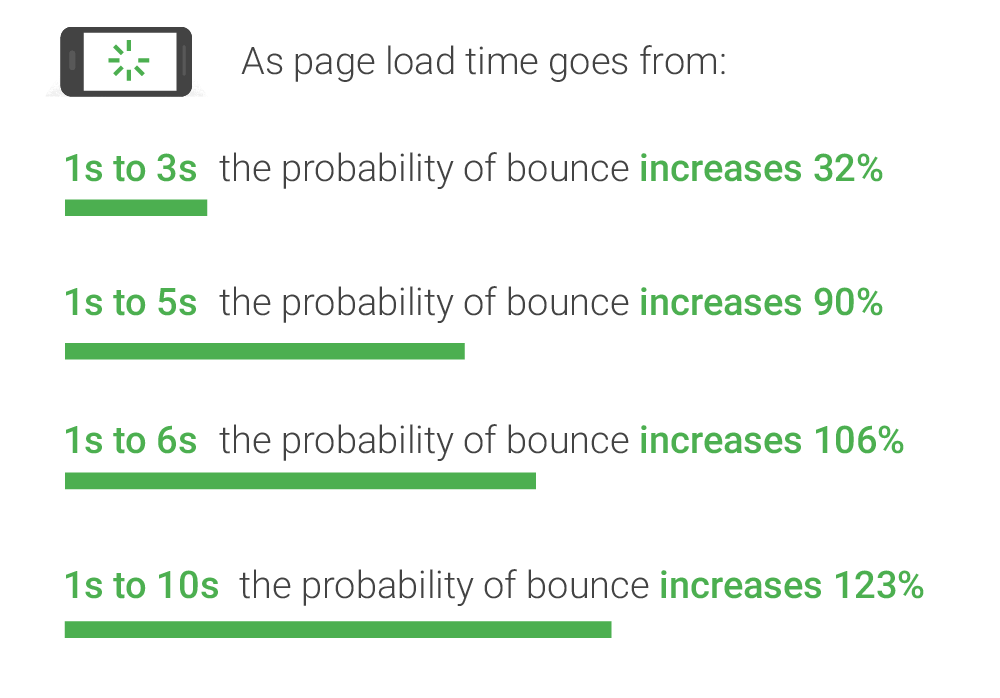
The average time it takes for a mobile landing page to fully load is 22 seconds, but if a mobile site takes more than three seconds to load, 53 percent of visitors would quit it. Furthermore, as the time it takes for a website to load climbs from one to 10 seconds, the likelihood of a mobile visitor bouncing increases by 123 percent.
This means that site owners in general have a lot of work ahead of them in order to bring their sites up to Google’s standards. On the plus side, if you put in the effort to make your site’s performance up to par, you’ll be well ahead of the competition in terms of user experience. You may use Google’s recommendations and benchmarks to set goals and track your progress as you develop your site. After all, being the world’s greatest search engine, Google can have a significant impact on your success. As a result, adopting their standards as your own is never a terrible idea.
How to Boost Your Site Speed
We need to go through and make some modifications after you’ve completed your test and have some ideas about what’s hurting your page speed. I’ve made an informed prediction as to what the major components will be, and I’ll share some advice with you below.
How to test your blog’s speed
Take a moment to see how quickly your blog is loaded now so you can do a before-and-after comparison. There are numerous programmes available online to assess load speed, but I like to compare my blog’s loading speed to that of others—after all, that’s what your visitors will do. WhichloadsFaster is one of my favourite tools for comparing the loading times of two websites. Enter your site’s URL and the URL of the other site into the two fields provided to compare your blog’s loading speed to that of a competitor blog or a large website utilised by readers in your niche.
How to speed up your blog
Now that you know how your site loads in relation to others, let’s look at how you may reduce the time it takes for your site to load.
Choose an efficient theme
Many bloggers make the error of selecting a free theme, or one which’s not correctly coded. In my expertise, each blogger should go for premium themes like Genesis, Thesis, or WooThemes. Premium themes are usually far more rigorously coded than free ones—Themeforest, for instance, has some good themes, however lots of the them aren’t well coded.
Review your hosting
Its blog’s loading speed is influenced by your hosting. Many new bloggers overlook this, but changing your hosting can have a significant impact on your blog’s speed. If you use shared hosting for your blog, you should consider switching to dedicated or grid hosting, as shared hosting can cause load speeds to slow down when the shared server is overburdened.
Remove extra widgets and plugins
This is one of the simplest ways to speed up the loading of your website. The more plugins you have installed, the longer it will take for your blog to load. Remove any superfluous widgets and plugins from your blog that aren’t strictly necessary and notice how your load time changes. Hand-code your functionality and integrate it directly into the WordPress theme to reduce the amount of server calls per page load.
Use the WordPress W3 Total Cache plugin
There’s one you should add now that you’ve reduced the amount of plugins you are utilising! For any WordPress user, W3 Total Cache is a must-have plugin. W3 Total Cache is a static caching plugin that creates HTML files that are served directly by Apache, bypassing the processing of PHP scripts, which are relatively hefty. It works with a wide range of servers and server configurations, and you can create the cache on your own server or through a content delivery network.
Use a content delivery network (CDN)
A CDN is a global network of efficient servers that cache copies of your website’s contents. The CDN maximises bandwidth and saves load time by making your site available from multiple servers. If you have visitors from all over the world, using a CDN is a great idea because the servers nearest to each user will be used to provide information promptly. A CDN provider like MaxCDN can give excellent performance without breaking the bank.
Optimize your blog images
Many bloggers overlook picture optimization, yet it’s a very efficient strategy to speed up your blog’s loading time. There are several plugins that can help you optimise blog images, but WP Smush.it is one of the best. It’s something I use on a lot of my blogs, and it actually helps them load faster. It has an API that automatically executes these improvements (except for stripping JPEG metadata) and connects with WordPress. You don’t have to do anything special because every image you add to a page or post will be processed by Smush.it behind the scenes.
Use a lightweight WordPress theme / framework
WordPress themes that include a lot of dynamic components, such as sliders, widgets, social icons, and other flashy elements, are very enticing to the eye. However, keep in mind that if they contain too many elements and larger page sizes, your web server will undoubtedly suffer. The best solution is to utilise lightweight themes in this case. One option is to use one of the WordPress default themes. Another option is to use something like Neve, which was created by the same people who created CodeinWP.
 Neve
NeveAuthor(s): Themeisle Current Version: 3.2.4 Last Updated: May 5, 2022 neve.3.2.4.zip
Alternatively, for a feature-rich website, you can also opt for a theme that uses a good framework like Bootstrap or Foundation.
Reduce image sizes
Images are the most significant contributions to a webpage’s size increase. The trick is to compress the photographs without sacrificing their quality. The process will take a long time if you use the Chrome PageSpeed Insights extension, Photoshop, or any other tools to manually optimise the photos. Fortunately, there are plugins for almost anything you can imagine, including picture optimization. The following are a few that are worth mentioning:
Using any of the above mentioned plugins on your WordPress site will drastically reduce image sizes, thus improving the speed of your website.
Minify JS and CSS files
If you use the Google PageSpeed Insights tool to analyse your website, you will most likely be advised to reduce the size of your CSS and JS files. This means that you can enhance site loading performance by minimising the amount of CSS and JS calls and the size of those files. You can also read the Google guidelines and conduct some manual fixing if you know your way around WordPress themes. If not, there are plugins that can assist you reach this goal, the most famous of which is Autoptimize, which can help you optimise your WordPress website’s CSS, JS, and even HTML.
Advanced Lazy Loading Techniques for 2026
Lazy loading is one of the most effective ways to improve perceived performance. Modern browsers support native lazy loading via the loading="lazy" attribute. Add it to your <img> and <iframe> tags. For WordPress, plugins like a3 Lazy Load or WP Rocket automatically implement this. According to web.dev, lazy loading can reduce page weight by up to 50% and improve LCP scores dramatically.
Summary: Key Takeaways for a Faster Blog
- Measure first: Use Google PageSpeed Insights, GTmetrix, or Pingdom to identify bottlenecks.
- Choose superior hosting: Shared hosting is a common culprit; upgrade to managed WordPress or VPS.
- Optimize images: Compress, resize, and use WebP format. Tools like ShortPixel and Imagify automate this.
- Implement caching: Page caching (W3 Total Cache, WP Rocket) reduces server load by 80%.
- Use a CDN: Cloudflare, BunnyCDN, or KeyCDN distribute content globally.
- Minify assets: Combine and minify CSS, JavaScript, and HTML.
- Reduce external scripts: Limit third-party embeds (social widgets, analytics) that block rendering.
- Monitor Core Web Vitals: Keep LCP under 2.5s, FID under 100ms, and CLS under 0.1.