
What is a WordPress Theme?
A WordPress theme is a group of interconnected files that form the overall appearance of your website. These files include code files, images, templates, style sheets, and so on. Editing your WordPress theme will change the outlook of your website such as
- Design of your website
- Navigation & header menu
- Font styling, size, and color
- Website color
- Widget locations
- Page layouts
- Web page & blog post styles
- Additional style details
WordPress provides in-built tools for editing your website theme. However, doing so requires WordPress theme editing skills.
Why Should You Edit Your WordPress Theme?
There are plenty of reasons to edit your WordPress theme. For starters, it helps to differentiate your brand, customize your website structure, add new functionality, and appeal to your target audience. Let’s talk about each reason more briefly.
- Differentiate your brand
Most WordPress website owners use a theme. And even though there are thousands of WordPress themes available in the market, they’re likely to be used by your competitors. Therefore, it is critical to edit your WordPress theme to make it uniquely yours and differentiate your website from the mass. Also, it is important to secure your WordPress websites with an SSL certificate.
- Not picking the Ideal selection
If you’re struggling with your current theme, it’s time to make a change. Choose a WordPress theme that better fits your website’s purpose and goals to improve its appearance and functionality. If you can’t pick a new one, you can make changes to your already installed theme and edit the UI.
- Customize Website Structure
All best-designed websites often have one thing in common — a well-organized website structure. Believe it or not but website structure plays a critical role in enhancing your website appearance & effectiveness. This is why you should always learn to customize your website structure to improve the look and feel of your website and offer an enhanced user experience.
- Add a New Functionality
Apart from modifying your website’s style and appearance, editing your WordPress theme also allows you to add new functionalities. There are a plethora of WordPress plugins (free & paid) available in the market. For instance, by installing a collaborative publishing WordPress plugin, you can allow multiple people to edit collaboratively on WordPress. For example, if one person on your team is responsible for writing blog posts, while another is responsible for doing Blog Post SEO of every article you publish, collaborative editing WordPress plugin can come in handy in such situations.
- Appeal to Your Target Audience
The theme you’ve installed might not precisely match your expectations such as font style, color, and other design elements. But, by editing your WordPress theme, you can modify the look and feel of your website in a way that highly influences how your website visitors perceive it. Most brands today change color and font style that appeals to the majority of their target audience. But, in order to make such modifications, you have to learn how to edit a WordPress theme. And that’s what we’re going to talk about next!
How to Edit WordPress Theme — 3 Methods
Most website owners reach out to WordPress theme developers for WordPress theme customization. However, you can definitely learn to edit a WordPress theme by yourself. Here are the 3 methods you can use to edit your WordPress theme.
WordPress Theme Customizer
WordPress Theme Customizer is the most straightforward way to edit a WordPress theme. In fact, it’s the default way to make visual changes in your WordPress theme without having to worry about anything. Let’s see how to access WordPress Theme Customizer to edit a WordPress theme:
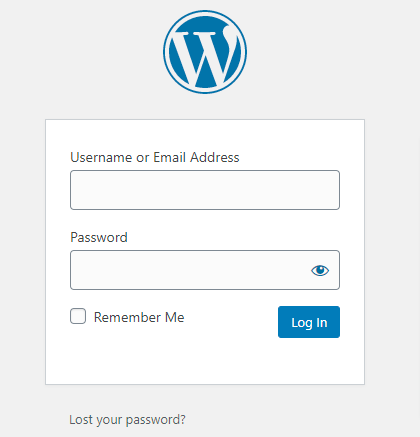
Step#1 — Log in to your WordPress Admin Dashboard. You can check alternative ways to log in to your WordPress dashboard for a quick reference.
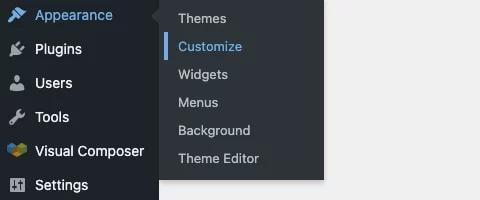
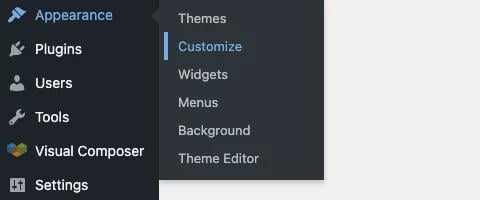
Step #2 — Navigate to the Appearance option from the left-side menu and click on Customize from the dropdown menu.
Step #3 — Upon clicking Customize, you’ll be redirected to WordPress Theme Customizer.
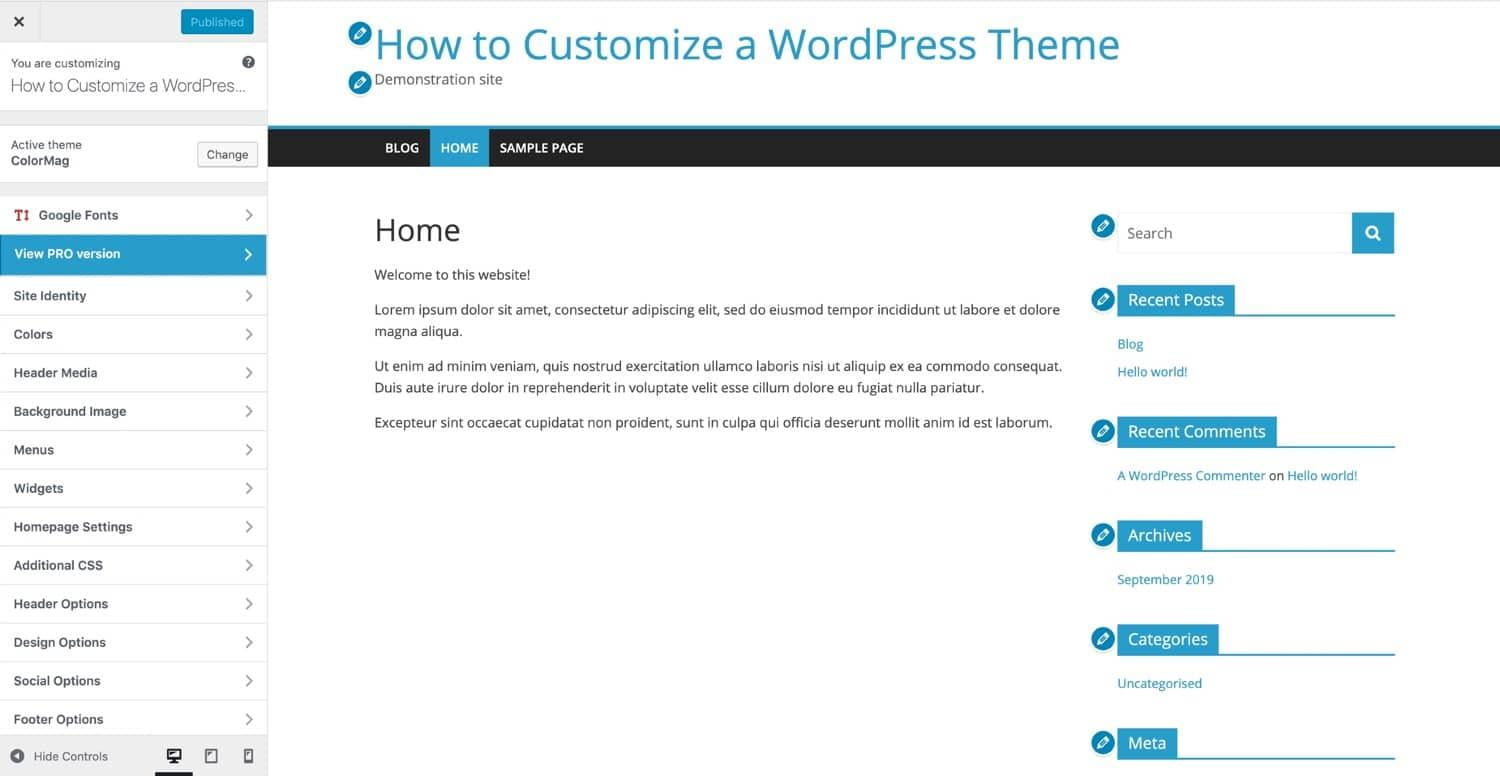
Step #4 — Once you’ve made your desired changes in the WordPress Theme Customizer, click on Save & Publish to finish the process.
WordPress Theme Editor
Another way to edit a WordPress theme is via Theme Editor. Unlike the first method, WordPress Theme Editor allows you to edit your theme using code. If you’re doing this for the first time, we recommend using a child theme so that it doesn’t affect the original files. With that, let’s see how to access WordPress Theme Editor to edit a WordPress theme.
Step #1 — First of all, log in to your WordPress Admin Dashboard.
Step #2 — Next, navigate to Appearance from the left-side menu and click on the Theme Editor option from the dropdown menu.
Step #3 — From Theme Editor, you can edit the style.css & function.php files of your WordPress theme.
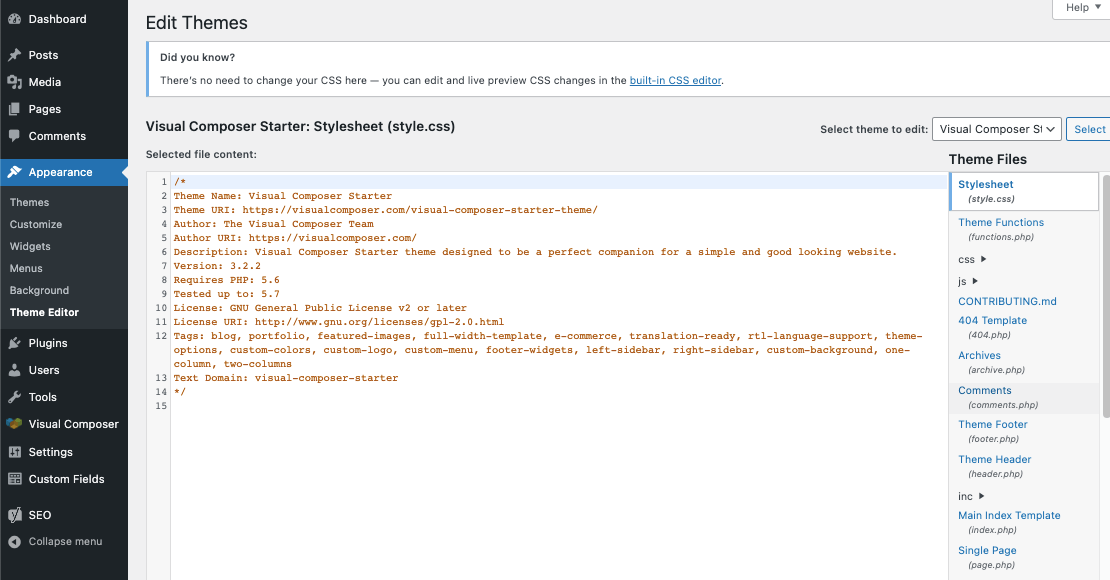
Step #4 — Once you’ve made your desired changes, live preview the changes you made in the built-in CSS editor. If everything looks good to go, click on the Update button to publish the changes to your live website.
Third-Party Page Builders
The last method you can use to edit your WordPress theme is third-party page builders. Page builders are WordPress plugins that make it easy for WordPress website owners to customize their website appearance with a drag-and-drop interface. Elementor, for example, is one such page builder plugin that is widely popular in the WordPress community.
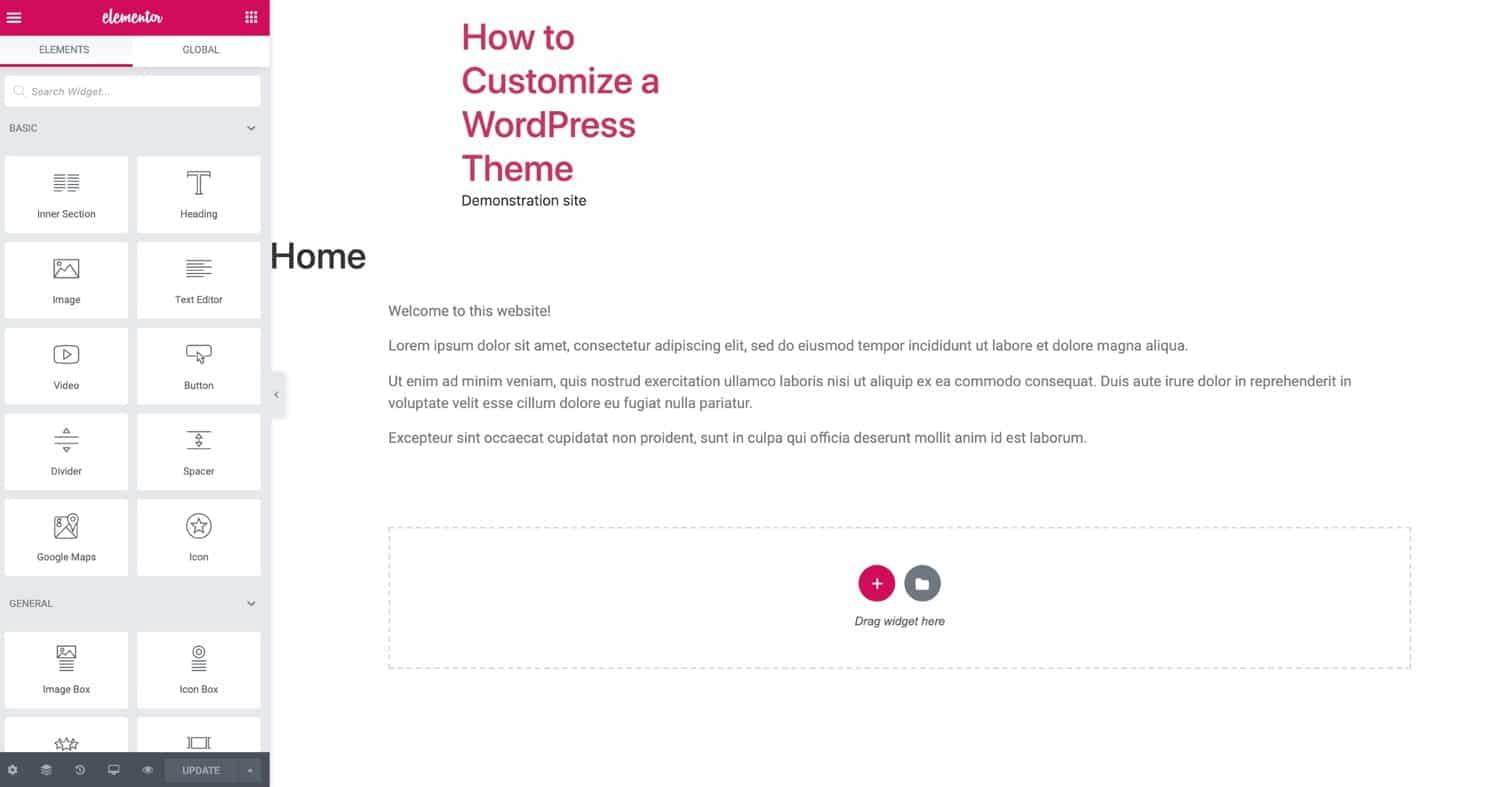
Using Elementor Pro, you can even edit your posts, pages, widgets, header menu, and more with the drag-and-drop interface. Furthermore, Elementor Pro offers extensive flexibility compared to the in-built WordPress Theme Customizer. If you’re planning to use Elementor Pro for your WordPress website, we have a special Elementor Pro Discount Code for you. Depending on your WordPress theme, you can install a page builder plugin that is most compatible with your theme and start using its drag-and-drop interface to start making your desired changes. Alternatively, you can also utilize other WYSIWYG editors to make your desired changes to your WordPress theme.
Essential Pre-Editing Checklist: Before You Start
Before you change a single line of code or adjust a color, proper preparation is essential. Following this checklist can save you hours of frustration and prevent you from breaking your live site.
Critical Warning: The Child Theme Mandate
Never, under any circumstances, edit the files of your parent theme directly. When WordPress updates your theme, all your custom changes will be wiped out instantly and permanently. Always create and activate a child theme before making any code-level modifications. This creates a safe layer where your customizations are stored separately and preserved through updates.
- Create a Full Backup: Use a reliable backup plugin like UpdraftPlus or BlogVault to create a complete backup of your site’s files and database. Store it in a secure, off-server location like Google Drive or Dropbox.
- Set Up a Staging Site: A staging site is an exact clone of your live website where you can test changes safely. Most quality managed WordPress hosts (like WP Engine, Kinsta, or SiteGround) offer one-click staging. If your host doesn’t, use a plugin like WP Staging to create one.
- Install a Code Editor: If you plan to edit code, ditch the basic Notepad. Use a dedicated code editor like Visual Studio Code or Sublime Text. They offer syntax highlighting, error detection, and auto-completion, making coding safer and easier.
- Clear Your Cache: Before and after making changes, clear your site’s cache (from your caching plugin and/or hosting panel) to ensure you’re seeing the most recent version of your site.
Pro Tip: The Browser Developer Tools Shortcut
Before writing any CSS in your theme files, test styling changes live using your browser’s Developer Tools (F12). You can modify colors, fonts, margins, and more in real-time on your live site. Once you’re happy with the look, you can simply copy the perfected CSS code from the browser and paste it into your child theme’s style.css file. This is the fastest way to prototype design changes.
Understanding Theme File Hierarchy: What to Edit and Where
A WordPress theme is like a puzzle made of template files. Knowing which file controls which part of your site is half the battle. The hierarchy dictates which file WordPress uses to display a particular page.
Here’s a simplified breakdown of the most common template files and their purpose:
| Template File | What It Controls | Common Edits |
|---|---|---|
| header.php | The top section of every page (logo, menu, header area). | Adding custom logo code, modifying navigation structure, inserting tracking scripts. |
| footer.php | The bottom section of every page (copyright, widgets, footer menu). | Changing copyright text, adding footer widgets, inserting footer scripts. |
| style.css | The visual styling of your entire site (colors, fonts, spacing, layout). | All CSS changes to appearance. This is the most frequently edited file. |
| functions.php | The “brain” of your theme. Adds features and modifies core functionality. | Enqueuing scripts/styles, registering widget areas, adding custom PHP functions. |
| index.php | The main blog posts listing page (fallback template). | Altering the main blog loop structure. |
| page.php | The template for individual static pages (About, Contact). | Creating custom page layouts without a page builder. |
| single.php | The template for individual blog posts. | Modifying post layout, adding author boxes, changing meta data display. |
For example, if you want to change something that appears on every page (like the header), you edit header.php. If you want to change how all your blog posts look, you edit single.php.
Advanced Customization: Going Beyond the Basics
Once you’re comfortable with the core methods, you can unlock more powerful customizations.
1. Creating a Custom Page Template
Sometimes you need one page to look completely different. You can create a unique template for it.
- In your child theme folder, create a new file, e.g.,
page-custom.php. - At the very top, add this template header comment:
/*
Template Name: My Custom Landing Page
*/
- Copy the code from your theme’s
page.phpfile into this new file and modify it as needed. - Save the file. Now, when you edit a page in the WordPress editor, you’ll see “My Custom Landing Page” as a template option in the Page Attributes panel.
2. Using Hooks: Actions and Filters
Hooks are the cleanest, most upgrade-safe way to modify theme functionality. They let you “hook” your custom code into specific spots in the WordPress core or theme without editing the original files.
- Actions: Let you add content at specific points (e.g., adding HTML after a post). Code goes in your child theme’s
functions.php. - Filters: Let you modify existing data before it’s displayed (e.g., changing excerpt length). Code also goes in
functions.php.
Example: Add a custom message after every post.
// Add to child theme's functions.php
function my_custom_post_message() {
    echo '
‘; } add_action( ‘the_content’, ‘my_custom_post_message’ );
3. Overriding Templates with a Child Theme
This is the core principle of safe editing. To change a template file:
- Identify the file in the parent theme you want to change (e.g.,
header.php). - Copy that file from the parent theme folder (
/wp-content/themes/parent-theme/) to your identical child theme folder (/wp-content/themes/child-theme/). - Edit the copied file in your child theme. WordPress will now use your child theme’s version instead of the parent’s.
Choosing the Right Method: A Decision Guide
Not sure which editing path to take? This guide will help you match your goal with the best method.
| Your Goal | Recommended Method | Difficulty Level | Risk Level |
|---|---|---|---|
| Change colors, fonts, or background images | WordPress Customizer or Page Builder | Beginner | Very Low |
| Rearrange homepage sections visually | Page Builder (Elementor, Beaver Builder) | Beginner | Low |
| Add custom CSS for fine-tuned styling | Customizer’s “Additional CSS” panel or Child Theme style.css | Intermediate | Low |
| Add a new widget area or menu location | Child Theme’s functions.php file using hooks | Intermediate | Medium |
| Modify the HTML structure of your header/footer | Child Theme (copy and edit header.php/footer.php) | Advanced | Medium-High |
| Create a completely unique page layout | Create a Custom Page Template in Child Theme | Advanced | Medium |
Pro Tip: The “Additional CSS” Safety Net
For minor to medium CSS tweaks, always use the WordPress Customizer’s “Additional CSS” panel first. This CSS is stored separately from your theme files and is designed to be a safe place for customizations. It persists through theme updates and is easier to manage for beginners. Only move CSS to your child theme’s style.css file when you have a large volume of stable, final styles.
Common Editing Tasks & How to Execute Them
Let’s apply what we’ve learned to solve specific, common problems.
- Task: Change the Site Title Font & Color.
- Method 1 (Easiest): Go to Appearance → Customize → Typography/Colors (options vary by theme).
- Method 2 (More Control): Use the “Additional CSS” panel in the Customizer with code like:
.site-title {
    font-family: 'Arial', sans-serif;
    color: #ff0000 !important;
}
- Task: Add a Social Media Icon Menu to the Header.
- Recommended Method: Use a plugin like Menu Icons or your theme’s built-in menu settings if available. For code, you would add HTML/PHP for the icons to your child theme’s
header.phpfile and style them in CSS.
- Recommended Method: Use a plugin like Menu Icons or your theme’s built-in menu settings if available. For code, you would add HTML/PHP for the icons to your child theme’s
- Task: Remove the “Category:” Prefix from Archive Titles.
- Method: Add a filter to your child theme’s functions.php file:
add_filter( 'get_the_archive_title', function ($title) {
    if ( is_category() ) {
        $title = single_cat_title( '', false );
    }
    return $title;
});
- Method: Add a filter to your child theme’s functions.php file:
End Note
Learning how to edit a WordPress theme isn’t difficult. And after reading this post, hopefully, you have finally learned how to edit your WordPress theme without external help. Your next job is to identify the appropriate method to edit your WordPress theme and start making customizations that suit your brand.
Once you’re done with customizations, make sure to test your website functionality, loading speed, and cross-browser compatibility. If you spot any issues, let’s say a loading speed issue, make sure to rectify it so that they don’t hurt your rankings and traffic. Conversely, if you can’t seem to resolve the loading speed issue on your own, contact a digital agency offering WordPress Speed Optimization Services to get your issue resolved.
Final Checklist Before Going Live
Before you push your beautifully edited theme to the world, run this final check on your staging site:
- Responsive Test: Resize your browser window. Does everything look good on mobile, tablet, and desktop?
- Browser Test: Check your site in Chrome, Firefox, and Safari. Are there any glaring differences?
- Plugin Compatibility: Do all your essential plugins (forms, SEO, e-commerce) still work correctly?
- Speed Test: Run a test on GTmetrix or PageSpeed Insights. Did your edits cause a performance drop?
- Link & Function Test: Click every major button, form, and navigation link to ensure they work.




Thank you so much for sharing this useful information! It’s helped me a lot.
The explanation of the content is very detailed and easy to understand.