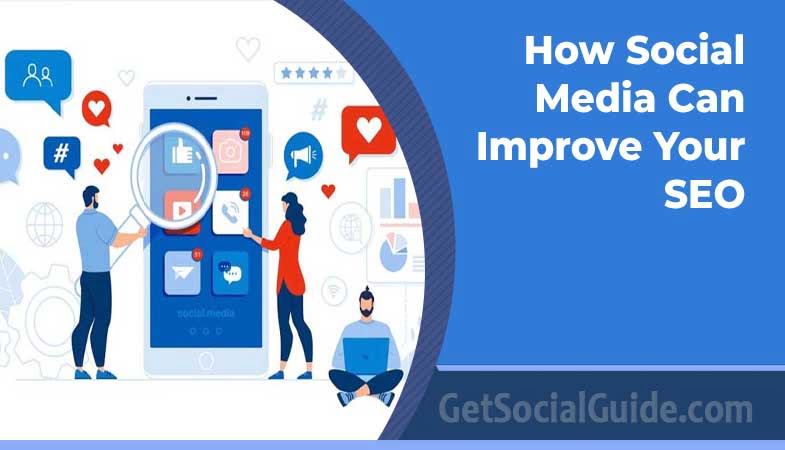
If you’re a marketer or a business owner, you already know the importance of search engine optimization (SEO). But have you considered social media’s role in your SEO strategy? In today’s world, social media is not just a platform to connect with people; it can also significantly impact your website’s search engine rankings.
Let’s talk about how social media can help improve your SEO strategy and give tips on leveraging social media to improve your search engine rankings.

Social media can help you gain more external links to your website. When you share content on social media, people can spread the word about your content, and they might link to your website or blog on their sites. This step is a great way to generate backlinks, an essential factor affecting your website’s visibility in search engine rankings. More external links would give you better chances of getting noticed, crawled, and indexed by search engines.
Better Engagement = Better Ranking
Engagement is an important metric in social media, and it can also have a positive impact on your search engine rankings. If your content is engaging, it can attract more shares and likes, which, in turn, can generate more clicks and visits to your website. Search engines also consider social signals when crawling your site, and higher engagement can help improve your rankings.
Not only do your posts on social media provide external links to your website, but your social media profiles can also rank on search engines. If you have optimized social media profiles, your followers and fans will likely search for you on social media, and your profiles will appear in search engine rankings. This step can create brand visibility and drive more traffic to your website.
Social media can help you create high-quality, informative, and engaging content that can attract people to your website. When you create fresh and relevant content, your audience will likely share it with others. As mentioned earlier, the more shares and likes your content receives, the better chance you have to generate backlinks, which helps to improve your website’s rankings in search engine results pages (SERPs).
Brand Awareness and Trust
Social media platforms are a great way to improve brand awareness and build trust with your target audience. When you consistently share high-quality content on social media platforms, you can attract more followers, and this audience can become your loyal customers. Higher user engagement, better brand awareness, and user trust translate to better search engine rankings.
Social media can significantly impact your SEO strategy and attract more users to your website, generate external links, and improve your website’s search engine rankings. To leverage social media effectively, you must have a well-thought-out and consistent strategy. Knowing how to grow your social media presence and use it to improve your SEO strategy can result in more web traffic and higher rankings for your website. So make sure you incorporate social media into your overall marketing plan and see the positive impact it can have on your SEO efforts.
Instead of treating social media as a broadcast channel, use it to identify trending topics and audience questions. Tools like BuzzSumo or native platform analytics reveal what resonates, allowing you to create content that naturally attracts links and shares—two core SEO ingredients. According to Moz, social signals themselves aren’t a direct ranking factor, but the visibility they generate leads to high‑quality backlinks and brand searches, which absolutely are.
Search engines like Google have repeatedly stated that social signals (likes, shares, follows) are not a direct ranking factor. However, the indirect benefits are undeniable. When your content gains traction on social platforms, it attracts natural backlinks from bloggers, journalists, and industry sites who discover your work. These backlinks are among the strongest ranking signals.
Additionally, social media can improve your site’s crawl efficiency. When your content is shared widely, search engine bots may discover it faster, leading to quicker indexing. This is especially valuable for time‑sensitive content or new pages you want to rank quickly.
Actionable insight: Use social media to amplify your most important SEO content. Share pillar pages, in‑depth guides, and original research. Monitor which pieces earn the most shares, then repurpose that content into multiple formats (video, infographic, carousel) to sustain momentum.
One of the most underutilized SEO tactics is leveraging social media for keyword research. Platforms like Reddit, Quora, and Twitter (X) are goldmines for the language your audience uses. By monitoring conversations in your niche, you can uncover long‑tail keywords, question‑based queries, and emerging topics that haven’t yet saturated search results.
Tools like Social Mention or even a simple Twitter advanced search can reveal how people phrase their problems. For example, a fitness brand might discover that users frequently ask “how to build muscle without weights” – a phrase they can then optimize a blog post around. This alignment ensures your content matches real user intent, a core SEO principle.
Thousands of likes or followers mean little if they don’t translate into website visits or brand searches. Focus on engagement that leads to clicks (CTR), shares, and saves—these are stronger indicators of content value. A small but highly engaged community often drives more SEO value than a large, passive audience.
Your social profiles often appear in the top search results for your brand name. Make sure each profile is fully optimized:
- Use consistent branding: Profile photos, cover images, and handles should be uniform across platforms to reinforce brand recognition.
- Complete all fields: Include your website URL, business category, and a keyword‑rich bio. For example, instead of “We sell coffee,” write “Ethically sourced coffee beans | Direct trade | Seattle.”
- Enable “clickable” links: On Instagram, use the website field; on LinkedIn, add a featured section with links to key content.
- Leverage business features: Google Business Profile, Facebook Business Page, and LinkedIn Company Page all enhance your digital footprint and can appear in branded search results.
These optimizations not only help your profiles rank, but they also signal to search engines that your brand is legitimate, contributing to your overall E‑E‑A‑T (Experience, Expertise, Authoritativeness, Trustworthiness).
User‑generated content (UGC) – reviews, testimonials, customer photos – serves dual purposes: it builds trust with potential customers and provides fresh, unique content that search engines love. Encourage customers to tag your brand or use a branded hashtag. Feature this content on your website (e.g., a “reviews” page or gallery). This approach adds authentic, keyword‑rich text to your site and can improve dwell time, a positive engagement signal.
Moreover, reviews on platforms like Google, Yelp, and Facebook can influence local SEO. According to Search Engine Journal, businesses with high review volume and positive sentiment tend to rank better in local pack results.
A siloed approach—treating SEO and social as separate teams—limits results. Instead, adopt a unified content strategy:
- Repurpose high‑performing content: Turn a popular blog post into a Twitter thread, a LinkedIn carousel, and an Instagram Reel. Each format reaches different segments of your audience and drives them back to the original article.
- Promote linkable assets: Original research, data studies, and comprehensive guides are naturally linkable. Share them across social with compelling captions, tag industry influencers, and engage in conversations to amplify reach.
- Use social media to build relationships: Connect with journalists, bloggers, and industry experts. A simple interaction can lead to a mention or backlink down the line. Tools like Hunter help find contact details for outreach, but building genuine rapport on social often yields better results.
By integrating social and SEO, you create a flywheel effect: social fuels content visibility, which attracts links, which boosts SEO, which in turn makes your content more shareable.
- Drive traffic and backlinks: Social shares lead to natural link acquisition, a core ranking factor.
- Boost engagement signals: Higher social engagement often correlates with better search visibility, though it’s an indirect effect.
- Dominate branded search: Optimized social profiles rank for your brand name, increasing discoverability.
- Inform keyword strategy: Use social listening to uncover real user questions and long‑tail opportunities.
- Enhance E‑E‑A‑T: Active, authentic social presence builds trust and authority with both users and search engines.
- Integrate for synergy: A unified content strategy maximizes the impact of every piece of content.
To succeed, move beyond posting sporadically. Develop a coordinated plan where social media amplifies your SEO efforts, and SEO insights guide your social content. The result is a self‑reinforcing loop that grows your online visibility exponentially.
FAQ