How to Create FB Ads Images To Get More Clicks | Boost Your Earnings (2026 Guide)
Facebook ads have been a key part of digital marketing for a while, but by 2026, the ad scene is a lot busier and more fast-changing.The platform’s AI-driven algorithms, which keep learning and adjusting to what users like, are the core of this change.With new ad formats popping up, like interactive polls and augmented reality experiences, and changes in how people use their devices—more on mobile and wanting real, authentic content—it’s clear that ads need to be creative and flexible to keep up.
To grab attention and boost conversions in this crowded space, it’s important to understand how the Facebook ad algorithm works in 2026. This knowledge is the foundation for creating visuals that really make an impact.
📌 2026 Key Takeaways
- AI‑powered algorithm: Meta’s algorithm now prioritizes ad engagement and relevance signals even more heavily; user value and estimated action rates dominate.
- Visuals are 90% of impact: With attention spans shrinking, bold, simple, and authentic imagery outperforms cluttered designs.
- Video and interactive ads lead: Short‑form video (Reels) and interactive polls in ads see 2x higher CTR.
- AI‑generated creatives: Tools like Meta’s Advantage+ creative now automate A/B testing; human oversight remains crucial for brand voice.
- Privacy‑first targeting: With cookie deprecation, contextual and first‑party data targeting are key; images must align with audience interests.
The 2026 Facebook Ad Algorithm: What’s Changed?
The algorithm is still a black box, but Meta has introduced more AI‑driven automation. The core factors remain: estimated action rates, user value, and bid amount—but the weighting has shifted. In 2026, user value signals (time spent after click, conversion quality, and return visits) are paramount. The algorithm also now favors ads that generate community interaction (shares, comments) and those that use Meta’s Advantage+ creative tools.
Whenever a business runs a Facebook ad, from choosing the objective to audience selection, the company has control, but the final delivery depends on the algorithm’s prediction of how well the ad will resonate.
Bidding is still an auction, but the “total value” formula now includes a new component: creative freshness. Ads with stale images are penalized, making regular creative updates essential.
Estimated Action Rates (AI‑Predicted)
The algorithm uses machine learning to predict how likely a user is to engage. It analyzes thousands of signals from the ad image, copy, and user history. In 2026, images with clear focal points, high contrast, and minimal text tend to score higher.
User Value (Post‑Click Experience)
After a click, Facebook tracks time on site, bounce rate, and conversion quality. If your landing page doesn’t match the ad’s promise, user value drops, increasing your cost per result.
Bid Amount + Creative Relevance
Bidding still matters, but relevance now outweighs bid for high‑quality placements. Meta’s AI gives preferential treatment to ads that generate positive interactions and low negative feedback.
The Psychology of Scrolling: Why 2026 Images Win
With millions of businesses competing, your ad must stop the scroll in under 0.4 seconds. Bright, complementary colors, authentic user‑generated content, and motion (video/cinema graphs) now dominate. Facebook’s algorithm favors visual content because it drives engagement.
Expert Tips for Creating Facebook Ad Images in 2026
If you want to become a Facebook Ads Specialist, these updated tips are essential.
1. Change the Location of Objects
Experiment with layout. Use the rule of thirds to guide the eye. In 2026, asymmetrical designs often outperform centered compositions because they feel more organic.
2. Use High‑Contrast Colors
With dark mode widespread, ensure your colors stand out against both light and dark backgrounds. Neon accents and gradients are trending in 2026.
3. Prioritize Authentic, Eye‑Catching Visuals
Stock photos are out; real‑life shots and UGC (user‑generated content) convert better. Show your product in action, not just on a white background.
4. Write Scannable, Benefit‑Driven Copy
In 2026, copy must be ultra‑concise. Use bullet points in the image itself (but keep text under 20%) and highlight the one core benefit.
5. Leverage AI‑Assisted Targeting
Meta’s Advantage+ audience optimization now automatically finds your best audience. Feed it high‑quality creative and let the AI do the rest.
6. Match CTA to Objective
Use CTAs that match the user’s intent. “Shop Now” for products, “Learn More” for educational content. In 2026, dynamic CTAs that change based on user behavior are available.
7. Make Your Offer Instantly Clear
You have seconds. Use large, bold text (sparingly) to communicate the offer. “50% Off” or “Free Shipping” still work, but must be integrated visually.
8. Watch Frequency Like a Hawk
If frequency exceeds 3 and CTR drops, refresh creative immediately. In 2026, ad fatigue sets in faster due to competition.
9. Optimize with AI‑Powered Insights
Use Meta’s “Creative Insights” tool to see which elements (color, layout, text) drive performance. Double down on winners.
10. Add a Secondary CTA (Subtly)
In the image, you can include a small text like “Limited stock” or “Join 10k+ happy customers” as a secondary nudge.
Include star ratings, a testimonial snippet, or a “As seen in” badge. In 2026, trust signals are more important than ever.
12. Use Psychological Click Triggers
Phrases like “Money‑back guarantee” or “Free trial” reduce risk. Pair them with relevant icons.
13. Create Urgency (Without Being Pushy)
Countdown timers (dynamic) or “Ending soon” text can boost CTR. But ensure the offer genuinely expires.
14. Leverage Loss Aversion
“Don’t miss out” or “Last chance” taps into FOMO. Use sparingly to maintain trust.
15. Make Headlines Ultra‑Specific
Instead of “Great shoes,” say “Lightweight running shoes with arch support.” Specificity boosts relevance.
16. Ditch Jargon, Speak Plainly
In 2026, conversational language resonates. Write like you talk.
17. Test “I” vs. “You”
First‑person testimonials (“I saved $200”) vs. direct address (“You can save $200”) – test to see which resonates with your audience.
18. Embrace AI‑Generated Creative (But Oversee It)
Tools like Meta’s Advantage+ Creative can automatically generate image variations. Use them to scale testing, but always review for brand alignment and accuracy.
18 Reasons Why Effective FB Ad Images Generate More Clicks in 2026
Advanced Design Principles for 2026
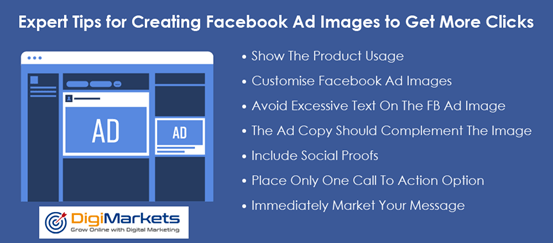
Show Product Usage, Not Just the Product
Demonstrate the product in a real‑life context. User‑generated content works best.
Customise for Micro‑Audiences
Use dynamic creative to swap images based on user demographics (e.g., age, location).
Text Overlay: Less Is More
Use bold, short phrases; let the image tell the story.
Ad Copy and Image Must Align
Disconnects increase bounce rates and reduce user value scores.
Include Trust Badges
Security seals, money‑back guarantees, and awards build trust instantly.
One CTA per Ad
Confusion kills conversions.
Immediate Message Clarity
The viewer should understand the offer in under 2 seconds.
Color Psychology + 2026 Trends
Neon gradients, earthy tones, and high contrast are in. Test which palette resonates with your niche.
Quick Reference: 2026 Facebook Ad Image Checklist
| Element | Do’s (2026) | Don’ts |
|---|---|---|
| Image Quality | High‑res, authentic, UGC style | Pixelated, overly polished stock |
| Text Overlay | < 20%, large font, key benefit | Cluttered, small text |
| CTA | Single, action‑oriented, dynamic if possible | Multiple, conflicting CTAs |
| Colors | High contrast, on‑brand, gradient accents | Muted, low contrast |
| Social Proof | Reviews, ratings, “As featured in” | Fake or outdated numbers |
| Mobile Optimization | Vertical/square, large elements | Horizontal only, tiny details |
Summary: Key Points for 2026
- Algorithm: Prioritizes user value and creative freshness; use AI tools to optimize.
- Visuals: Authentic, high‑contrast, mobile‑first.
- Testing: Continuous A/B testing with AI assistance.
- Psychology: Urgency, social proof, loss aversion remain powerful.
- Compliance: Stay within Meta’s evolving guidelines.
Frequently Asked Questions About Facebook Ad Images (2026)
1. How much text is allowed on images in 2026?
Still recommended under 20%, but the algorithm now uses AI to assess if text is intrusive. Minimal, high‑impact text works best.
2. What’s the best image size for 2026?
1080×1350 pixels (4:5) for feed, 1080×1920 for Stories/Reels.
3. Can I use AI‑generated images?
Yes, but ensure they are not misleading and match your brand’s visual identity. Disclose if required by regulations.
4. How often should I refresh creatives?
Every 2‑3 weeks, or when frequency exceeds 3 and CTR drops.
5. Do video ads still outperform static?
Yes, especially short‑form (Reels). But static images remain cost‑effective for retargeting.
6. How do I A/B test efficiently?
Use Meta’s Advantage+ creative to automatically test up to 10 variations; then manually refine winners.
7. What colors work best in 2026?
High‑contrast combinations like orange/blue, purple/yellow, and neon accents are trending. Test with your audience.
⚠️ Warning
Avoid using AI‑generated fake testimonials or misleading “before/after” images. Meta’s 2026 algorithm heavily penalizes deceptive content with reduced delivery and potential account suspension.
⚡ Pro Tip
Use Meta’s score in Ads Manager to see how your image compares to competitors in the auction. A high differentiation score can lower your CPM.
Conclusion
Getting the hang of Facebook ad images in 2026 takes a mix of creativity, careful data checking, and working smartly with artificial intelligence.The platform’s algorithm is putting more focus on what’s actually valuable to users, so your visuals need to provide real benefit or something interesting, not just come off as a sales pitch.Try using real, relatable pictures like ones from users or sneak peeks behind the scenes instead of those super polished stock photos
.A travel company might share real vacation moments instead of carefully posed photos at resorts.Keeping up with ongoing A/B testing of various image styles, color choices, and layouts is really important.Look at things like click-through rates and conversion numbers to get a real sense of what clicks with your target audience.AI tools can help find the best parts of an image and guess how well it will do.Keep an open mind about new trends, stick to honest advertising, and let data guide your creativity.These updated strategies are your way to not just catch attention, but also increase your earnings a lot.