
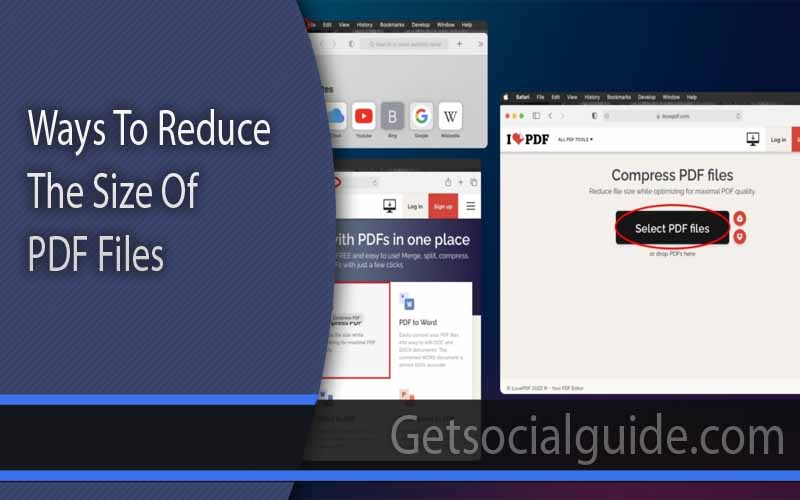
Top 5 Ways To Reduce The Size Of PDF Files – Beginner’s Guide
The ability to create a document that looks exactly like a printed copy makes PDF a very popular format. The PDF format is ideal for content-rich documents like magazines, brochures, presentations, and reports due to its complex layouts, fonts, colors, and high-resolution images.
The 15 MB limit imposed by many email platforms may catch you off guard when you have to send your file to clients or colleagues via email. In this piece, we’ll share some advice on how to shrink the size of your PDF file as well as the outcomes of our testing of various options.
#1 Compress Your PDF File with Adobe Acrobat
This is the quickest repair for decreasing the dimensions of your PDF. Here’s what you might want to do: Go to the Tools tab > choose Optimize PDF > click on Open to entry the PDF file you need to compress > choose Reduce File Size > click on OK. 
Alternatively, you should use Adobe Online PDF Compressor. It’s a free tool that provides three compression choices:
- High Compression (smallest dimension, decrease high quality)
- Medium Compression (medium dimension, good high quality)
- Low Compression (virtually no high quality loss)
We’ve tried this methodology for a 32 MB PDF file and efficiently introduced it down to fifteen MB with Medium settings! It did have an effect on the picture high quality, however except your PDF file is a photograph album supposed for giant screens, your readers won’t see the difference.
#2 Reduce PDF File Size with an Online Compressor
There are quite a few on-line PDF compression tools out there available on the market. We’ve examined just a few well-liked ones, so you can select one that matches you best.
iLovePDF

Extremely simple to use, this tool is free. You only need to add your PDF file (Google Drive and Dropbox are supported), wait for it to convert, and then download the finished product. It offers three compression options, ranging from delicate to extreme, much like the Adobe Acrobat tool and other businesses. Our look at file was reduced from 32 MB to 5 MB when using the ‘Recommended’ settings. If you need a small PDF file size, the final result of 9 MB is amazing.
SmallPDF Pro

SmallPDF Pro only has two PDF compression profiles: basic and robust, but it does provide you with an estimate of the resulting file size, which can be very helpful. The tool reduced the size of the test file from 32 MB to 19 MB using basic conversion settings. The picture quality remained on par with the original, and sending the PDF file as an attachment via email became possible. You can figure out how to use the tool in just a few seconds because it is free and has a simple, user-friendly interface.
PDF2Go

Of the three options, PDF2GO is unquestionably the easiest. When you add a PDF file, the tool immediately compresses it and automatically downloads the file. So, shrinking the size of your PDF file only requires one click. Additionally, it facilitates URL import, which is a welcome extra. The tool provides two conversion options and a variety of presets, ranging from “Prepress” (high quality, 300 DPI) to “Insane” (most compression, 20 DPI).
We reduced the look at PDF file from 32MB to 5MB using the necessary conversion settings. The images are not suitable for large screens or printing out, despite the fact that they look fantastic when you don’t zoom in. Therefore, if you want better results, we advise choosing a preset with a higher DPI.
5 easy & superior methods to scale back PDF dimension
Here are 7 totally different strategies you should use to compress a PDF, we’ll undergo every of them below:
- Use “Save As” as an alternative of “Save.”
- Export PDF files with a dedicated PDF editor.
- Use a PDF compressor to scale back file dimension.
- Audit the area utilization of your PDF doc.
- Use your PDF editor’s superior optimization settings.
- Remove undesirable objects in your PDF doc.
- Compress the photographs in your PDF file.
You can use as many of those strategies as you need.
1. Use “Save As” as an alternative of “Save”
Here’s why using the “Save As” button is our first method for compressing PDFs: Many functions have completely different “Save” and “Save As” options. Yes, they each have the power to add new files to your system. While “Save” retains any changes you make to the original file, “Save As” always generates a new file. Therefore, the distinctive PDF file you produced and its file size are both preserved.
When you edit or add new content to your document and select “Save,” your editor adds the changes as an afterthought to the end of the file. The unique is not rewritten. As a result, the file dimension increases with each “Save” click. The editor can make a new, clean, and optimized file by using “Save As.”.
2. Export PDFs with a dedicated PDF editor
All main PDF editors include the power to scale back PDF dimension in just a few easy clicks. Here’s tips on how to do it in Adobe Acrobat:
- Open a PDF file.
- Click File within the top menu.
- Select Reduce File Size or Compress PDF.
- Choose a location to save lots of your compressed PDF file.
Instructions for Foxit PDF Editor:
- Open your PDF file within the editor.
- Click File within the higher menu.
- For v10 and later, click on PDF Optimizer, then Reduce File Size.
If you’re utilizing an earlier model of the app, click on File ➡ Reduce File Size.
And lastly, directions for Nitro:
- Open a PDF.
- Click File.
- For digital PDFs, choose Reduced Size. For print-ready PDFs, choose Reduced Size and Print Ready to make sure high quality is maintained for print.
- Click Show Details to see what’s being modified to scale back the dimensions of your PDF file.
- Click Optimize if you’re prepared.
pdfFiller can be an awesome possibility that features its personal compression tool, which I’ll discuss in a second.
3. Use a PDF compression tool
Another fast method to cut back the file dimension of a PDF file that already exists is by working it by way of a compression tool. For most tools, it’s so simple as importing your unique massive PDF file, clicking “Compress PDF” or the tool’s equal, and downloading your optimized file.

Here are just a few compression tools to attempt:
- pdfFiller – Free compression tool. Includes different helpful features. Their paid tool is a robust PDF editing tool.
- PDF24 – Multiple files; select compression degree; no limits.
- Smallpdf – Compress PDF files in bulk; modify file earlier than downloading; 5GB max PDF file dimension.
- PDF Compressor – Compress as much as 20 PDF files directly.
- Soda PDF – Compress one file; select compression degree.
- iLovePDF – Simple tool to compress PDF files in bulk.
- PDF Converter – Simple compression tool.
- Adobe Acrobat – Good for one file; 2GB max PDF file dimension.

4. Audit your PDF doc’s area utilization
Acrobat Pro has a nifty characteristic for PDF file optimization. It breaks down your doc so you possibly can see how a lot area every ingredient takes up. This information will aid you decide precisely which components of your file have to be optimized. There are 3 ways to seek out this tool in Acrobat.
- File ➡ Save As Other ➡ Optimized PDF ➡ Advanced Optimization ➡ Audit Space Usage.
- Tools ➡ Optimize PDF ➡ Advanced Optimization ➡ Audit Space Usage.
- View ➡ Show/Hide ➡ Navigation Panes ➡ Content ➡ select Audit Space Usage from the Content pane’s navigation menu.
5. Reduce PDF dimension together with your editor’s superior optimization settings
Many PDF editors have superior optimization settings you possibly can configure alongside their regular compression performance. This consists of well-liked editors like Adobe, Foxit and Nitro.
To entry these settings in Adobe: File ➡ Save As Other ➡ Optimized PDF ➡ Advanced Optimization or Tools ➡ Optimize PDF ➡ Advanced Optimization.
To entry these settings in Foxit: File ➡ PDF Optimizer ➡ Advanced Optimization.
To entry these settings in Nitro: File ➡ Optimize PDF ➡ Custom ➡ Show Details.

Now, you’ll be capable of optimize your PDF file in quite a few methods. They embrace configuring picture settings, eradicating embedded fonts and eradicating undesirable objects.
Advanced Techniques: Going Beyond Basic Compression
For professionals who frequently work with large PDFs (e.g., designers, publishers, legal professionals), mastering these advanced techniques ensures maximum efficiency without compromising quality.
6. Flatten Layers and Remove Transparency
PDFs created from design software (like Adobe InDesign) often contain layered objects and transparency. Flattening these elements merges layers into a single image, significantly reducing file size. In Adobe Acrobat Pro: Print Production → Flattener Preview → Apply Flattening. Use this after final edits, as flattened files are harder to edit later.
7. Downsample Images with Smart Settings
Images are the biggest contributors to PDF bulk. In Acrobat’s Advanced Optimization, you can set downsampling for color, grayscale, and monochrome images. Recommended settings for web/email:
- Color images: 150 DPI, bicubic downsampling
- Grayscale images: 150 DPI
- Monochrome (bitmap): 300 DPI
- Compression: JPEG (quality Medium)
For print‑ready files, keep 300 DPI and use JPEG2000 lossless or ZIP compression.
8. Remove Embedded Fonts (Carefully)
Embedded fonts ensure consistent display but add weight. If your PDF uses only standard fonts (Arial, Times New Roman, Helvetica) and will be viewed on systems with those fonts, you can uncheck “Embed all fonts” or subset fonts to only the characters used. In Acrobat Advanced Optimization, go to “Fonts” and select “Unembed” for fonts you don’t need.
9. Remove Metadata, Bookmarks, and Annotations
Metadata (document properties, XMP data), bookmarks, and annotations add kilobytes to your file. In Acrobat Pro, use “Save As” → “Optimized PDF” and under “Discard Objects” you can choose to discard metadata, bookmarks, links, and form fields. This is especially useful for final distribution copies where interactivity isn’t needed.
10. Use Batch Processing for Multiple Files
If you have many PDFs to compress, use Acrobat Pro’s “Action Wizard” to create a batch process. Set compression rules once, then apply to a folder of files. This saves hours of repetitive work.
Comparison Table: Top PDF Compression Methods
| Method | Speed | Quality Retention | Best Use Case | Cost |
|---|---|---|---|---|
| Adobe Acrobat Pro (Desktop) | Fast | Excellent (customizable) | Professional/print documents | Subscription |
| SmallPDF / iLovePDF (Online) | Very Fast | Good (presets) | Quick email attachments | Free / Freemium |
| Save As technique | Instant | Identical to original | Daily file management | Free |
| Advanced Optimization (Acrobat) | Moderate | User‑controlled | Fine‑tuning for specific needs | Subscription |
| Image Downsampling | Slow (on large files) | High (with right settings) | Image‑heavy PDFs | Varies |
Frequently Asked Questions About PDF Compression
Final ideas
Bloggers, business owners, and many organizations enjoy exchanging or producing downloadable PDF documents. It is simpler to share a clean, optimized, and compressed PDF online, via email, and especially to those with sluggish internet connection. Although it’s not always simple, shrinking PDF files is quick. Numerous techniques exist for reducing the size of PDF files without sacrificing quality.
The best techniques include using a tool to compress PDF files online or the compression capabilities of your PDF editor when you save. Using “Save As” instead of “Save” will also allow you to create a new, optimized file. To answer the question of what size you should aim for, many consultants say that 1,024 KB or 1 MB is the ideal size for web-based PDFs. The maximum add dimension of the location where you want to distribute your PDF should be used in the absence of that.
Article published in cooperation with PDFQuiz – a PDF to Quiz AI test questions generator.
Key Takeaways: Master PDF Compression
- Use “Save As” instead of “Save” to prevent file bloat from incremental edits.
- Leverage dedicated PDF editors (Adobe Acrobat, Foxit, Nitro) for controlled compression.
- Online tools like iLovePDF and SmallPDF are excellent for quick, non‑sensitive files.
- Advanced techniques: downsampling images, removing metadata, flattening layers, and subsetting fonts.
- Always consider the final use: screen vs. print dictates ideal DPI and compression level.
- Batch process multiple files to save time.
- For maximum security, use offline software for confidential documents.
By applying the methods in this guide, you can confidently send and share PDFs without worrying about size limits or quality loss.



Thank you for Ways To Reduce The Size Of PDF Files