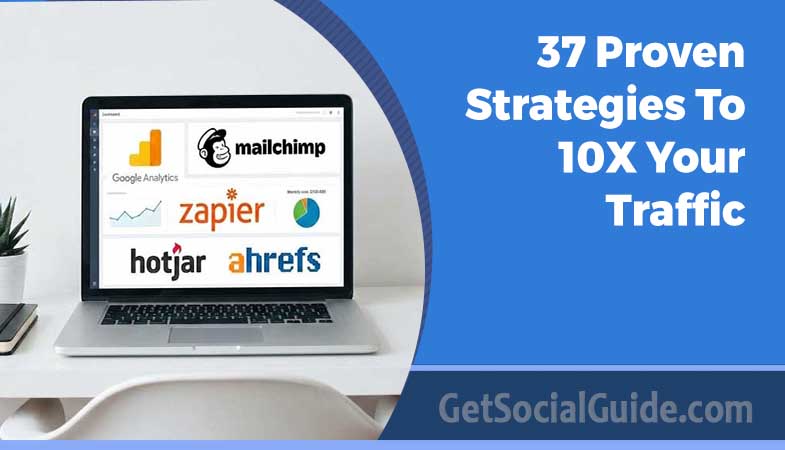
Growth Hacking : 37 Proven Strategies to 10X Your Traffic
TL;DR: Quick Hack Overview
| Category | Number of Hacks | Key Focus |
|---|---|---|
| Acquisition | 12 | Drive targeted traffic & leads |
| Activation | 8 | Convert visitors to active users |
| Retention | 9 | Keep users engaged & coming back |
| Revenue | 8 | Maximize customer value |
Traditional marketing is dead. Expensive ad campaigns, slow content strategies, and hoping for gradual growth won’t cut it anymore. In 2026, the companies winning are those deploying growth hacking strategies—leveraging creative, data-driven tactics to achieve exponential growth with minimal budgets.
Growth hacking isn’t about gaming the system. It’s about finding scalable, repeatable strategies that drive rapid user acquisition, activation, retention, and revenue. Whether you’re a startup fighting for survival or an established brand seeking explosive growth, the 37 strategies in this guide have driven billions in value for companies like Airbnb, Dropbox, and Notion.
This isn’t theory. These are battle-tested tactics actively working in 2026 as part of comprehensive digital marketing strategies that combine traditional and innovative approaches.
What You’ll Learn:
- 12 acquisition hacks to flood your funnel with qualified leads
- 8 activation strategies that convert visitors to users instantly
- 9 retention tactics that build addictive product experiences
- 8 revenue hacks that maximize customer lifetime value
- Real case studies from companies who 10X’d their growth
- The exact tools and tech stack growth hackers use
Let’s unlock your exponential growth.
What is Growth Hacking in 2026
Growth hacking has evolved significantly since Sean Ellis coined the term in 2010. Here’s what it means today:
The Modern Definition
Growth Hacking (2026): A data-driven, experimental approach to achieving rapid, sustainable growth through creative, low-cost strategies that combine product, marketing, data analytics, and psychology to acquire and retain users at scale.
What’s Changed Since 2020:
- More sophisticated data analytics (AI-powered)
- Privacy regulations (GDPR, CCPA) require new approaches
- Product-led growth dominates
- Community and creator economy integration
- AI tools enable faster experimentation
- Multi-channel attribution is standard
Growth Hacking vs. Traditional Marketing
| Traditional Marketing | Growth Hacking |
|---|---|
| Brand awareness focused | Metrics-driven growth |
| Large budgets required | Minimal spend, maximum creativity |
| Long campaign cycles | Rapid experimentation |
| Siloed departments | Cross-functional integration |
| Paid channels primary | Viral/organic preferred |
| Yearly planning | Weekly iteration |
| Qualitative success | Quantitative KPIs |
The Characteristics of Growth Hacks
Effective growth hacks share common traits:
- Scalable: Can be systematized, grows with the business
- Measurable: Clear metrics and KPIs, trackable impact
- Repeatable: Not a one-time fluke, can be executed consistently
- Creative: Novel approach, stands out from competition
- Low-Cost: Maximizes ROI, relies on ingenuity over budget
💡 PRO TIP
Example: Dropbox’s Referral Program – Scalable (automated system), Measurable (3900% growth in 15 months), Repeatable (still works today), Creative (two-sided incentive), Low-Cost (free storage vs. paid ads).
The Growth Hacking Mindset
Before tactics, you need the right mental framework. For a deeper dive into the analytics side, see our Marketing Analytics Guide.
The 10 Principles of Growth Hackers
- 1. Data Over Opinions: Every decision backed by data. Set up analytics before launching.
- 2. Speed Over Perfection: Move fast and iterate. Launch MVP in weeks, not months.
- 3. Creativity Over Budget: Ingenuity wins. $100 creative hack > $100K ad spend.
- 4. Product Is Marketing: Build virality into product. Create “aha moments” quickly.
- 5. Cross-Functional Collaboration: Growth team spans departments.
- 6. Systematic Experimentation: Science, not guesswork. Form hypothesis, design experiment.
- 7. User-Centric Thinking: Understand user psychology, map user journeys, remove friction.
- 8. Leverage Network Effects: Each user brings more users. Build in social sharing.
- 9. Long-Term Optimization: Balance quick wins with sustainability. Customer LTV > acquisition cost.
- 10. Learn From Everyone: Copy, adapt, improve. Study successful companies.
Key Metrics Growth Hackers Track
North Star Metric: The one metric that matters most – Airbnb: Nights booked, Facebook: Daily active users, Slack: Messages sent.
Supporting Metrics: Acquisition (CPA, traffic sources), Activation (sign-up conversion, time to aha), Retention (DAU/MAU, churn), Revenue (LTV, ARPU), Referral (viral coefficient, K-factor).
The AARRR Framework (Pirate Metrics)

Dave McClure’s AARRR framework is the foundation of growth hacking. Master each stage:
Stage 1: Acquisition
Goal: Get people to your site/app. Focus on content marketing for SEO traffic and social media growth.
Stage 2: Activation
Goal: Provide great first experience. Identify the “aha moment” and optimize onboarding.
Stage 3: Retention
Goal: Keep users coming back. Focus on email/push notifications, habit formation.
Stage 4: Revenue
Goal: Monetize user base. Optimize pricing, upsell/cross-sell.
Stage 5: Referral
Goal: Turn users into advocates. Design referral programs and viral loops.
💡 PRO TIP
The Leaky Bucket Analogy: Fix leaks before filling faster. Acquisition = water flowing in, Activation = reducing entry resistance, Retention = plugging leaks, Revenue = collecting valuable water, Referral = water creating more water.
Acquisition Hacks: Fill Your Funnel
These 12 acquisition hacks drive targeted traffic without massive ad spend. For more on content-driven acquisition, see our SEO content strategies.
Add “Powered by [Your Company]” to your product’s output. Examples: “Created with Canva”, “Made with Mailchimp”. Every use is free advertising targeting your exact audience. This turns every user into a micro-influencer for your brand, generating organic impressions at scale. For more on viral loops, see our viral marketing guide.
Hack #2: Product Hunt Launch Strategy
Launch on Product Hunt for massive exposure. Build email list pre-launch, launch Tuesday-Thursday, prepare engaging images, respond to every comment. A successful launch can bring 10K-50K visitors and attract early adopters. Learn launch tactics in our Product Hunt checklist.
Hack #3: Strategic Integrations
Integrate with popular platforms to access their user base: Slack apps, Shopify apps, WordPress plugins, Zapier integrations, browser extensions. Each integration puts your product in front of users already active in those ecosystems. For plugin development tips, see our WordPress plugin guide.
Hack #4: SEO Content Cluster Strategy
Create comprehensive content hubs that dominate search results. Choose core topic, research 20-30 long-tail keywords, create pillar content (5,000+ words), build 15-20 supporting articles. This signals topical authority to Google and attracts organic traffic consistently. For detailed implementation, see our SEO Site Score Generator to audit your current content and our content optimization guide.
Hack #5: Reverse Image Search Outreach
Find people using your product via screenshots, offer to feature them. Upload product screenshots to Google Images, find blogs using them, reach out to create case studies. This generates backlinks and social proof. Learn more in our link building guide.
Hack #6: Strategic Guest Posting 2.0
Target high-intent sites, provide exceptional value (data-driven insights, original research), optimize author bio, repurpose everywhere. Guest posts on authoritative sites build backlinks and drive referral traffic. Check our free article submission sites list for opportunities and our guest posting guide for templates.
Hack #7: Community Takeover Strategy
Provide massive value in communities (Subreddits, Facebook Groups, Slack/Discord, Forums). Contribute value for 2-4 weeks, become authority, then strategically mention your solution when relevant. This builds trust and drives targeted traffic. For Reddit strategies, see our Reddit marketing guide.
Hack #8: Free Tool Creation
Build free tool that solves specific problem. Examples: HubSpot’s website grader, Ahrefs’ backlink checker. A well-executed tool can drive 100K+ monthly visitors and capture leads. Use our Google Page Speed Checker as a model, and see our free SEO tools for inspiration.
Hack #9: Launch Jacking
Piggyback on buzz around major product launches. Create comparison guides, “alternatives to” posts, feature breakdowns within 24 hours of launch. This captures search traffic from people researching the new product. Learn more in our competitor analysis guide.
Hack #10: Strategic PR Newsjacking
Tie your expertise to trending news. Monitor news in your industry, create hot take, pitch journalists within 3 hours with expert perspective + data. This can earn media coverage and backlinks. Use tools like HARO – see our HARO guide for pitching tips.
Hack #11: Micro-Influencer Partnerships
Partner with smaller influencers (10K-100K followers). Higher engagement rates, more affordable, better ROI. Models: product seeding, affiliate partnerships, content collaboration. Find influencers in your niche with our influencer marketing guide.
Hack #12: LinkedIn Thought Leadership
Build authority on LinkedIn to drive B2B leads. Post daily long-form content, engage on others’ posts, build network with ideal customer profiles. For comprehensive strategies, see our social media marketing strategy and our LinkedIn B2B guide.
Activation Hacks: Convert Visitors to Users
Getting traffic is one thing; converting visitors to active users is another. These 8 hacks maximize activation. For more on conversion optimization, see our CRO guide.
Hack #13: The “Aha Moment” Acceleration
Identify the exact moment users realize value, then design onboarding to reach it ASAP. Analyze retained users, interview users, find correlation between specific actions and retention. For example, Facebook found users who add 7 friends in 10 days stick around. Learn more in our onboarding guide.
Hack #14: Interactive Demos Over Signup
Let users experience value before asking for email. Build lightweight product demo, allow full interaction without account, require signup only to save/continue. This removes friction and increases trial-to-user conversion by 2-4x. See examples in our interactive demo tools post.
Hack #15: Personalized Onboarding Paths
Customize onboarding based on user’s role, goals, or company size. Different tutorial emphasis, relevant templates, appropriate feature highlights. Use tools like Appcues or Userpilot. For segmentation strategies, read our customer segmentation guide.
Hack #16: Progress Bar Psychology
Show completion progress to motivate finishing setup. Use Zeigarnik Effect, Goal Gradient Effect, and Endowed Progress. Start at 10-20%, clear next step always visible. This can increase onboarding completion by 20-35%. Learn more in our psychology in marketing guide.
Hack #17: Email Verification Hack
Don’t force email verification before product use. Let users access product immediately, then verify after value demonstrated. This reduces drop-off from 30-50% to 5-10%. Implement rate limiting and CAPTCHA to prevent abuse. For email deliverability tips, see our email marketing guide.
Show overwhelming evidence others trust your product: user count, recent activity, testimonials, company logos, case studies, media mentions. Place social proof on landing pages, signup pages, and during onboarding. Use tools like Hotjar to see how users interact with your social proof and our social proof examples for inspiration.
Hack #19: Contextual Micro-Commitments
Ask for small commitments before big ones. Tiny → Small → Medium → Large → Huge progression. Don’t ask for huge commitment immediately. For example, start with “click to learn more” before asking for email. This builds trust and reduces friction. Learn more in our persuasion techniques guide.
Hack #20: Gamification Elements
Add game-like elements: points/rewards, streaks, challenges, progress visualization. Examples: Duolingo streaks, LinkedIn profile completion, Fitbit badges. Gamification increases engagement and motivates users to complete actions. For implementation tips, see our gamification guide.
⚠️ IMPORTANT WARNING
Don’t gamify core product; gamify peripheral actions (setup, invites, sharing). Core product should deliver value without game mechanics.
Retention Hacks: Build Habit-Forming Products
Retention is your most important metric. Acquiring users who churn is expensive and unsustainable. For more on retention, see our customer retention guide.
Hack #21: Trigger-Action-Reward Loop
Build habit loops using Nir Eyal’s Hooked model: Trigger (external → internal), Action (simplest possible), Variable Reward (unpredictable positive outcomes), Investment (user puts something in). This creates recurring engagement. Learn more in our habit formation guide.
Hack #22: Email Re-engagement Sequences
Automated emails that bring inactive users back. Day 3 (friendly check-in), Day 7 (show what they’re missing), Day 14 (last chance). Personal sender name, plain text, specific value prop. For templates, see our email campaign examples.
Hack #23: Push Notification Strategy
Strategic push notifications that add value. Timely, personal, actionable, valuable. Triggered by user behavior, time-based reminders, social triggers. Use tools like OneSignal. For best practices, read our push notification guide.
Hack #24: Product Updates That Delight
Regular feature releases that give users reasons to return. Major features quarterly, minor improvements bi-weekly. Announce in-app, via email, and on social/blog. This shows you’re improving and listening. For update strategies, see our product launch guide.
Hack #25: Customer Success Checkpoints
Proactive outreach at critical junctures: Day 7 (how’s first week?), Day 30 (advanced features), Day 60 (feature deep-dive), Day 90 (renewal approaching). This reduces churn and increases loyalty. Learn more in our customer success guide.
Hack #26: Community Building
Create spaces where users connect with each other. Platforms: Facebook Group, Discord, Circle. Community ROI: 2-3x higher retention, organic content creation, reduced support burden. See our guide to social media importance and our community building guide.
Hack #27: Data-Driven Churn Prevention
Use data to predict and prevent churn. Monitor usage-based signals (login frequency declining), engagement-based (email open rates falling), value-based (ROI declining). Create churn risk score and trigger interventions. For analytics setup, see our marketing analytics tools post.
Hack #28: Feedback Loop Integration
Make it effortless for users to provide feedback, then act on it visibly. Use in-app surveys, user interviews, support ticket analysis. Close the loop: Acknowledge → Update → Deliver → Credit. Use Hotjar for feedback collection and our customer feedback guide.
Hack #29: Surprise and Delight Moments
Unexpected positive experiences that create emotional connections: milestone celebrations, random acts of wow, anticipated delight (birthday recognition). These moments increase loyalty and word-of-mouth. For ideas, see our loyalty programs guide.
Revenue Hacks: Maximize Customer Value
Growing revenue isn’t just about more customers—it’s about extracting maximum value from existing ones ethically and sustainably. For more, see our revenue optimization guide.
Hack #30: Value-Based Pricing Optimization
Price based on value delivered, not cost + margin. Quantify customer value (time saved, money made), calculate willingness to pay, price segment. For example, if your tool saves $10K/year, charge $2K-3K. Learn more in our pricing strategies guide.
Hack #31: Strategic Upsell/Cross-Sell
Sell additional products or tiers to existing customers. Usage-based triggers, feature gating, team growth triggers. 20-40% revenue increase from existing customers. For tactics, see our upsell/cross-sell guide.
Hack #32: Annual Plan Incentives
Encourage annual payments for better cash flow and retention. 2-4 months free, premium features for annual, priority support. 40-60% better retention. Frame as “get 3 months free” rather than “save 25%”. See our subscription pricing guide.
Hack #33: Recovering Failed Payments
Automate dunning process. Retry immediately, email sequence over 10 days. 30-50% recovery rate. Use Stripe’s built-in dunning or tools like ChurnBuster. For email templates, see our dunning email examples.
Hack #34: Smart Discount Strategies
Use discounts strategically, not desperately. Good reasons: annual commitment, new feature launch, bulk purchases, seasonal promotions. Bad reasons: low conversions, competitor pressure. Always time-bound. Learn more in our discounting guide.
Develop high-value tier for power users. 3-10x base tier, targets top 10-20% of users. Features: white-glove service, dedicated support, API access. This can generate 50-70% of total revenue. For tier design, see our SaaS pricing models.
Hack #36: Monetizing Free Users
Generate revenue from free tier without annoying: affiliate recommendations, educational content, community access, marketplace/ecosystem, data insights (anonymous). Never sell personal data. For ideas, see our freemium monetization guide.
Hack #37: Referral Revenue Programs
Reward customers financially for bringing new paying customers. Cash reward, recurring commission, credit system, tiered rewards. Referred customers have 2-3x higher LTV. For comprehensive strategies, see our referral marketing guide and try ReferralCandy.
The Growth Hacking Mindset
Before tactics, you need the right mental framework. For a deeper dive into the analytics side, see our Marketing Analytics Guide.
The 10 Principles of Growth Hackers
- 1. Data Over Opinions: Every decision backed by data. Set up analytics before launching.
- 2. Speed Over Perfection: Move fast and iterate. Launch MVP in weeks, not months.
- 3. Creativity Over Budget: Ingenuity wins. $100 creative hack > $100K ad spend.
- 4. Product Is Marketing: Build virality into product. Create “aha moments” quickly.
- 5. Cross-Functional Collaboration: Growth team spans departments.
- 6. Systematic Experimentation: Science, not guesswork. Form hypothesis, design experiment.
- 7. User-Centric Thinking: Understand user psychology, map user journeys, remove friction.
- 8. Leverage Network Effects: Each user brings more users. Build in social sharing.
- 9. Long-Term Optimization: Balance quick wins with sustainability. Customer LTV > acquisition cost.
- 10. Learn From Everyone: Copy, adapt, improve. Study successful companies.
Key Metrics Growth Hackers Track
North Star Metric: The one metric that matters most – Airbnb: Nights booked, Facebook: Daily active users, Slack: Messages sent.
Supporting Metrics: Acquisition (CPA, traffic sources), Activation (sign-up conversion, time to aha), Retention (DAU/MAU, churn), Revenue (LTV, ARPU), Referral (viral coefficient, K-factor).
The Growth Hacking Tech Stack
The right tools amplify your growth efforts. Here’s the essential tech stack:
Analytics & Data
- Google Analytics 4 – Website traffic, behavior insights
- Mixpanel – Product analytics, funnels
- Amplitude – User behavior, retention cohorts
- Heap – Auto-capture event tracking
- Hotjar – Heatmaps, session recordings
Experimentation
- Optimizely – Feature flags, experiments
- VWO – Visual editor, multivariate testing
- Google Optimize – Free testing tool, integrates with GA
Automation
- HubSpot – All-in-one marketing platform
- ActiveCampaign – Email automation
- Customer.io – Behavioral messaging
- Zapier – Connect apps, automate workflows
Acquisition
- Ahrefs – Backlinks, keywords, rank tracking
- SEMrush – Competitive analysis
- Surfer SEO – Content optimization
- Buffer – Social scheduling
Conversion & Retention
- Unbounce – Landing page builder
- OptinMonster – Popups, targeting
- OneSignal – Web & mobile push notifications
- ReferralCandy – Referral program software
Community & Support
- Circle – Branded community platform
- Discord – Real-time community engagement
- Zendesk – Customer support system
- Intercom – Conversational customer support
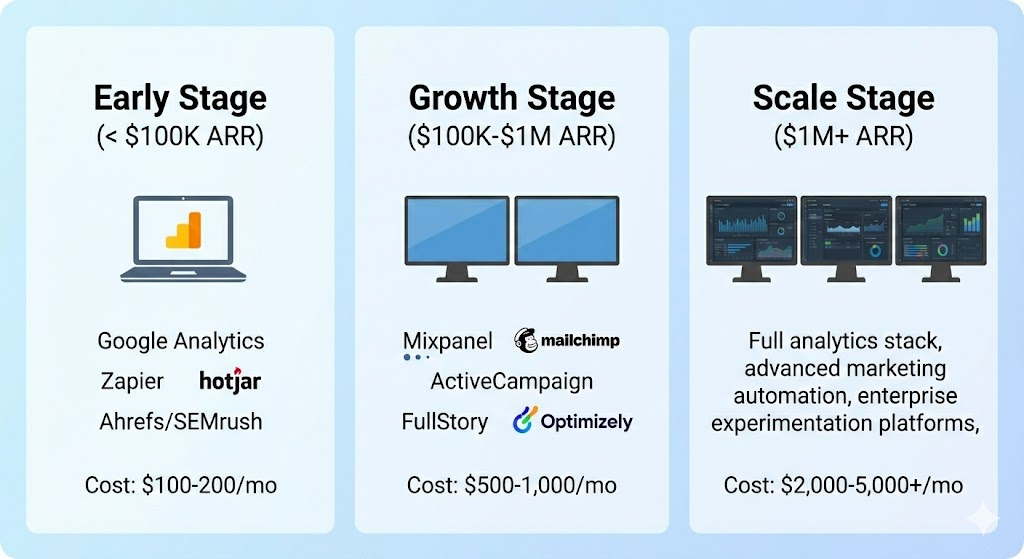
Recommended Tech Stack by Stage
- Early Stage (< $100K ARR):
Google Analytics,
Mailchimp (free),
Zapier (free),
Hotjar (basic),
Ahrefs /
SEMrush (choose one).
Monthly cost: $100-200 - Growth Stage ($100K-$1M ARR):
Google Analytics +
Mixpanel,
ActiveCampaign,
Zapier (paid),
Hotjar +
FullStory,
Ahrefs +
SEMrush,
Optimizely.
Monthly cost: $500-1,000 - Scale Stage ($1M+ ARR):
Full analytics stack, advanced marketing automation suite, and enterprise experimentation platforms.
Monthly cost: $2,000-5,000+
Case Studies: Billion-Dollar Growth Hacks
Real examples of companies that achieved massive scale through growth hacking.
Dropbox: The $10B Referral Program
Growth Hack: Two-sided referral incentive (500MB free storage for both parties). Result: 3,900% growth in 15 months, 35% of daily signups from referrals, saved $48M in acquisition costs.
Airbnb: Craigslist Integration
Growth Hack: Cross-posted listings to Craigslist, tapped into existing traffic. Result: 10X increase in listings, millions in free traffic.
Hotmail: The Email Signature Hack
Growth Hack: Added signature to every outbound email: “PS: I love you. Get your free email at Hotmail”. Result: 1 million users in 6 months, 12 million in 18 months, acquired for $400M.
Slack: Bottom-Up Enterprise Strategy
Growth Hack: Free team tier with viral mechanics, easy to invite colleagues. Result: Fastest SaaS to $1B valuation, 500K users in first year.
Yelp: Review Incentive System
Growth Hack: Elite Squad program recognizing top reviewers with exclusive events and badges. Result: Millions of high-quality reviews, self-sustaining content engine.
💡 PRO TIP
Key Lesson: Turn your product into a distribution channel. Find where your customers already are and meet them there.
Your 90-Day Growth Hacking Plan
Implementing all 37 hacks at once is overwhelming. Here’s a phased approach:
Month 1: Foundation & Quick Wins
- Week 1: Install Google Analytics 4, set up Mixpanel, configure event tracking, create AARRR dashboards. Use our SEO Site Score Generator for baseline.
- Week 2-3: Launch on Product Hunt, create SEO content cluster, build free tool.
- Week 4: Identify “aha moment”, map onboarding, implement 2-3 activation hacks.
Month 2: Experimentation & Optimization
- Week 5-6: Set up experimentation platform, run 2-3 tests on key pages. Use Optimizely.
- Week 7: Build re-engagement email flows, implement push notifications.
- Week 8: Audit pricing strategy, implement one upsell flow, set up failed payment recovery.
- Week 9-10: Design referral incentive structure, build referral system. Use ReferralCandy.
- Week 11: Launch community platform, publish 4-6 SEO articles, host first webinar.
- Week 12: Automate repetitive tasks with Zapier, build drip campaigns.
Expected Results After 90 Days
- Traffic: 3-5x increase in organic traffic, viral coefficient > 0.5
- Conversion: 20-40% improvement in activation, onboarding completion > 60%
- Retention: 10-20% churn reduction, active community established
- Revenue: 15-30% increase in ARPU, improved LTV:CAC ratio
- Overall: 2-4x user growth, profitable unit economics
Conclusion: Your Growth Hacking Mindset
Growth hacking isn’t about tricks or shortcuts—it’s a systematic, creative, data-driven approach to building and scaling businesses. The 37 strategies in this guide have collectively generated hundreds of billions in value. Now it’s your turn.
The Core Principles to Remember
- Start Small, Think Big: Pick 3-5 hacks aligned with your biggest bottlenecks.
- Data Drives Decisions: Without data, you’re guessing. With data, you’re optimizing.
- Speed Beats Perfection: Test fast, fail fast, learn fast.
- Product Is Your Best Marketing: Build virality into your product.
- Never Stop Experimenting: Continuously test, measure, and optimize.
Your First Three Actions
- Action 1 (Today): Set up comprehensive analytics if you haven’t already.
- Action 2 (This Week): Identify your biggest growth bottleneck and choose 2-3 hacks to address it.
- Action 3 (This Month): Design and launch your first experiment.
The Growth Hacker’s Manifesto
- ✅ I will measure everything
- ✅ I will experiment relentlessly
- ✅ I will fail fast and learn faster
- ✅ I will prioritize user value over vanity metrics
- ✅ I will build for viral growth
- ✅ I will optimize continuously
- ✅ I will stay creative, curious, and data-driven
Now stop reading and start building. Your 10X growth awaits.
Frequently Asked Questions
Is growth hacking just for startups?
No. While popularized by startups, growth hacking principles apply to businesses of any size. Large companies like Amazon, Netflix, and Uber continuously employ growth hacking tactics.
How much budget do I need for growth hacking?
Growth hacking emphasizes creativity over budget. Start with $500-1,000/month for essential tools. Most hacks rely on time and ingenuity rather than money.
How long until I see results?
Quick wins can show results in days. Compounding strategies take 3-6 months. Most companies see significant impact within 90 days of systematic implementation.
Can I growth hack a bad product?
No. Growth hacking amplifies what’s already there. Achieve product-market fit first, then growth hack to scale.
- SEO Growth Hacking Techniques
- Social Media Growth Strategies
- Content Marketing for Growth
- Marketing Analytics Guide
- How to Create an Effective SEO Strategy
- Social Media Marketing Strategy
- ReferralCandy – Referral Program Software
- Hotjar – User Behavior Analytics
- Customer Retention Strategies
- Conversion Rate Optimization
Ready to 10X Your Growth?
Join our Growth Hacking Masterclass for weekly experiment reviews, private Slack community, growth teardowns, and proprietary frameworks. Use code GROWTH10X for 40% off enrollment.
About the Author: This guide was created by growth marketers who have collectively scaled startups from zero to millions in revenue. We stay current with the latest growth tactics and test strategies continuously.
Disclaimer: Results vary based on product, market, execution, and timing. Growth hacking requires systematic experimentation and adaptation to your specific context.