
Email Marketing Metrics Every Marketer Should Track for Improved Performance
In the dynamic realm of email marketing, meticulous tracking and analysis of crucial metrics is paramount. This data-driven approach is the linchpin for gauging campaign success and making informed decisions. Without it, marketers are essentially navigating blind.
By diligently monitoring key email marketing metrics, marketers gain invaluable insights into subscriber engagement levels, conversion rates, and the overall efficacy of their campaigns. For instance, analyzing open rates reveals the effectiveness of subject lines, while click-through rates gauge content engagement. Conversion rates, on the other hand, unveil the campaign’s ability to drive desired actions, such as purchases or sign-ups.
This examination of data is integral to iterative improvement. This piece will delve into the essential Key Performance Indicators (KPIs) in email marketing that every marketer must actively monitor to optimize campaign performance and achieve their marketing goals.
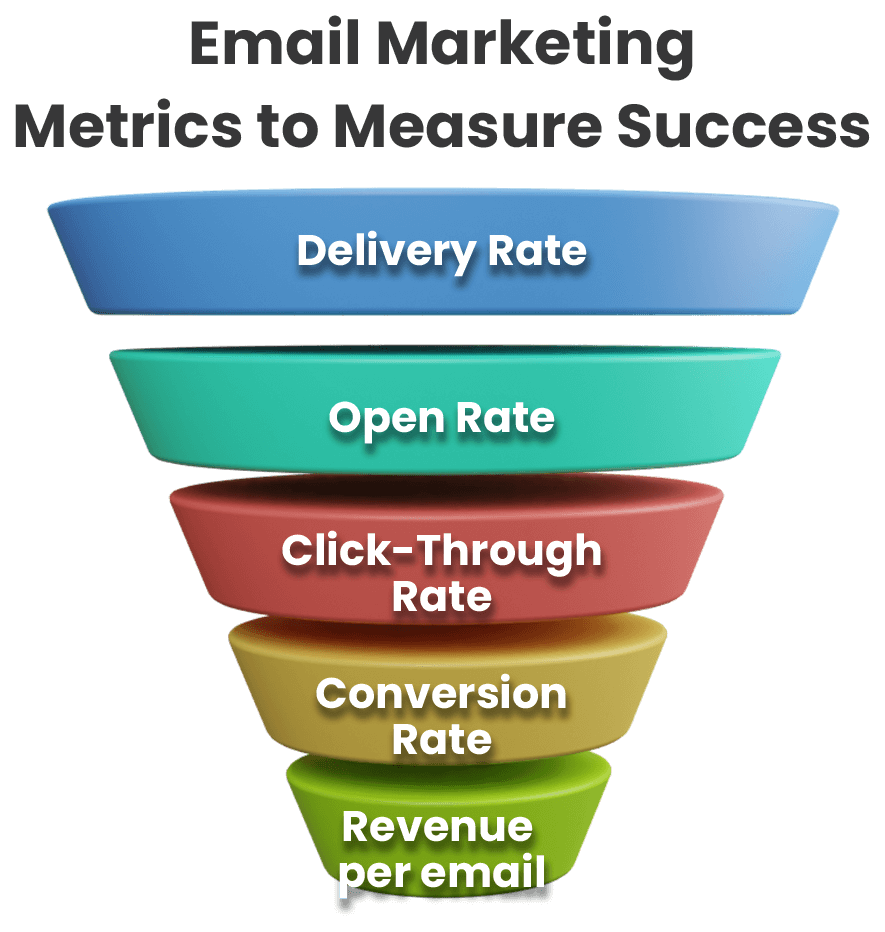
Essential Email Marketing Metrics Overview
| Metric | What It Measures | Industry Average | Impact on ROI | Priority Level |
|---|---|---|---|---|
| Open Rate | Percentage of recipients who open your email | 15-25% | High | Critical |
| Click-Through Rate (CTR) | Percentage of recipients who click links in your email | 2-5% | High | Critical |
| Conversion Rate | Percentage who complete desired action after clicking | 1-3% | Very High | Critical |
| Bounce Rate | Percentage of emails that couldn’t be delivered | <2% | Medium | Important |
| Unsubscribe Rate | Percentage who opt-out of your emails | 0.1-0.5% | Medium | Important |
| List Growth Rate | Rate at which your email list is growing | 2-5% monthly | Medium | Important |
| Email Sharing Rate | Percentage who forward/share your email | 0.5-1.5% | Low | Monitor |
| Overall ROI | Return on investment from email campaigns | $36-40 per $1 spent | Very High | Critical |
GSG Pro Tip: Focus on Conversion Metrics First
While all metrics provide valuable insights, prioritize optimizing conversion rate and ROI first, as these directly impact your bottom line. Then work backwards to improve open rates and CTRs that feed into conversions.
Open Rate
Definition: The percentage of email recipients who open a given email.
Formula: (Number of emails opened / Number of emails delivered) × 100
One of the most important metrics is the open rate, which shows what proportion of your email recipients actually read your messages.
It gives you an understanding of how successful your subject lines and sender names are, as well as the overall relevancy of your emails.
To increase the percentage of people who read your emails, you should concentrate on writing subject lines that are appealing, personalizing the content of the emails you send, and dividing your audience into different groups according to the preferences and interests they express.
Click-through Rate (CTR)
Definition: The percentage of email recipients who clicked on one or more links contained in an email.
Formula: (Total clicks / Number of emails delivered) × 100
The “click-through rate” refers to the number of people who open your emails and go on to click the links you’ve provided.
It’s useful for measuring how many people opened your emails, clicked on your CTAs, and otherwise interacted with your messages.
To increase click-through rate, you should make your emails simple to navigate, make your calls to action stand out, and make your landing pages relevant to the information presented in the email.
Conversion Rate
Definition: The percentage of email recipients who completed a desired action after clicking through from an email.
Formula: (Number of people who completed goal / Number of total emails delivered) × 100
A crucial number is the conversion rate, which indicates how many people who receive an email actually perform an intended action (such as buying something, subscribing to a newsletter, or completing a form).
Analyzing conversion rates allows you to discover weak spots in your email content, landing web pages, and overall user experience, which you can then address to increase conversions.
To increase your conversion rate, try out persuasive copywriting, intriguing offers, and efficient conversion processes.
Bounce Rate
Definition: The percentage of your total emails sent that could not be delivered to the recipient’s inbox.
Formula: (Number of bounced emails / Number of emails sent) × 100
The bounce rate is the proportion of email messages that were returned undeliverable to their intended recipients.
There are two distinct varieties of it, which are referred to as hard bounces and soft bounces, respectively.
When an email is permanently returned as undeliverable, this is known as a hard bounce. Soft bounces are momentary failures in delivery, typically due to overloaded inboxes or server problems.
Maintaining a clean email list, removing invalid addresses using a bulk email verifier and using a reliable email delivery system can all lower bounce rates.
One way to ensure a clean email list and keep away from invalid email addresses is to build email addresses by using an email lookup tool.
GSG Pro Tip: Bounce Rate Management
Regularly clean your email list (at least quarterly). Remove hard bounces immediately and addresses with repeated soft bounces after 3-5 attempts. A clean list improves deliverability and sender reputation.
Email Verification & Lookup Tools Comparison
| Tool | Primary Use | Key Features | Pricing Tier | Best For |
|---|---|---|---|---|
| Clearout | Email Verification | Bulk verification, API access, Real-time checking | Freemium + Paid plans | List cleaning & maintenance |
| GetEmail.io | Email Finding | AI-powered search, Browser extension, LinkedIn integration | Freemium + Paid plans | Prospecting & lead generation |
| Hunter.io | Email Finding & Verification | Domain search, Email verifier, API access | Freemium + Paid plans | Sales teams & marketers |
| NeverBounce | Email Verification | Real-time API, Bulk cleaning, List management | Pay-as-you-go + Subscriptions | Large lists & enterprises |
| Voila Norbert | Email Finding | Name/domain search, Verification, Integrations | Pay-per-result + Subscriptions | Small businesses & startups |
How to Look Up a Email Address?
Having current and accurate email addresses is essential for effective outreach and engagement when using email marketing.
There are many different approaches that can be taken if you require the email addresses of members of your target audience.
One method that has proven to be successful is the use of social media networks for professionals, such as LinkedIn.
LinkedIn’s search feature makes it easy to find information about people and businesses, including contact email addresses.
LinkedIn’s messaging features let you directly contact leads by asking for their email addresses and initiating conversations with them.
But remember that LinkedIn you can browse the profile of only those who you are connected to.
In such a case, an email finder tool like GetEmail.io helps greatly. To start with, you can go for the freemium version.
You can also try one of the many other email finder tools that are freely accessible online.
These tools use advanced algorithms and large databases to find email addresses for your target prospects based on their names or other relevant information.
For instance, GetEmail.io is an AI-based email lookup tool, which speeds up the process of locating precise email addresses.
If you were wondering how to look up a email address, I hope this helps!
Unsubscribe Rate
Definition: The percentage of email recipients who unsubscribe from your email list after receiving an email campaign.
Formula: (Number of unsubscribes / Number of emails delivered) × 100
The unsubscribe rate is the proportion of email recipients who have requested to be removed from the mailing list.
Even though it’s normal to have some people unsubscribe, keeping an eye on this measure can help you figure out how relevant and valuable the content of your emails is.
Concentrate on providing high-quality, valuable material that speaks to the interests and concerns of your audience to cut down on the number of people who unsubscribe from your mailing list.
You should personalize your emails, divide your subscribers into different lists, and give your subscribers the chance to modify their email preferences.
Email Sharing/Forwarding Rate
Definition: The percentage of email recipients who clicked on a “share this” or “forward to a friend” button/link within your email.
Formula: (Number of shares or forwards / Number of emails delivered) × 100
The email forwarding and sharing rate quantifies the frequency with which your emails are forwarded to other people.
This metric reveals how involved and satisfied your subscribers are.
Encourage email sharing by adding social sharing buttons, sending out useful and shareable content, giving rewards for referrals, or sending out exclusive offers.
GSG Pro Tip: Increase Sharing with Valuable Content
Create content that makes subscribers look smart or helpful when they share it. Industry insights, useful templates, exclusive research, or entertaining content gets shared 3-5x more than promotional content.
ROI (Return on Investment)
Definition: The revenue generated from email marketing campaigns compared to the cost of running those campaigns.
Formula: [(Revenue from campaign – Cost of campaign) / Cost of campaign] × 100
Return on investment (ROI) is an essential indicator of the success of your email marketing campaigns.
It takes into account a variety of aspects, including revenue created, conversion rates, and costs associated with the campaign. The success and profitability of your email marketing efforts can be evaluated by calculating your return on investment.
ROI can be improved by concentrating on optimizing conversion rates, expanding the lifetime value of existing customers, and decreasing the cost to acquire new ones.
Email Marketing Analytics Platforms
| Platform | Key Metrics Tracked | Automation Features | Integration | Best For |
|---|---|---|---|---|
| Mailchimp | All standard metrics + revenue tracking | Basic to advanced workflows | Extensive (300+ apps) | Small to medium businesses |
| Constant Contact | Engagement metrics + social media tracking | Basic automation | Good selection | Beginners & nonprofits |
| HubSpot | Full funnel tracking + lead scoring | Advanced workflows & AI | Native CRM integration | Sales & marketing alignment |
| ActiveCampaign | Detailed engagement + site tracking | Sophisticated automation | Good selection | E-commerce & automation focus |
| Sendinblue | Standard metrics + SMS tracking | Multi-channel automation | Decent selection | European markets & startups |
Frequently Asked Questions (FAQs) on Email Marketing Metrics
What is a good open rate for email marketing?
A “good” open rate varies by industry, audience, and the type of email you’re sending. As a general benchmark, across most industries, the average open rate often falls between 15% and 25%. However, targeted newsletters or segmented campaigns to highly engaged audiences can see rates of 30% or higher. The key is to track your own rates over time and focus on improving them through better subject lines and segmentation.
How can I improve my email click-through rate (CTR)?
Improving your CTR involves making your email content compelling and easy to act upon. Key strategies include:
- Clear, action-oriented calls-to-action (CTAs): Use buttons or linked text that tell the reader exactly what to do (e.g., “Download the Guide,” “Shop the Sale”).
- Relevant and valuable content: Ensure the email body delivers on the promise of the subject line and provides clear value.
- Mobile-friendly design: Most emails are opened on mobile devices, so your links and buttons must be easy to tap.
- Segmenting your list: Send targeted offers to groups most likely to be interested, which significantly boosts engagement.
Why is my email bounce rate high, and how do I fix it?
A high bounce rate usually indicates problems with your email list health. Hard bounces (permanent failures) are caused by invalid, fake, or non-existent email addresses. Soft bounces (temporary failures) can be due to a full inbox or server issues. To fix it:
- Use an email verification service (like a bulk email verifier) to clean your list before sending campaigns.
- Remove old, inactive addresses that haven’t engaged in a long time.
- Ensure you use a double opt-in process for new subscribers to confirm their address is valid.
What tools can I use to find email addresses for prospecting?
Finding accurate email addresses is crucial for outreach. While LinkedIn is a great professional network to start with, dedicated email finder tools can automate and scale the process. Tools like GetEmail.io use algorithms to find professional email addresses based on a person’s name and company domain. Many offer free tiers or trials to get started.
How do I calculate the ROI of my email marketing campaign?
Email marketing ROI measures the profitability of your campaigns. Use this simple formula:
ROI = [(Revenue Generated from Campaign – Cost of Campaign) / Cost of Campaign] x 100
Example: If a campaign cost $200 to create and send, and it generated $1,000 in sales, your ROI would be [(1000 – 200) / 200] x 100 = 400%. To track this effectively, use UTM parameters on your links and integrate your email platform with your sales or analytics software.
How can I reduce my email unsubscribe rate?
To keep subscribers on your list, focus on relevance and value:
- Set clear expectations: Tell new subscribers what type of content they’ll receive and how often.
- Segment and personalize: Don’t send every email to your entire list. Group subscribers by interest or behavior.
- Provide an easy preference center: Allow subscribers to choose the types of emails they want to receive or how often, instead of unsubscribing entirely.
- Regularly review your content to ensure it remains useful to your audience.
Concluding thoughts
The success of an email marketing campaign can be greatly enhanced by monitoring and analyzing relevant metrics.
Marketers can learn a lot about the success of their campaigns by keeping tabs on metrics like open rates, click-through rates, conversions, bounce rates, unsubscribes, shares, and return on investment.
Reaching out to the right people requires using strategies like tapping into professional networks and employing email finder tools to ensure that you have their correct email addresses.
Therefore, you can improve engagement, drive conversions, and maximize the impact of your campaigns by constantly measuring and refining your email marketing efforts.
GSG Pro Tip: Create a Monthly Metrics Dashboard
Create a simple dashboard tracking your top 5-7 metrics month-over-month. Include goals for each metric and note what changes you made that affected performance. This practice turns data into actionable insights.





Absolutely insightful! These email marketing metrics are essential for tracking real success. A must-read for all marketers!
Thanks for the comments, be sure to bookmark and share