So your business has taken the plunge into social media. You have a Facebook page, you are actively posting on LinkedIn, and maybe even dabbling in TikTok. Best of all: You’ve acquired a rising list of social media followers. But in 2026, follower counts have become vanity metrics while conversion rates represent the true measure of social media success. This guide reveals the sophisticated strategies that separate brands with engaged communities from those with actual revenue-generating audiences.
Followers are vanity metrics. Sales are sanity metrics. In 2026, the most successful brands have moved beyond engagement to build direct revenue channels through social platforms.
However, are these fans buying your products? What can you do to help convert them into loyal clients? Listed below are nine actionable steps for upping your social media sales conversion success, expanded with advanced techniques, psychological triggers, and platform-specific strategies that work in the 2026 social commerce landscape where AI-driven recommendations, shoppable content, and community-driven selling have become the norm.
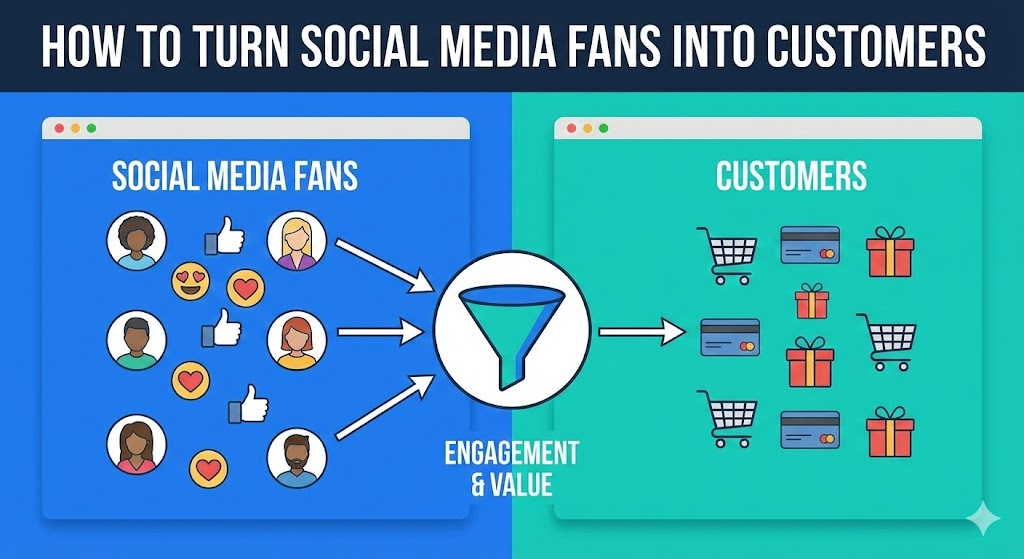
Begin off on the correct foot by making a social media strategy. All these Facebook posts and tweets may not help your sales much without proper planning. In 2026, strategy extends beyond content calendars to encompass conversion funnels, community architecture, and platform-specific monetization pathways that align with both algorithmic preferences and human behavior patterns.
First, decide the goals of your social media presence, whether it’s attracting more clients, boosting brand recognition, or improving customer service. Resolve who your target audience is, and spell out a content strategy covering multiple conversion pathways:
Advanced Strategy Components for 2026:
Modern social commerce strategy incorporates three interconnected layers that work together to drive conversions:
Discovery Layer
Algorithm-friendly content that reaches new audiences through entertainment, education, or inspiration. This layer focuses on maximizing reach through platform-native formats that trigger algorithmic distribution.
Engagement Layer
Community-building activities that transform passive viewers into engaged followers. This includes responding to comments, hosting live sessions, and creating interactive content that builds relationships.
Conversion Layer
Platform-native shopping features that make purchasing seamless within the social experience. This includes shoppable posts, in-app checkout, and limited-time offers that create urgency.
The best social media page on the planet won’t do you much good if it’s driving fans to an awful website—one that’s hard to navigate and suffering from jargon-laden text. A clean, attractive website with compelling visuals is all-important for converting social media fans into paying clients. However, in 2026, optimization extends beyond basic web design to encompass the entire digital ecosystem that captures and converts social traffic.
Guests shouldn’t have to do lots of clicking or scrolling to find what they need. Pages on your website should prominently feature your contact information and clear calls to action (CTAs). But more importantly, your website should reflect the same visual language, tone, and user experience patterns that users encounter on your social profiles, creating a seamless transition that maintains engagement momentum.
Enhance your conversion odds by creating unique landing pages for each of your social media campaigns. A “Link in Bio” page is a good start, but a dedicated landing page for a specific Instagram offer converts much higher. In 2026, landing page optimization incorporates principles from behavioral psychology, neuromarketing, and platform-specific user expectations to maximize conversion rates from social traffic.
Ensure you have consistent messaging. If your ad says “50% Off,” the landing page header must say “50% Off” immediately. But beyond consistency, effective landing pages for social traffic must address the specific mindset and intent of users arriving from each platform, recognizing that TikTok users have different expectations than LinkedIn users.
| Social Platform | User Mindset | Landing Page Strategy | Conversion Optimization |
|---|---|---|---|
| TikTok | Entertainment-seeking, impulsive, visually stimulated | Immediate value delivery, minimal text, video continuation | Single CTA, frictionless checkout, limited-time urgency |
| Aspirational, discovery-oriented, aesthetically focused | High-quality visuals, social proof, lifestyle context | Multiple visual CTAs, user-generated content integration | |
| Professional, problem-solving, research-oriented | Data-driven content, case studies, professional validation | Form-based lead capture, whitepaper offers, consultation booking | |
| Community-oriented, trust-seeking, relationship-focused | Testimonials, community highlights, conversational tone | Group invitations, community access offers, webinar registration |
Social selling is the method of building a community on sites like LinkedIn and Facebook to make connections and present yourself as an expert in your field. To get started, research companies you are interested in doing business with and take a close look at who you’d want to join with. In 2026, social selling has evolved from basic networking to strategic relationship architecture that creates sustainable business pipelines through authentic value exchange.
Then, connect and start building a relationship by sharing content, inviting them to events, or introducing them to potential clients. But don’t expect this system to make large wins quickly. Social selling is all about fostering relationships over the long term. The most successful social sellers in 2026 focus on becoming valuable resources within their niche communities rather than directly pitching products.
Spend 80% of your social selling time providing value (sharing insights, making introductions, answering questions) and only 20% on direct sales activities. This ratio builds the trust and authority that makes your sales efforts more effective when you do make them.
Social media platforms now allow companies to instantly promote their products and services with paid ads and native shopping features. In 2026, social commerce has evolved far beyond basic product tags to encompass full-fledged storefronts, AI-powered recommendations, and seamless checkout experiences that rival dedicated e-commerce platforms.
TikTok Shop & Live Shopping
Allows users to buy products directly within the app without ever leaving the video feed. Impulse buying is seamless, with creators able to tag products in videos and during live streams, creating real-time shopping experiences that drive urgency and social validation.
Instagram Shopping & Drops
Product tags in posts and Stories let users tap to view price and purchase immediately. The latest “Drops” feature allows brands to create hype around limited-edition products with countdowns and exclusive access for engaged followers.
Pinterest Visual Search & Shopping
Show real-time pricing and availability on your pins, turning your boards into a catalog. Advanced visual search allows users to find products from images, while personalized shopping recommendations appear directly in users’ feeds based on their saved pins and search history.
LinkedIn Product Pages & Services
B2B companies can now create dedicated product pages and list services directly on LinkedIn, complete with customer testimonials, case studies, and direct contact options for qualified leads.
6. Implement Data-Driven Measurement and Optimization Cycles
As in any conversation, listening is half the job. Make sure you’re monitoring what fans are saying and doing. Take a look at what sorts of content sparks the most response and results in the best conversion rates. In 2026, measurement has evolved beyond basic engagement metrics to encompass full-funnel attribution, customer lifetime value tracking, and predictive analytics that anticipate future conversion opportunities.
And monitor other successful companies in your industry to see what they’re doing on social media. Then, optimize your actions to do more of what works and less of what doesn’t. The most successful brands implement continuous optimization cycles where data informs creative decisions, which then generate more data for further refinement.
| Metric Category | Key Performance Indicators | Optimization Focus |
|---|---|---|
| Discovery Metrics | Reach, Impressions, Video Views, Content Save Rate | Algorithm compatibility, content format performance, audience targeting accuracy |
| Engagement Metrics | Engagement Rate, Comment Quality, Share Rate, DM Response Rate | Community building effectiveness, conversation quality, relationship depth |
| Conversion Metrics | Click-Through Rate, Conversion Rate, Average Order Value, Return on Ad Spend | Funnel optimization, offer effectiveness, checkout experience quality |
| Retention Metrics | Repeat Purchase Rate, Customer Lifetime Value, Advocacy Rate | Community loyalty, product satisfaction, brand affinity strength |
We live in a very social media-driven world. If you are trying to convert social media to sales, you might be struggling to come up with the right numbers. Social media can represent 62% of lead generation if you know how to do it effectively. However, the statistics that matter most in 2026 focus on purchasing behavior rather than just platform usage, revealing where actual commerce happens versus where time is simply spent.
| Platform | Active Users (2026) | Commerce Readiness | Best Conversion Use Cases | Average Conversion Rate |
|---|---|---|---|---|
| 3.2+ Billion | High (Established Marketplace, Shops) | Community Groups, Older Demographics, Local Services | 1.8% | |
| YouTube | 2.9+ Billion | Medium-High (Shoppable Videos, Product Links) | Long-form Education, Tutorials, High-Consideration Products | 2.1% |
| 2.3+ Billion | Very High (Native Checkout, Shoppable Posts) | Visual Branding, Fashion, Home Decor, Beauty Products | 2.4% | |
| TikTok | 1.9+ Billion | Very High (TikTok Shop, Live Shopping) | Viral Products, Gen Z Commerce, Impulse Purchases | 3.2% |
| 1.2+ Billion | Medium (Lead Gen Forms, Services Marketplace) | B2B Services, Software, Professional Consulting | 1.5% | |
| 550+ Million | High (Visual Search, Product Pins) | Home Planning, Wedding Planning, DIY Projects | 2.7% |

1. Strategic Platform Selection Based on Commerce Potential
Where do you even begin? Choose the networks that will be best suited for where your audience hangs out. It’s simple: know your audience. If you are selling B2B software, don’t waste time on Pinterest. If you are selling wedding dresses, LinkedIn is useless. But in 2026, platform selection goes beyond basic demographics to consider purchase intent signals, platform-specific commerce features, and competitive saturation.
Use tools like BuzzSumo or Semrush to find out where your demographic is most active. Narrow it down to 2 or 3 platforms and master them. Additionally, consider these advanced selection criteria:
Companies often overlook this. Organizing your profile correctly can make or break lead conversion. Profile specifics to include: In 2026, profile optimization extends beyond basic information to encompass conversion-focused elements that guide visitors toward specific actions based on their intent and platform context.
3. Authentic Brand Storytelling That Drives Emotional Connection
It is crucial that your passion shines through in your social media shares. Branding is the one thing that your audience needs to resonate with to build trust. Your brand colors should be prevalent throughout every social post. The font and language should also be consistent. In 2026, storytelling has evolved beyond simple consistency to encompass multi-format narrative development that builds emotional connections across the customer journey.
Don’t be a corporate robot. Share behind-the-scenes content, employee stories, and “fail” moments. Vulnerability builds trust faster than perfection. As AI-generated content becomes more prevalent, genuine human stories and imperfect moments will become increasingly valuable differentiators that drive connection and conversion.
The 2026 Brand Storytelling Framework:
Origin Stories & Purpose
Share why your business exists beyond profit. Connect your products to meaningful values, community impact, or personal journeys that resonate with your audience’s own values and aspirations.
Customer-Centric Narratives
Feature customer stories, transformations, and testimonials as the central characters in your brand narrative. Let your customers tell your story through their experiences and results.
Journey Documentation
Document your business evolution, product development process, and learning experiences transparently. This builds credibility and allows your audience to grow with you over time.
HubSpot said it best with their tagline, “grow better”. Educating your audience is key to discovering ways to convert social media to sales. Bringing value to your social media posts will keep your audience engaged and coming back for more. In 2026, education has become the primary currency of social media trust-building, with the most successful brands positioning themselves as indispensable resources rather than just product sellers.
Advanced Educational Content Strategies:
5. Strategic Content Cadence Based on Algorithmic Understanding
Here is the biggest question of all. When and how often do I post? Consistency is key. You will be unable to automate every network to be the same. In 2026, content cadence has evolved from simple frequency formulas to strategic timing based on platform algorithms, audience behavior patterns, and content performance data that maximizes both reach and conversion opportunities.
Advanced Cadence Guidelines for 2026:
| Platform | Optimal Frequency | Best Times (EST) | Content Mix Strategy |
|---|---|---|---|
| TikTok/Reels | 1-3 times per day (Volume wins algorithm favor) | 6-9 PM Weekdays, 10 AM-2 PM Weekends | 70% entertainment/value, 20% community, 10% direct promotion |
| 3-5 times per week (Quality wins engagement) | 8-10 AM, 5-6 PM Weekdays | 40% industry insights, 30% company culture, 20% product value, 10% direct CTA | |
| Instagram Stories | Daily (Retention mechanism) | Throughout active hours | 50% behind-scenes, 30% interactive (polls/Q&A), 20% product highlights |
| 1-2 times per day | 1-4 PM Weekdays, 12-1 PM Weekends | 40% community content, 30% educational, 20% promotional, 10% conversational |
6. Strategic Hashtag Usage for Discovery and Community Building
Hashtags have evolved. They are now data signals for the algorithm. Do not spam 30 hashtags. Use 3-5 highly relevant tags that describe the content (e.g., #DigitalMarketingTips) and the target audience (e.g., #SmallBusinessOwner). In 2026, hashtag strategy incorporates community building, competitive analysis, and trend participation to maximize discoverability while attracting the right audience segments.
The 2026 Hashtag Strategy Framework:
7. Proactive Community Engagement That Builds Conversion Readiness
Social media lead conversion doesn’t stop with simply posting. You have to interact! Every comment, direct message, and post contains the chance to convert a lead. The faster you reply, the more human you come across. In an age of AI bots, a genuine human response is a luxury. In 2026, engagement has evolved from reactive responses to proactive community building that creates conversion-ready audiences through consistent value delivery and relationship nurturing.
Aim to respond to comments and messages within 15 minutes during business hours. Data shows that rapid response times increase conversion probability by up to 7x, as it demonstrates respect for the customer’s time and attention while the interest is highest.
Social media is a powerful tool to convert fans into sales for your enterprise. Harness the power of data and you can optimize your lead conversions with every post. We went over how to decide on your networks correctly, optimizing your profile, converting landing pages, publishing your passion, and educating your audience.
Good luck converting social media posts into sales! Remember that in 2026, social commerce success comes from building integrated systems rather than executing isolated tactics. The most successful brands create seamless experiences that guide customers from discovery to purchase within the social environment while building communities that sustain growth over time. By implementing the advanced strategies outlined in this guide, you can transform your social media presence from a cost center into a revenue-generating engine that delivers measurable business results.
Don’t guess. Use our proven framework to build a social commerce strategy that delivers measurable results in 2026.