
Strategies To Use Effective Market Research To Accelerate Growth
In the competitive business landscape, understanding customer behaviors is critical. Picture having the ability to decode consumer desires, anticipate their actions, and even identify what prompts their buying decisions. This power lies in effective market research. When applied strategically, it unlocks significant business growth, transforming elusive goals into achievable outcomes. Essentially, it is like gaining profound insight into your market, enabling you to shape the future based on current understanding. So, let’s explore how market research can be a potent tool for accelerating your business growth.
⚠️ Research Alone Doesn’t Drive Growth
Market research is only valuable if you act on it. Many businesses collect data but fail to implement changes based on their findings. The strategies below are useless without execution. Commit to turning insights into action, or you’re just gathering interesting facts.
1. Know Your Customers
In order to know your customers, you can utilize surveys and interviews. Utilize tools like surveys, interviews, and focus groups to gain a clear picture of your customer’s needs, preferences, and pain points. Each of these methods has its own strengths and weaknesses. For instance, surveys allow for large-scale data collection and quantitative analysis. However, they might not capture the full depth of customers’ feelings or experiences like an in-depth interview might. Despite the strengths and weaknesses of a survey, they are a cost-effective way to gather customer insights. Tailoring your products, services, and marketing efforts based on these insights can lead to increased customer satisfaction and loyalty.
🎯 Pro Tip: Mix Methods for Maximum Insight
Quantitative data (surveys) tells you what is happening; qualitative data (interviews) tells you why. Use surveys to identify trends, then interview a subset of respondents to understand the motivations behind the numbers. This combination gives you both breadth and depth.
2. Identify Market Trends
Look for emerging trends in your industry that can provide new growth opportunities. These might include new technologies, shifts in consumer behavior, or changes in regulatory environments. Early identification of these trends allows you to adjust your strategies and seize these opportunities before your competitors do.
How to spot trends early: Set up Google Alerts for industry keywords, follow thought leaders on social media, attend industry conferences, and subscribe to relevant trade publications. Tools like Exploding Topics and Trend Hunter can also help you identify rising trends before they go mainstream.
3. Analyze Your Competition
Understanding your competitors’ strategies, strengths, and weaknesses can give you a competitive edge. Use market research to analyze their product offerings, marketing strategies, customer service, and more. This insight can help you find gaps in the market that your business can fill.
Competitive analysis framework:
- Identify your top 3–5 direct competitors.
- Analyze their website, social media, and content marketing.
- Read customer reviews to see what they do well and where they fall short.
- Use tools like SEMrush or Ahrefs to see their top keywords and backlinks.
- Identify gaps – what are customers complaining about that you can solve better?
4. Segment Your Market
Divide your market into distinct segments based on characteristics such as age, income, buying behavior, etc. This can help you better understand the specific needs and preferences of each segment and target your marketing efforts more effectively.
Common segmentation bases:
- Demographic: Age, gender, income, education, occupation
- Geographic: Country, region, city, climate
- Psychographic: Lifestyle, values, personality, interests
- Behavioral: Purchasing habits, brand loyalty, usage rate
Once you’ve segmented, create detailed buyer personas for each segment. This makes it easier to tailor your messaging and product development.
5. Test Your Ideas
Before launching a new product or service, use market research to test its potential. This can help you avoid costly mistakes and ensure that your new offering meets the needs and expectations of your customers.
Testing methods:
- Concept testing: Show potential customers a description or prototype and ask for feedback.
- A/B testing: Test two versions of a landing page, ad, or email to see which performs better.
- Minimum Viable Product (MVP): Launch a basic version to a small audience and gather feedback before full launch.
- Focus groups: Gather a small group of target customers to discuss your idea in depth.
6. Track Your Brand’s Performance
Monitor how your brand is perceived in the market. Use techniques such as brand awareness surveys and social media monitoring to understand whether your marketing efforts are resonating with your audience and leading to increased brand recognition.
Key brand metrics to track:
- Brand awareness (aided and unaided)
- Brand sentiment (positive, neutral, negative mentions)
- Net Promoter Score (NPS) – how likely customers are to recommend you
- Share of voice – how often your brand is mentioned compared to competitors
7. Identify Opportunities for Expansion
Look for potential markets where your business can expand. This might involve geographic expansion, demographic expansion, or expanding into new product or service areas. Market research can provide the insights you need to make informed decisions about these growth opportunities.
Expansion research checklist:
- Is there demand for your product in the new market?
- Who are the local competitors?
- Are there regulatory or cultural barriers?
- What pricing strategy will work?
- How will you reach customers in this new market?
8. Price Optimization
Use market research to understand what customers are willing to pay for your product or service. This can help you optimize your pricing strategy to maximize revenue and profitability.
Pricing research methods:
- Van Westendorp Price Sensitivity Meter: Asks customers at what price a product is too cheap, a bargain, expensive, or too expensive.
- Conjoint analysis: Determines how customers value different product features, including price.
- A/B testing: Test different price points with small audience segments.
- Competitor benchmarking: Analyze competitors’ pricing to find your optimal position.
faster growth for companies using customer insights
higher ROI when testing before launch
of new products fail due to lack of market research
Quick Comparison: 8 Strategies at a Glance
| Strategy | Primary Goal | Key Methods | Time to Implement | Impact on Growth |
|---|---|---|---|---|
| Know Your Customers | Understand needs & pain points | Surveys, interviews, focus groups | 1–4 weeks | High |
| Identify Market Trends | Spot opportunities early | Trend tools, industry reports | Ongoing | Very High |
| Analyze Competition | Find gaps & advantages | SWOT analysis, competitor tools | 2–3 weeks | High |
| Segment Your Market | Target effectively | Data analysis, persona creation | 2–4 weeks | Medium |
| Test Your Ideas | Avoid costly failures | MVP, A/B testing, concept testing | 2–8 weeks | Very High |
| Track Brand Performance | Monitor perception | NPS surveys, social listening | Ongoing | Medium |
| Identify Expansion Opportunities | Grow into new markets | Market sizing, competitor analysis | 4–12 weeks | Very High |
| Price Optimization | Maximize revenue | Van Westendorp, conjoint analysis | 2–4 weeks | High |
Market Research Methods Compared
| Method | Type | Best For | Cost | Time |
|---|---|---|---|---|
| Online Surveys | Quantitative | Large-scale data, statistical analysis | Low–Medium | 1–2 weeks |
| In‑Depth Interviews | Qualitative | Deep understanding, emotional drivers | Medium | 2–4 weeks |
| Focus Groups | Qualitative | Group dynamics, idea testing | Medium–High | 2–3 weeks |
| Observational Research | Qualitative | Actual behavior, not reported | Low–Medium | 1–4 weeks |
| Secondary Research | Both | Background data, industry trends | Low | 1–2 weeks |
| A/B Testing | Quantitative | Optimization, comparing options | Low–Medium | 1–4 weeks |
Step‑by‑Step Market Research Implementation Plan
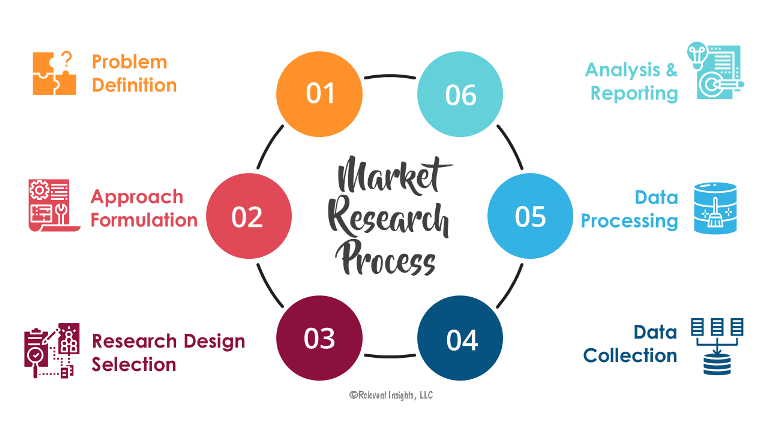
- Define your objectives. What specific business decisions will this research inform? (e.g., “Should we launch a new product?” or “Why are customers churning?”)
- Choose your research methods. Based on objectives, budget, and timeline, select the appropriate mix of qualitative and quantitative methods.
- Design your research instruments. Create survey questions, interview guides, or focus group scripts. Ensure questions are unbiased and aligned with objectives.
- Collect data. Deploy surveys, conduct interviews, run focus groups, or gather secondary data. Ensure you have a representative sample.
- Analyze the data. Look for patterns, trends, and insights. Use statistical tools for quantitative data and thematic analysis for qualitative data.
- Translate insights into action. Create a report with key findings and specific recommendations. Share with decision-makers.
- Implement changes. Act on the recommendations – adjust products, marketing, pricing, etc.
- Measure results. Track the impact of your changes. Did they move the needle as expected? Use this to refine future research.
Common Market Research Mistakes to Avoid
❌ 7 Market Research Mistakes That Waste Time and Money
1. Asking leading questions – “How much do you love our product?” biases responses.
2. Surveying the wrong audience – Ensure respondents match your target market.
3. Ignoring sample size – Small samples can’t be generalized.
4. Confirmation bias – Only looking for data that supports your preconceptions.
5. Analysis paralysis – Collecting data but never acting on it.
6. Not testing research instruments – Unclear questions produce garbage data.
7. Forgetting competitors – Researching customers is not enough; know your competition too.
Glossary of Key Market Research Terms
| Term | Definition |
|---|---|
| Primary Research | Data collected directly from sources (surveys, interviews, focus groups). |
| Secondary Research | Data already collected by others (industry reports, government statistics). |
| Qualitative Research | Non‑numerical data exploring attitudes, motivations, and behaviors (interviews, focus groups). |
| Quantitative Research | Numerical data that can be statistically analyzed (surveys with closed questions). |
| Sample | A subset of the population selected to represent the whole. |
| Margin of Error | A statistic expressing the amount of random sampling error in survey results. |
| NPS (Net Promoter Score) | A metric measuring customer loyalty and likelihood to recommend. |
Frequently Asked Questions (FAQs)
How much should I budget for market research?
It varies widely. Small businesses can start with free tools (Google Forms, social media polls) and spend $0. Larger projects with professional agencies can cost $10,000+. A good rule is to allocate 1–2% of your projected revenue for the project being researched.
How often should I conduct market research?
Continuously. Customer needs and market conditions change constantly. At minimum, conduct major research annually, with smaller pulse checks quarterly (e.g., customer satisfaction surveys).
Can I do market research myself, or should I hire a professional?
For basic research (surveys, simple interviews), DIY is fine. For complex projects requiring statistical rigor, large samples, or specialized techniques (conjoint analysis), consider hiring experts to ensure valid results.
What’s the biggest mistake in market research?
Collecting data without a clear plan for how it will be used. Always start with: “What decision will this research help me make?” Then design your research to answer that question.
How do I know if my sample is representative?
Compare your sample demographics to known population demographics. If your sample is skewed (e.g., too young, too male), weight your results or collect more data from underrepresented groups.
What tools can I use for market research?
Free: Google Forms, SurveyMonkey (basic), Typeform, social media polls. Paid: Qualtrics, SurveyMonkey Audience, Tableau (analysis), SEMrush (competitor research).
Wrapping It All Up
In the dynamic world of business, understanding the mind of your customer isn’t just a strategy; it is your secret weapon. Market research isn’t merely about crunching numbers. Rather it is about looking into the hearts of your consumers, foreseeing trends, and staying one step ahead. Only by harnessing this power can you master the art of growth and elevate your business to unprecedented heights.
The eight strategies outlined above provide a roadmap – but the real work begins when you start asking questions, listening to answers, and acting on what you learn. Start small, stay curious, and let data guide your decisions. Your customers are already telling you what they want. Are you ready to listen?
You can also read about MiniTool Partition Wizard, Data Recovery,
Top 10 Biggest Social Media Mistakes,
Guest Posting vs Guest Blogging,
Shopify Performance Optimization,
How to Mine Crypto On A Phone,
How To Create A PopUp In WordPress,
3 Exciting Career Paths for Computer Lovers,
Can I Sue a Social Media Company?,
Navigating Phone Tracking Apps,
Why Paraphrasing Is Important,