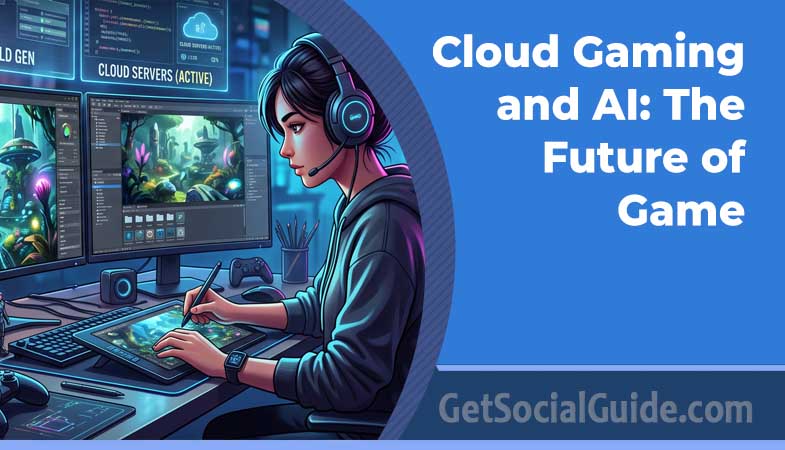
Cloud Gaming and AI: The Future of Game Development
I can still recall the first time I was able to play a full Windows version of a game on a meager laptop that only ran a web browser. The game was loading in a few seconds and the controls were close to perfect and I was still hoping for the “but” part. I felt there was one (my internet had a slight glitch twice), but the bigger feeling was that something had changed. Add what AI is doing behind the scenes at game studios, and I think we are in the midst of a new paradigm for game making, and game playing.
Why Cloud Gaming has changed the starting line
With cloud gaming, the weight is lifted off of the device and onto servers located elsewhere. Your mobile phone, tablet or old laptop only gets a video feed and they respond to your button presses. That’s good news for gamers, who now have no need to buy the console or graphics card. For developers, it’s more interesting: They can develop for one powerful hardware target in a data center, rather than swapping through dozens of configurations.
That’s more important than it sounds. Optimization takes a lot of programming time, and is the process of getting a game to run acceptably on less powerful machines. If the game is running on known server hardware, teams can take that time to focus on art, systems and feel. The testing matrix used to consume weeks of testing time for indie developers, I’ve been told.
How AI is currently being used in development
The trend of games using AI is often about having bots create full games, but this is not what the technology is being used for in this instance. The actual use is more subdued and functional. Machine learning applies chaos in the process of identifying bugs by having automated agents traverse levels thousands of times, highlighting areas where players are getting mired down or “falling through the map. Artists create concept sketches and variations of texture using AI tools and then handcraft them.Artists come up with ideas for concepts and texture variations in AI tools and then handcraft them. Boilerplate code is usually provided to the programmer for use by the program, and place-holding dialogue is provided to the writer to help create a level for testing prior to production of the final script.
Not one of these is a substitute for the people. It shortens the drab sections. A small team which used to take months to produce assets can prototype in weeks, which changes the types of games produced, and even if they are made.
Themes: Smarter Characters & Living Worlds
It’s the aspect that I get the most excited about. Non-player characters are the characters that are scripted. The blacksmith speaks to you, and he says exactly three words, and that sums it up. AI-driven dialogue is based on actions and words, characters can remember previous interactions with you, and react differently based on how you play the game.
For instance, the design of a creature. Consider the design of a dragon pokemon favorite picker: A team decides on a type identity, a silhouette, a signature move and a feel saying “rare and powerful”. There are, dozens of rough variations of that can brief to be created with AI in minutes, giving you the designers of freedom to choose which directions to pursue, rather than staring at a blank page. The final creature still requires a human eye shape, but the exploration is much more higher and quicker. With a procedural system, you can extend it further, and make it so that fighting a dragon can come across as a more personalized experience instead of a cookie-cutter battle.
Where Cloud and AI Meet
Now, that’s where the two trends really mesh. It’s difficult to use large AI models on a phone. It’s easy to run them on the cloud with the game. Accessing a big model for dialogue, difficulty level or real-time content generation can be done without involving your device in a cloud-hosted game.
It also unlocks personalisation on a large scale. Envision a game that’s aware of you being a lover of exploration and adds more covert rooms without you feeling put down, or one that feels the pain of your struggling opponents and makes them “bend over backwards” in mercy without you feeling patronized. Since all of this is stored locally on the server, you can update these systems over the night without touching anything on your system.
Tools players use already
The same personalization urge is present in little fan products. One of your favorite pokemon picker one of a handful of questions or conducts a bracket poll and tells you the actual favorite, which may not be the one you’d guessed. It’s a small detail but it’s what players want — experiences that are in their style. Developers are noticing. Take that sort of preference information and combine it with AI in the cloud and you could see a game begin to suggest quests, companions or even designs for creatures that you always seem to prefer. I have experimented with some of these pickers, and the thing to be surprised at at the end is half the fun.
The Problems Nobody Should Ignore
I don’t want to lie to you this is all good news. While cloud gaming still requires a stable connection, in many areas, this is a significant obstacle. Competitive games are frustrating because of the latency. Ownership is another thing – if the game is in a server, what happens when the service goes down?
AI poses its own questions. Artists are concerned with training data and about being undercut. Some players are afraid of games that are devoid of personality and have only generated content. There’s also the expense of operating all these models – and someone has to foot the bill – and that bill often comes in at subscription costs. Studios that use AI clips as a way to quickly fill time with filler will quickly lose the trust of their audience. Those lucky enough to adopt it as a tool for human creators will have a lot more fun.
What I Expect Next
I’m sure the coming couple of years will be less sensational than the headlines make them sound, but more useful than the skeptics would agree. Cloud services will reap benefits at low latitudes, AI tools will be integrated into the very fabric of the game development workflow, and smaller studios will send games that were too expensive to do in the past. Ideally, there will be games that are more alive, more accessible and that maintain a strong human touch.
For players, it’s a smart time to experience a cloud service for any gadget you have. For developers, it’s a great opportunity to tinker around with AI for the mundane tasks first. It is either way, the future of game development seems a lot more open than it was couple of years ago.