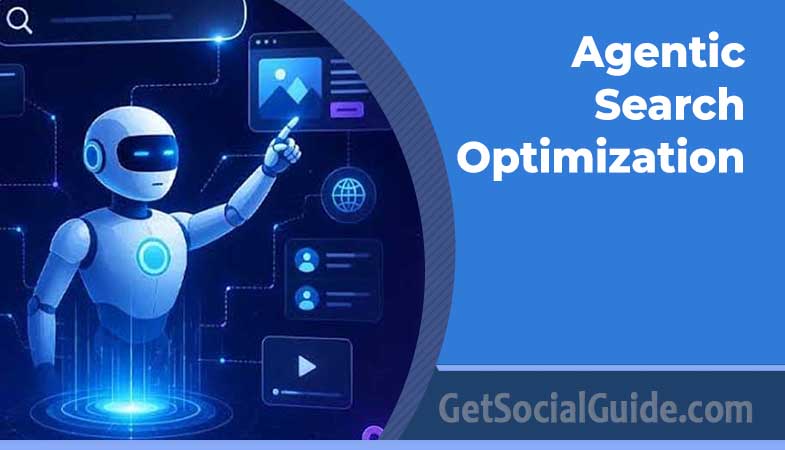
Search is no longer only about people typing queries into Google. AI agents now browse, compare and act on behalf of users. Agentic search optimization is the practice of making your website easy for those agents to find, understand and use. This guide explains what it means, how it differs from SEO and GEO, and what you can do today on a WordPress site.
The shift is easy to underestimate. Traditional search sends a person to your page, where they read, compare and decide. Agentic search sends software that performs part of that work before the person ever arrives. An agent might check your stock levels, confirm a price, compare two products, or attempt to book a slot. If your site cannot be read or operated by that software, you are excluded from the recommendation before a human ever sees your brand. The practical work is not exotic; it builds directly on clean technical SEO, but it adds new emphasis on machine-readable structure and working interactive elements.
What Is Agentic Search Optimization?
Agentic search optimization means preparing your site for autonomous AI agents, not just search engine crawlers. Where SEO targets rankings and GEO targets citations in AI answers, agentic optimization aims to make your site usable by agents completing a task for a person, such as comparing products, finding a price or booking a service.
It helps to think of three layers. The first is discoverability: can an agent reach your pages at all? The second is comprehension: can it extract the facts it needs without guessing? The third is action: can it complete a task such as submitting a form or reading a booking calendar? Agentic optimization addresses all three, and a failure at any layer removes your site from the agent’s shortlist.
SEO vs AEO vs GEO vs Agentic Optimization
| Main audience | Goal | |
|---|---|---|
| SEO | Search engine crawlers | Rank in search results |
| AEO | Answer engines (AI Overviews, People Also Ask) | Be featured in answers |
| GEO | Generative AI (ChatGPT, Perplexity, Gemini) | Be cited in AI responses |
| Agentic optimization | Autonomous AI agents | Be usable for task completion |
The distinctions matter because they change what you measure. SEO success is a ranking position. AEO success is a featured snippet or an answer box inclusion. GEO success is a citation inside a generated response. Agentic success is a completed action: a price read correctly, a form submitted, a booking confirmed. Each layer builds on the one before it, which is why technical fundamentals carry so much weight here.
Why Agentic Optimization Matters Now
Interest is growing fast. Ahrefs reports that agentic optimization keywords, such as “llms.txt” and “agentic seo”, average 541 searches a month across 18 keywords, with about 852% growth. The term “agentic seo” alone shows the highest growth in that set.
Google is also showing AI visibility data in Search Console. If you want to measure part of this, read our guide on the Search Console AI performance report.
Adoption is moving faster than most site owners expect. Commerce platforms now expose product catalogs through feeds designed for automated comparison, and travel and booking services increasingly receive requests from software rather than browsers. The sites that adapt early tend to be the ones an agent can parse without special handling, which gives them an advantage that compounds as more tasks move to automated completion.
The CARE Checklist for AI Agents
A helpful way to organize the work is the CARE framework from Similarweb: Crawlability, Accessibility, Readability and Executability.
C: Crawlability, can agents reach your site?
- Check robots.txt and remove rules that block AI crawlers you want, such as GPTBot.
- Review your CDN and firewall (WAF) settings. Bot protection built to stop scrapers can accidentally block legitimate AI agents.
- Keep an XML sitemap with every page you want discovered.
A: Accessibility, can agents find what matters?
- Use clear navigation and a working site search.
- Use descriptive link text instead of “click here”.
- Add ARIA labels and clear button text. Agents rely on structured text and the accessibility tree more than visual layout.
R: Readability, can agents parse your content?
- Use a logical heading structure: one H1, clear H2s and H3s.
- Answer questions directly near the top of each section.
- Add Article, FAQPage or Product schema where it matches the visible content.
- Show key facts, such as prices and specs, in plain HTML text, not only in images.
E: Executability, can agents complete a task?
- Use real forms, buttons and booking tools with clear labels.
- Keep shopping feeds and APIs complete and accurate if you sell products.
- Keep FAQs, terms and policies up to date.
Technical Requirements for AI Agents
Beyond the CARE framework, several technical details determine whether an agent can work with your site reliably. None of them are new to experienced SEOs, but each one matters more when the visitor is software rather than a person.
Structured Data and Schema for Agentic Search
Schema markup translates visible content into a format an agent can read without interpretation. Product schema with price, availability and currency, Article schema with author and date, FAQPage schema for question-and-answer blocks, and LocalBusiness schema for service pages all reduce ambiguity. The rule that matters most is accuracy: markup must match what a human sees on the page. Inconsistent markup, such as a price in schema that differs from the visible price, is worse than no markup at all because it actively misleads automated systems.
Robots.txt and Bot Access for AI Agents
Robots.txt is the first gate an agent encounters. Blocking every bot with a blanket disallow rule is a common default in security configurations, and it silently removes your site from AI discovery. A better approach is to decide per bot: allow the agents whose traffic you want, such as search-oriented crawlers, and block only the ones you have a reason to exclude. Keep the file current and test it after any server or CDN change, since infrastructure migrations frequently overwrite it.
Accessibility Tree and Semantic HTML
Agents consume the accessibility tree and the underlying HTML rather than the rendered visual design. Buttons built from clickable divs, navigation that exists only as images, and form fields without labels all become invisible or ambiguous. Semantic elements such as button, nav, form, label and heading tags give agents a reliable map of the page. This is why accessibility improvements and agentic optimization so often overlap: a site that works well with a screen reader usually works well with an agent.
Does llms.txt Help?
Treat it as optional. llms.txt, markdown versions of pages and the accessibility tree are all ways of telling an agent what a page contains. But Ahrefs analyzed 137,000 sites and found that 97% of llms.txt files are never read. Spend your time on crawlability, clean structure and content quality first, then add llms.txt if you want.
The practical takeaway is sequencing, not dismissal. If your robots.txt blocks AI crawlers or your prices exist only inside a JavaScript widget, an llms.txt file will not rescue the situation. Fix the foundations first, then treat llms.txt as a low-cost addition that may help some agents and will be ignored by most.
Agentic Optimization on WordPress: Quick Steps
- Open Settings, then Reading, and confirm your site is not set to discourage search engines.
- Check your robots.txt and security plugin or CDN settings for blocked AI user agents.
- Submit and maintain your XML sitemap in SEOPress.
- Add schema in SEOPress for articles, FAQs and products.
- Rewrite key pages with direct answers, short paragraphs and clear headings.
- Test your forms and contact or booking buttons with a keyboard only, since good keyboard accessibility also helps agents.
Agentic Search Optimization Checklist for WordPress
Use the checklist below as a recurring audit rather than a one-time setup. Run it after plugin updates, theme changes, and hosting migrations, since all three can silently alter crawl and access behavior.
- Verify that the Reading settings still permit search engine indexing after any migration.
- Confirm that the robots.txt file does not contain a blanket disallow rule added by a security plugin.
- Check that the XML sitemap includes every published page you want discovered and excludes staging URLs.
- Validate schema markup with a structured data testing tool after editing product or FAQ content.
- Test each form and booking flow with the keyboard alone, then confirm that labels are present in the HTML.
- Review the site’s navigation in plain HTML to ensure every important page is reachable through real links.
- Check that prices, specifications and availability appear as text rather than only inside images or scripts.
- Record the date of each change so later visibility shifts can be traced to a specific edit.
Measuring Agent Traffic and AI Visibility
Measurement is still imperfect, but several signals are available today. The key is to combine them rather than rely on any single source.
Server Log Analysis for AI Bots
Server logs record the user agent string of every request, including known AI crawlers and agents. Filtering logs by user agent reveals how often these systems visit your site, which pages they request, and whether they encounter errors. A sudden drop in AI bot requests after a firewall change is one of the clearest early warnings that access has been accidentally blocked.
Search Console AI Performance Report
Google’s AI performance report shows how often your pages appeared inside AI Overviews and AI Mode. It reports impressions only, with no query data and no separate click figure, so read it alongside the standard Performance report. The report is covered in detail in our guide to the Search Console AI performance report.
Third-Party AI Visibility Tools
Several platforms now track brand mentions and citations across AI assistants. These tools are useful for competitive context and for spotting trends, but their coverage varies and their numbers are not directly comparable to Search Console data. Treat them as directional rather than definitive, and confirm important findings against your own logs and analytics.
Common Mistakes
- Blocking all bots in security settings.
- Hiding important details, such as pricing, behind scripts or images.
- Adding llms.txt and assuming the job is done.
- Stuffing keywords. Agents favor clear, factual structure.
- Publishing schema that does not match the visible page content.
- Assuming an agent can complete a checkout or booking flow that requires a visual captcha or hover interaction.
- Testing only in a browser and never inspecting the raw HTML an agent actually receives.
Frequently Asked Questions
What is agentic search optimization?
It is the practice of making your website discoverable, understandable and usable by autonomous AI agents that act for users.
Is agentic SEO different from GEO?
Yes. GEO aims to get your content cited in AI-generated answers. Agentic optimization aims to let agents complete tasks on your site.
Do I need llms.txt?
Not necessarily. Studies suggest most llms.txt files are never read, so it should not replace technical basics.
Should I allow AI bots in robots.txt?
If you want AI visibility, yes. Blocking them can stop agents from reading your pages. Choose per bot based on your goals.
Can I measure agent traffic?
Partly. Server logs and some WordPress analytics plugins can identify AI bots and agents. Google’s Search Console AI report covers only Google’s AI surfaces.
What is the difference between an AI crawler and an AI agent?
A crawler reads pages to build an index or train a model. An agent goes further: it retrieves information and then performs an action, such as comparing prices or attempting a booking. A site can be fully crawlable and still fail agentic optimization if its interactive elements cannot be operated without a human.
Does agentic optimization replace traditional SEO?
No. It builds on it. Crawlable pages, clear headings, accurate content and working internal links remain the foundation. Agentic optimization adds emphasis on machine-readable facts, semantic HTML and operable forms, but it does not remove any of the traditional requirements.
How do I know if my site is blocked to AI agents?
Start with robots.txt and your security plugin or CDN configuration. Then review server logs for requests from known AI user agents. If you see no requests at all from major AI systems over an extended period, something is likely blocking them, whether at the firewall, the CDN, or the robots file itself.
Which pages should I optimize for agents first?
Start with pages that already convert well with human visitors: product pages, pricing pages, service descriptions and booking flows. These are the pages an agent is most likely to need when completing a task. Optimizing a blog post that supports no transaction is far less valuable than fixing a product page whose price is trapped inside an image.
Will agentic optimization improve my normal SEO results?
Usually, yes, indirectly. The same changes that help agents, such as semantic HTML, clear headings, accurate schema and faster access to key facts, also help search engines and human readers. The overlap is large enough that most agentic work counts as general technical and on-page improvement.
Final Thoughts
Agentic search optimization builds on good SEO: crawlable pages, clear structure, accurate facts and working forms. Use the CARE checklist, avoid blocking helpful bots, and keep content easy to read. The sites that are clear and easy to use will be easier for agents to recommend.
The most useful way to approach this is incrementally. Audit crawlability once, fix the robots and firewall settings that block legitimate agents, then work through the page types that matter most for task completion. Measure what you can with server logs and Search Console, accept that AI visibility data is still maturing, and keep the underlying content accurate and easy to parse. Sites that do this consistently will be the ones that remain eligible as more search and buying decisions are delegated to software.