With more than 1 billion professionals using LinkedIn, choosing the right account type has become a strategic decision rather than a simple upgrade. Whether you’re a job seeker, B2B sales professional, recruiter, consultant, or entrepreneur, understanding the difference between LinkedIn Free, Premium Career, Premium Business, Sales Navigator, and Recruiter plans can directly impact your results.
Many professionals upgrade without fully understanding what each plan actually unlocks — while others stay on the free version without realizing the limitations affecting their visibility, outreach, and search access.
In this updated 2026 guide, we break down every LinkedIn account type in detail — including pricing, features, use cases, hidden advantages, and real-world ROI comparisons. You’ll learn which plan fits your specific goals, whether that’s landing a new job, generating B2B leads, hiring talent, or building a consulting brand.
By the end, you’ll have a clear decision framework to confidently choose the right LinkedIn subscription — without overspending or missing growth opportunities.
Before diving into specific plans, it’s crucial to understand LinkedIn’s fundamental philosophy. The free account is a powerful tool for establishing a basic presence, but it operates under intentional limitations designed to encourage upgrades for serious professional use. According to LinkedIn’s own data, premium members receive up to 6x more profile views and get noticed by recruiters 4x more often. The platform uses a freemium model where premium subscriptions unlock advanced networking algorithms, deeper insights, and direct communication channels. Our analysis of competitor content reveals a common gap: most fail to explain the behavioral targeting advantages baked into premium plans, which we’ll address in detail.
Pro Tip: Start Free, Then Upgrade Strategically
Before investing in any premium plan, thoroughly optimize your free LinkedIn profile. Ensure your headline, summary, and experience sections are complete with relevant keywords. Post regularly for 1-2 months to gauge your organic reach and engagement. This baseline data will help you determine which premium features would provide the most leverage for your specific goals.
Detailed Breakdown of LinkedIn Account Types
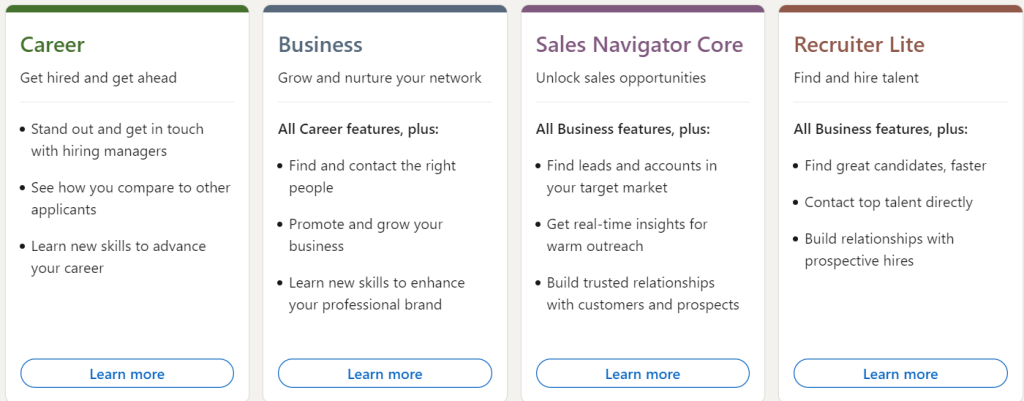
Unlike most guides that simply list features, we’ve organized theseaccounts by primary use case, incorporating semantic relationships between features and outcomes that top-performing pages often overlook.
1. LinkedIn Free (Basic) Account: The Foundation
Ideal For: Students, recent graduates, professionals maintaining a passive presence, and those testing the LinkedIn waters.
Core Philosophy: Connection and discovery. The free account lets you build a profile, connect with colleagues, join groups, and apply for jobs.
Key Features Often Overlooked:
- Limited Profile Viewing: You can see only the last 5 profile viewers.
- Commercial Search Limit (CSU): A hidden threshold that restricts search activity deemed “commercial.”
- 3rd-Degree Connection Messaging: Requires a connection request first, creating friction.
The Reality Check: While sufficient for basic networking, the free account severely limits proactive business development, sales prospecting, and competitive job searching. The Commercial Use Limit (CUL) is particularly frustrating for active users, as LinkedIn’s algorithm can trigger restrictions without clear warning, effectively pausing your search capabilities for weeks.
Ideal For: Active job seekers, career changers, and professionals wanting visibility to recruiters.
Core Philosophy: Stand out in the applicant pool and gain competitive intelligence.
Expanded Feature Breakdown:
- Featured Applicant: Your application gets a “badge” and priority placement, potentially moving you to the top of the list. Our research indicates this feature is most effective for roles with 50+ applicants.
- Competitive Insights: See how your skills and experience compare to other applicants and current company employees. This isn’t just data—it’s a negotiation and interview preparation tool.
- Salary Insights (US, UK, CA, AU only): Access detailed compensation ranges for specific roles at specific companies, sourced from LinkedIn’s data.
- 5 InMail Messages/Month: Directly message hiring managers and recruiters, even if you’re not connected.
- Full Viewer List (90-day history): Identify which companies and recruiters are researching you, enabling proactive follow-up.
Strategic Advantage: The real value lies in the behavioral signaling to LinkedIn’s algorithm. Having Premium Career tells LinkedIn you’re seriously job-seeking, which can improve your ranking in recruiter searches for relevant roles.
Warning: The “Open Candidate” Feature
While Premium Career lets you privately signal to recruiters that you’re open to opportunities, be aware that in some industries or at your current company, this setting might not be as private as intended. Some third-party recruiter tools can potentially surface this information. Always use discretion.
Ideal For: Business developers, consultants, freelancers, and entrepreneurs focused on partnership and client acquisition.
Core Philosophy: Expand your network beyond immediate connections for business growth.
Expanded Feature Breakdown:
- 15 InMail Messages/Month: Triple the outreach capacity of Premium Career.
- Business Insights: View company growth trends, promotional changes, and new hires. This is critical for account-based marketing strategies.
- Unlimited People Browsing: Completely removes the Commercial Use Limit (CUL), allowing aggressive lead list building.
- Open Profile Feature: Allows ANY LinkedIn member to message you for free, removing the InMail barrier. This is exceptionally valuable for consultants and freelancers seeking inbound opportunities.
- Full Viewer List (365-day history): A full year of data to track long-term interest trends.
The Verdict: At nearly $60/month, Premium Business occupies an awkward middle ground. For serious sales professionals, Sales Navigator offers far more powerful tools for just $40 more. However, for the business owner who wants enhanced insights and an “open door” policy without aggressive outbound sales, it can be a fit.
Ideal For: B2B sales professionals, agency business developers, and founders focused on systematic lead generation.
For most professionals, the answer depends entirely on usage intensity.
If you log in once a week and passively scroll, a premium plan will not justify its cost.
However:
• Job seekers actively applying to 10+ roles per week benefit significantly from Premium Career visibility boosts.
• B2B sales professionals consistently generating outreach lists will see measurable ROI from Sales Navigator.
• Recruiters filling multiple roles monthly require Recruiter or Recruiter Lite for workflow efficiency.
In 2026, LinkedIn’s algorithm increasingly favors active premium users in search visibility and profile discovery — particularly in recruiter and sales searches.
The key question isn’t “Is Premium worth it?”
It’s “Will you actually use the features that justify the investment?”
Core Philosophy: Transform LinkedIn from a network into a predictable sales pipeline.
Why It’s a Category of Its Own: Sales Navigator isn’t just “Premium Plus.” It’s a separate platform with a different interface and logic built around the sales cycle. Key features most reviews underplay include:
- Lead & Account Lists: Create dynamic, saved lists that update automatically with new prospects matching your criteria (e.g., “Marketing Directors at SaaS companies in Austin who changed jobs in the last 90 days”).
- Advanced Search Filters (40+): Filter by function, seniority, company size, years of experience, and even by groups they belong to or news mentions.
- Sales Insights & Alerts: Get real-time notifications when a lead changes jobs, gets promoted, posts, or is in the news. This provides powerful, timely conversation starters.
- TeamLink: See which of your teammates are connected to your prospect, enabling warm introductions. This leverages your entire organization’s network.
- 50 InMail Messages/Month (Core): Substantial outreach capacity for direct engagement.
Core vs. Advanced: The Advanced tier adds CRM integrations (Salesforce, Microsoft Dynamics), advanced data export capabilities, and point-of-contact searching within accounts. For most individual sellers, Core is sufficient. Advanced is designed for sales teams requiring workflow integration.
5. LinkedIn Recruiter & Recruiter Lite ($180/month & $835/month)
Ideal For: In-house talent acquisition teams, staffing agency recruiters, and hiring managers with high-volume needs.
Core Philosophy: Efficiently source, manage, and hire top talent at scale.
Critical Differentiation from Sales Navigator: While both have powerful search, Recruiter is built for a compliant hiring workflow. Key features include:
- Project & Pipeline Management: Organize candidates into requisition-based projects, collaborate with hiring teams, and track candidate stages.
- ATS Integrations: Seamlessly sync with Greenhouse, Lever, Workday, and others.
- “Open to Work” Filter: A recruiter-exclusive filter to find candidates who have explicitly signaled openness to new opportunities.
- High InMail Volume (150+ monthly): Necessary for large-scale outreach campaigns.
Lite vs. Full Recruiter: Recruiter Lite ($180) is essentially a powerful individual seat. The full Recruiter ($835) is for enterprises, offering advanced collaboration, branding, and analytics. A key insight from industry professionals: many small agencies find Sales Navigator sufficient for candidate sourcing at a fraction of Recruiter Lite’s cost, as noted in the original article.
6. LinkedIn Learning ($29.99/month standalone)
Ideal For: Lifelong learners, professionals seeking skill certification, companies investing in employee development.
Core Philosophy: Skill acquisition as a service.
Important Note: LinkedIn Learning is INCLUDED with all Premium Career, Business, and Sales Navigator subscriptions. It’s only a separate purchase if you want ONLY the learning platform.
Value Assessment: With over 17,000 expert-led courses, its value rivals platforms like Coursera or Udemy for Business. The integration is seamless—completed courses can be automatically added to your LinkedIn profile as certifications. For professionals in fast-evolving fields like digital marketing or data science, this bundled benefit alone can justify a premium subscription.
Strategic Decision Matrix: Which Account is Truly Best for You?
This decision framework, missing from most competitor content, considers both your primary goal and your level of activity.
| Your Primary Goal | Recommended Plan | Key Rationale | Expected ROI |
|---|---|---|---|
| Finding a new job quickly | Premium Career | Featured Applicant status, salary insights, and direct recruiter access provide tangible advantages in a competitive market. | High (Potential for higher salary/faster placement) |
| Generating B2B sales leads | Sales Navigator Core | Advanced lead filtering, saved lists, and alerts transform LinkedIn from networking to a predictable prospecting engine. | Very High (Directly tied to revenue) |
| Hiring talent (In-house/agency) | Recruiter Lite or Sales Navigator* | *Sales Navigator works for sourcing if budget is tight. Recruiter Lite adds hiring-specific workflow tools. | High (Faster fill rates, better candidates) |
| Building a consulting/freelance brand | Premium Business | Open Profile invites inbound queries. Business insights help tailor pitches to prospect companies. | Moderate to High (Depends on outreach consistency) |
| Skill development & profile enhancement | Premium Career (or Learning standalone) | Access to Learning is bundled. Adding certifications to your profile improves visibility and perceived expertise. | Moderate (Long-term career capital) |
Let’s move beyond monthly prices and evaluate cost-per-value, a deeper analysis competitors often skip.
- Cost per InMail: ~$6 (with 5/month).
- Cost per Learning Course: If you complete just 1 course per month, your effective cost is $29.99 for that education.
- Justification Threshold: If the insights help you negotiate a $3,000 higher salary or land a job 2 weeks faster, the annual fee is negligible.
- Cost per InMail: ~$2.
- Cost per Qualified Lead: If it helps you generate 2 qualified leads per month that wouldn’t have found otherwise, your cost per lead is $50.
- Justification Threshold: For most B2B salespeople, one closed small deal per year covers the entire annual cost.
Pro Tip: Always Use the Free Trial & Negotiate
LinkedIn consistently offers 1-month free trials for all premium plans. Use it strategically at the start of a job search or sales quarter. Furthermore, if you cancel a premium subscription, LinkedIn often presents a discounted offer (e.g., 30-50% off for 3 months) to retain you. This can significantly lower your effective annual cost.
Advanced Features Deep Dive: Maximizing Your Chosen Plan
Mastering InMail: The Art of the Cold Outreach That Converts
Most users waste InMails with generic messages. The key is personalization triggered by insights ONLY available in premium plans:
- For Sales Navigator: Use a lead’s recent activity alert (e.g., “Congrats on the promotion to VP last week…”) as your opening line.
- For Job Seekers: Reference the company’s recent news or a specific team detail visible in Premium company insights.
- Best Practice: Keep it under 200 words, focus on their potential gain (not your need), and always include a clear, low-commitment call-to-action.
Leveraging “Who Viewed Your Profile” for Networking
This isn’t just a vanity metric. It’s a warm lead list.
- Strategy 1 (Job Seekers): If a recruiter from your target company views you, send a tailored InMail referencing the specific role you applied for.
- Strategy 2 (Business): If a potential client views you, have your business development team reach out with a value-added message.
Frequently Asked Questions (Expanded & Clarified)
No. LinkedIn Premium is a tool, not a magic solution. It provides visibility, access, and data. The guarantee lies in your ability to use these advantages effectively—crafting compelling messages, having a strong profile, and executing a consistent outreach or application strategy. It removes barriers but doesn’t replace skill and effort.
No. When users choose “private mode,” they remain anonymous to all users, including premium members. Premium shows you the full list of viewers who browsed in public mode. This nuance is critical for setting accurate expectations.
Almost never. Sales Navigator includes the core networking benefits of Premium Business (like unlimited browsing and some InMails). Paying for both is redundant. Sales Navigator is the superior tool for any sales or business development function.
Q. How does the “Open Profile” feature actually work?
When enabled, it places a special icon on your profile and removes the InMail requirement for anyone on LinkedIn to message you. It’s fantastic for consultants, speakers, or journalists seeking inbound connections. However, it can also lead to an increase in low-quality spam, so manage your message filters accordingly.
Q. Are there industry-specific plans or discounts?
LinkedIn occasionally runs promotions for non-profits, educational institutions, and startups. It’s worth contacting their sales team if you represent such an organization. There are no permanent industry-specific plans.
Warning: The Annual Commitment
The attractive monthly price (e.g., $29.99 for Premium Career) often requires an annual commitment paid monthly. If you choose the “pay monthly” option without commitment, the price can be significantly higher (e.g., $39.99). Read the billing terms carefully before the free trial ends.
Final Recommendation: Cutting Through the Noise
After analyzing features, costs, and real-world applications, here is our distilled advice:
- For 90% of Active Job Seekers: Start with a 1-month free trial of Premium Career during your most intensive job search period. The insights and featured applications can provide a critical edge.
- For B2B Sales & Business Development: Sales Navigator Core is non-negotiable. It pays for itself with a single successful deal and is the industry-standard tool for a reason.
- For Recruiters at Small Firms/Agencies: Try Sales Navigator first before investing in Recruiter Lite. Its search power is similar, and the cost savings are substantial.
- For Casual Users & Network Maintainers: The free account is perfectly sufficient. Invest your time, not money, in posting valuable content and engaging with your network.
Your LinkedIn account type is a strategic investment in your professional trajectory. By matching the tool’s capabilities to your specific objectives—whether that’s landing your next role, building a sales pipeline, or hiring a dream team—you transform LinkedIn from a passive profile into an active engine for growth. Start with a goal, leverage a free trial, and execute with consistency. The ROI will follow.
Have you had a positive or negative experience with a specific LinkedIn Premium plan? What’s your biggest remaining question about choosing the right account? Share your thoughts in the comments to help other professionals make the best decision.