Beginner’s Guide to WordPress SEO for Better Google Rankings
Ever feel like you’re shouting into the void on social media? You post great content, but growth is slow. The secret often isn’t just what you post on the platforms, but how you optimize your presence for them. Think of it as SEO for your social profiles-making sure your ideal audience can actually find you. This guide will walk you through the steps to make your social media channels discoverable, engaging, and primed for growth.
You’ve built a beautiful website. You’ve written great content. You’ve hit “Publish.” But when you check your analytics, the only visitor is you (and maybe your mom).
This is a common frustration for new website owners. The truth is, “if you build it, they will come” is a myth. To get traffic, you need SEO (Search Engine Optimization).
If you are using WordPress, you are already ahead of the game. WordPress is the best platform for SEO, but it doesn’t do the work for you automatically. You have to configure it correctly.
In this guide, we will break down the essential steps to turn your WordPress site from a ghost town into a traffic magnet.
So, why this SEO obsession?
SEO or Search Engine Optimization in layman’s terms is the magical tool which keeps your site from playing the hide, and, seek game with search engines. Getting to know the SEO orchestra is extremely important for newcomers only entering the WordPress realm. It’s similar to a website’s visa to fame in the vast virtual world. Without it, your site can very well be like a valuable book buried in the disorderly shelves of an enormous library.
It is like a compass which shows your potential customers the way directly to your digital home. We are not merely touching the surface today but are actually digging deep to find the Tips and Best Practices for WordPress SEO which would be like your website raising its head above the digital market crowd.
Understanding WordPress SEO Basics
What is it that everyone is talking about with SEO in WordPress? SEO, which is short for Search Engine Optimization, is the magic wand for your site. It is the charm that makes your site visible among the millions of other sites in the online world. And why is it a good reason to care about this digital magic especially when you’re using WordPress? Your website is like a hidden treasure on an isolated island and SEO is the map that directs search engines to your hidden treasures. Let’s be honest about SEO’s influence on your ranking among WordPress sites.
It is not a keeper of vanity metrics but rather the very breath of your online life. It is the one that determines whether your site is the captain of the ship or already lost in the wide ocean of websites. Now, going further down into the details of WordPress SEO, we are actually referring to the most important issue that is keywords. Keywords are the little soldiers that inform the search engines about the topic of your content. You can use them wisely in meta tags and quality content to produce the perfect mixture for SEO triumph. In addition, user-friendliness and mobile-friendliness are not just the trendy terms but the real champions of SEO success.
It is like having a warm and cozy welcoming mat that really invites people in and lets them know that you’re exactly what they’re looking for! In this tale of SEO, your WordPress site is not just a page that can stand still but a player that changes its role in the digital orchestra. Therefore, when the SEO tune is on, don’t just move your foot to the beat and let your WordPress site be the one in the spotlight.
Optimizing Your WordPress Site for Search Engines
The scoop of an SEO-friendly WordPress theme is like having a secret map to buried gold. To begin with, the theme must possess more than mere beauty. It must be responsive as a personal butler who serves the needs of your website visitors regardless of the device they are using. It is a theme that not only dazzles but also smoothly dances from desktop to tablet to smartphone ensuring that your content looks stunning universally. That is the magic of a responsive theme. Now, let us add some SEO fairy dust. An SEO-optimized theme is your golden ticket to stardom in the search engines. It is the language your website uses to communicate with Google, Bing, and the rest. It means clean code, fast loading times, and an architecture that is loved by search engines. Imagine it as giving your site a VIP pass to the search engine party.
Your Profile Foundation: The Digital Handshake
First impressions are the main factors. Before someone following you or engaging with your content, they see your profile. This is your digital handshake, and it should be both clear and confident.
Try to fix the most important things at first: your username and name field. Your username (or handle) should be not only similar on different platforms but also as close as possible to your brand name. The name field, however, is like the most expensive property in the world for the keywords. A bakery shouldn’t just be “Sarah’s Kitchen”; it should be “Sarah’s Kitchen | Artisan Bread & Pastries in [Your City].” This immediately lets people and search algorithms know what your business is.
Then again, your bio is not the story of your life; it is a statement of your worth. In one or two sentences, respond to: Who are you helping, and what problem do you solve? Incorporate relevant keywords in a natural way. “I help new coaches land their first 3 clients through LinkedIn” is a lot more effective than “Coach passionate about growth.” Make it a point to have a clear call, to, action always such as your latest guide or website link.
Lastly, do not profile pictures and cover photos as if they were the least important things. Make use of a good quality, easily identifiable photo of yourself or your logo. The cover photo is like a billboard advertisement, you can use it to display your work, bringing attention to a present offer, or helping your brand vibe be understood.
Content That Connects and Captivates
Of course, if you don’t have a compelling profile and feel for content, you’re already lost. But even if you do have that, the algorithm (or as Cassey’s dad sweetly puts it, the “Al Gore rhythm”) demands that content be disciplined.
Identifying what your audience wants is step one. What questions do they have? What pains are they feeling? Use these insights for “keyword” research. As a fitness coach, your audience searches Instagram or YouTube for key words like “beginner home workouts” or “how to meal prep for weight loss.” Your content topics and captions will need to speak to that.
You need to learn the art, the science and the craft of the hook and caption. The first seconds of a video and the first line of a post caption are vital. Up top, you must hook the audience by either stating a problem, asking a provocative question or promising a benefit or outcome. The copy — all 2,200 characters of it, or around 330 words — should walk the line between delivering value and being concise and entertaining. It also needs a call to action at the end that invites readers to comment in response to a question or prompt.
Structure also matters. For a longer caption or article, such as on Instagram or LinkedIn, your content should have legible hierarchy. You don’t want to miss the strong hook and clear breakdown of your thesis. This helps keep the content scannable and useful.
The Growth Engine: Engagement and Discovery
Great content alone isn’t enough. This means that as creators grow their audience, they need to convert passive followers into an active community.
This means engaging authentically. Social media is a two-way street. It’s incredibly time consuming, not just to post but to respond to every comment, answer D.M.s and engage with other creators’ content. Second, you connect with others, signaling to the algorithm that you’re an engaged member of the community.
To start, take advantage of hashtags, S.E.O. Do use simple, relevant hashtags — but don’t use only the most popular ones. It is also key to tag your content with a mix of broad topics, niche subjects and locations. Along with the tags, title your content with relevant keywords, focusing on each platform’s character or word limits. Write full descriptions, or “alt” text, of any images you use, for the blind and the robots.
And look at analytics as a compass. Was there a post that got the most saves or shares? When was your audience the most engaged? Do you get the most profile visits from Reels, Carousels or Stories? At a minimum, it would be wise to know your “reach” goal — i.e., the number of accounts to which your content is exposed — and your “engagement” goal — i.e., the number of interactions your posts receive. Use them to strengthen what works and improve what doesn’t.
Building a Lasting Presence
The goal, in fact, is not one viral post but a trusted and recognizable brand that brings in the opportunities by itself. Vanity metrics should take a back seat while you focus on quality and value. A 1, 000 highly engaged followers who will buy from you is worth more than a 10, 000 followers who never interact. Produce content that genuinely helps your target audience solve their problem, the “ultimate guide” that they will inevitably save and share. Absolutely, hold on to your patience and keep going with your work.
There will be times when the algorithm will change and the trend will be different. What stays the same is that you keep showing up for your audience with valuable content. Authenticity and consistency are the trust factors and trust is what constitutes a community that will expand with you. Begin your journey by performing an audit on one of your social profiles today. Put these steps into practice, plan ahead for the next month and see how your presence changes from being unnoticed to being unmistakable. May you have clarity and grow,
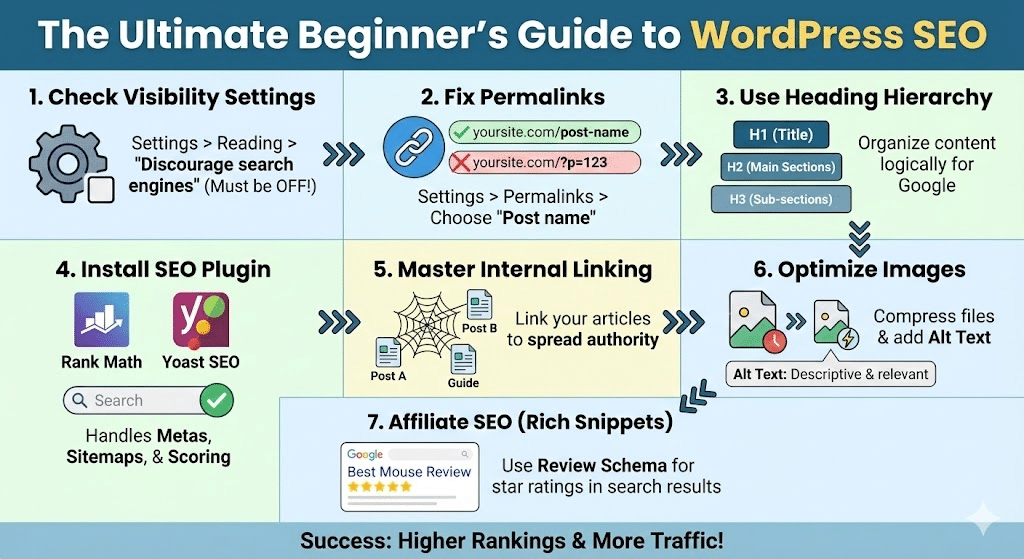
Step 1: Check Your “Visibility” Settings
Before you do anything technical, you need to make sure you haven’t accidentally locked Google out.
When you install WordPress, there is a tiny checkbox that stops search engines from indexing your site. It is often checked by default while a site is “under construction,” but many beginners forget to uncheck it when they launch.
- Go to: Settings > Reading
- Look for: “Search Engine Visibility”
- Action: Ensure the box that says “Discourage search engines from indexing this site” is UNCHECKED.
- Save Changes.
If this box is checked, no amount of SEO work will help you. You are telling Google, “Go away.”
Step 2: Fix Your Permalinks (URL Structure)
By default, WordPress might create URLs that look like this: https://yoursite.com/?p=123
This is terrible for SEO. Google (and humans) have no idea what “Page 123” is about. You want your URL to explain the content, like this: https://yoursite.com/best-gaming-mouse-2025/
- Go to: Settings > Permalinks
- Select: “Post name”
- Save Changes.
Note: If your website is already old and has lots of links pointing to it, be careful changing this setting as it can break old links. But for a new site, this is mandatory.
Step 3: Use Headings Correctly (Hierarchy)
Google reads your content like an outline. It uses Heading tags (H1, H2, H3) to understand the structure of your argument.
- H1 (The Title): This is your main headline. You should only have one H1 per page. It tells Google what the entire page is about.
- H2 (Main Sections): Use these to break your article into big chapters. (e.g., “Top 5 Keyboards,” “Buying Guide,” “Conclusion”).
- H3 (Sub-sections): Use these to break down H2s. (e.g., Under the “Top 5 Keyboards” H2, you might use H3s for “Logitech,” “Razer,” etc.).
Pro Tip: Never use an H2 just because you want “big bold text.” Use it only for structure.
Step 4: Install a SEO Plugin
Don’t try to memorize every SEO rule. Use a plugin to act as your assistant. There are two major players in the WordPress world:
- Rank Math SEO: (Recommended for 2026). It is lightweight, modern, and the free version includes features that others charge for (like 404 monitoring and redirection).
- Yoast SEO: The classic choice. Reliable, solid, and used by millions.
These plugins add a box to your post editor that scores your content. It will remind you to:
- Add your keyword to the Title.
- Write a Meta Description (the short summary that appears in Google search results).
- Check if your sentences are too long or hard to read.
Step 5: Master Internal Linking
Internal linking is the “secret sauce” of SEO. This simply means linking from one of your blog posts to another one of your blog posts.
Imagine your website is a spiderweb. If pages aren’t connected, the spider (Google) can’t crawl from one to the other.
- The Strategy: If you write a “Master Guide to Mechanical Keyboards,” you should link out to your specific reviews of switches or keycaps.
- The Benefit: This keeps readers on your site longer (reducing “Bounce Rate”) and spreads “authority” from your popular pages to your new ones.
Step 6: Optimize Your Images
Giant images are the #1 reason WordPress sites run slow. And if your site is slow, Google will drop your rankings.
- Compress Images: Before you upload an image, use a tool like TinyJPG to shrink the file size, or install a plugin like Smush or ShortPixel to do it automatically.
- Alt Text: When you upload an image, WordPress asks for “Alt Text.” Do not leave this blank! Describe the image.
- Bad: “IMG_5054.jpg”
- Good: “Black Logitech wireless gaming mouse on a desk.”
- Why: This helps visually impaired users (Accessibility) and tells Google what is in the picture.
Step 7: Affiliate SEO (Rich Snippets)
If you are reviewing products (like mice and keyboards), you want those shiny Yellow Stars to appear next to your website in Google Search results. This is called “Schema Markup.”
Standard blog posts don’t get stars. Reviews get stars.
To get this, you need to use a plugin that supports Review Schema.
- Rank Math has a built-in “Review” block.
- There are dedicated plugins like WP Review Pro.
When you configure a post as a “Review,” you tell Google: “Hey, this is a product rating of 4.5/5.” Google is then much more likely to show that rating in the search results, which drastically increases your clicks.
Crafting Content that Speaks to Both Users and Search Engines
Let’s delve into the craft of keyword research for your WordPress journey. To a beginner, it is comparable to choosing the right colors for your digital canvas. You may come up with a list of words that best describe your content. It is like your SEO palette. You may scatter them strategically in your masterpiece.
Now, the tools and techniques are your artist’s toolbox. Resources such as Google Keyword Planner and Ubersuggest are the brushes that assist you in finding the gems that are not obvious. You can immerse yourself in your niche and find the related terms so that these tools can be your guide like an art mentor shaping your vision. Additionally, you can move to content creation. It is not only about words but also about building a story that attracts both users and search engines. Quality content is your magnum opus that brings both users and search engine crawlers.
Your content is a dialogue with your audience. You may involve them with a story that appeals to them. Make the necessary adjustments to the search engines without giving up the human element. It is like getting the right balance in a melody which means that it is catchy, harmonious, and all the right notes are hit. In addition, acknowledge the customers’ issues and propose the answers to see your articles not only
Frequently Asked Questions (FAQ)
Q: How long does it take for my new WordPress site to rank on Google?
A: SEO is a marathon, not a sprint. generally, it takes 3 to 6 months to see significant movement for a new website. Google needs time to trust your domain and understand your content. Be consistent, and don’t get discouraged if you don’t see results in the first few weeks.
Q: Do I really need an SEO plugin like Yoast or Rank Math?
A: Technically, no. You can edit code manually to manage SEO. However, for 99% of users, a plugin is essential. It handles complex technical tasks (like sitemaps, robots.txt, and canonical tags) automatically, allowing you to focus on writing great content.
A: Think of your website like a book.
- Categories are the Table of Contents (broad chapters like “Gaming Mice,” “Keyboards”).
- Tags are the Index (specific details like “Wireless,” “RGB,” “Logitech”).
- SEO Tip: Don’t overuse tags. Stick to 5-8 broad categories and minimal tags to avoid confusing search engines.
Q: Why isn’t my site showing up on Google yet?
A: First, check your “Search Engine Visibility” setting (Step 1 in this guide). If that is correct, verify that you have submitted your XML Sitemap to Google Search Console. If your site is brand new (less than a week old), Google simply may not have crawled it yet. Give it time.
Q: Should I change my Permalinks if my site is already established?
A: Be very careful. If you change your permalink structure on a site that already has traffic, all your old links will break (returning 404 errors), and you will lose your SEO rankings. You must set up “301 Redirects” immediately if you decide to change them.
Q: Is site speed really a ranking factor?
A: Yes. Google uses “Core Web Vitals” to measure user experience. If your site takes more than 3 seconds to load, visitors will leave (bounce), and Google will lower your rankings. Use a caching plugin and optimize your images to keep it fast.
💡 Pro Tip: How to Add This in WordPress
If you are using the Gutenberg block editor (or Elementor), don’t just paste this as plain text.
- Search for the “FAQ” block (Rank Math and Yoast both provide one).
- Paste the questions and answers into that specific block.
- Why? This automatically adds “Schema Markup” code behind the scenes. This tells Google specifically “Hey, these are questions and answers,” which helps you rank in the “People Also Ask” boxes on Google.
Conclusion
SEO, which is short for Search Engine Optimization, is not just a single task; rather, it is a set of practices, a habit that requires the same level of attention and development as planting and taking care of a garden. GA data management is a never-ending process that you can compare with a garden’s life cycle. First, you put in the seeds (site optimization), then you water and nurture them with content creation, and finally you eliminate the weeds (broken links, outdated content) and get to enjoy the healthy and plentiful harvest (high search rankings).
One of the misconceptions that people have is that to get to the top of the rankings one has to be a coding expert. The crux of good SEO rests on systematic approaches: data structuring of your website, speed enhancement, and content creation for your target audience.
Data structuring is an important task that must be done first. It involves building a clear site structure that has well-organized categories and subcategories, which makes the navigation easy for users and search engine crawlers. Then, do internal linking by connecting the related pages, so the users get guided through and the link juice is distributed.
Definitely, content is king. Make sure to create content that is not only high quality but also informative, engaging, and that can astutely answer users’ questions. Get familiar with the terms through keyword research that your potential users would use and then integrate those terms in a natural way throughout the content including the title, headings as well as the text body. User experience should always be the top priority; if your content is helpful and easy to read, users will stay longer, hence sending a signal to search engines that your site has some value.
Your SEO adventure starts when you do a checkup of