

No matter your business or industry, you most likely value Search Engine Optimization (SEO). Indeed, better search result rankings drive traffic and sales and help your business thrive. However, SEO is a complicated, multi-faceted endeavor, so there are multiple factors to keep in mind. A crucial one among them is domain authority; search engines value authoritative domains and penalize untrustworthy ones. As such, we’ve gathered a list of ways to boost your website’s domain authority – and your SEO efforts in the process.
Starting from the basics, let us define Domain Authority (DA). DA is a vital SEO criterion that assesses how credible and trustworthy a domain is. Search engines determine this through different factors, but mostly through backlink quality and quantity. Other SEO metrics also play a role, of course, so you should treat most such practices as good ways to boost your website’s domain authority. Consider the following examples:
It was developed by Moz and assigns a score between 1 and 100. As a result, if your website has a high score, it has a better chance of ranking well in search engine results pages (SERPs).
Another way to look at domain authority is as a measure of your site’s significance in relation to your industry or a certain issue. In terms of rankings, you can observe how strong or authoritative your domain is.
However, don’t mix domain authority with page authority, as there is a distinction between the two.
It’s crucial to start with a clear understanding: Domain Authority is not a Google ranking factor. Google does not use Moz’s DA score to rank websites.
Instead, think of DA as a competitive benchmarking tool. It’s a score from 1 to 100 that Moz calculates to predict how well one website might rank against another. A higher DA suggests a stronger overall backlink profile and site strength relative to competitors.
- How is it Calculated? While Moz’s exact algorithm is proprietary, it’s known to be based on over 40 factors, with the most significant being the number and quality of unique websites linking to you (your backlink profile). Other metrics like MozRank and MozTrust also feed into the score.
- What’s a “Good” DA Score? There’s no universal target. DA is relative to your industry and competition. A score of 40-50 might be average, 50-60 is good, and 60+ is often considered excellent. Focus on outperforming your direct competitors rather than chasing an arbitrary number.
Warning: Avoid “Guaranteed” DA Increase Scams
A common pitfall, especially for new website owners, is seeking quick fixes. Forum discussions are filled with warnings about services that promise rapid DA increases through spammy “Private Blog Networks” (PBNs) or thousands of low-quality links. These tactics violate Google’s Webmaster Guidelines and can lead to manual penalties, tanking your real search visibility. As one experienced SEO professional stated, “There’s really no ‘guaranteed’ SEO service… anyone promising certainty is misleading you”.
Improving DA is a long-term strategy that mirrors ethical, effective SEO. It’s about building a foundation of trust and value. The following table outlines the core pillars of this strategy and common pitfalls to avoid.
| What TO Do (The Path to Real Authority) | What NOT To Do (Common Pitfalls & Scams) |
|---|---|
| Focus on earning backlinks from relevant, high-quality websites. | Buying links or using automated link schemes (e.g., from Fiverr gigs or PBNs). |
| Create exceptional “linkable assets” (e.g., original research, ultimate guides). | Creating thin, duplicate, or auto-generated content just to have more pages. |
| Ensure your site is technically healthy (fast, secure, mobile-friendly). | Ignoring site speed, broken links, or mobile usability. |
| Build a logical internal link structure to help users and search engines. | Having a disorganized site with no clear topical hierarchy. |
| Audit your backlink profile regularly to disavow toxic, spammy links. | Assuming all backlinks are good and ignoring harmful ones. |
Core Strategy 1: Master Link Building Through Value
Since backlinks are DA’s primary fuel, your strategy must focus on quality, not quantity.
- Create “Linkable Assets”: Develop cornerstone content that naturally attracts links because it’s uniquely valuable. This includes original research and data studies, comprehensive guides, and high-value tools or calculators. For example, Backlinko found that data-driven “stats pages” generated a disproportionate amount of their high-quality backlinks.
- Practice Strategic Outreach: Don’t just ask for links. Provide value first.
- Guest Posting: Write authoritative articles for reputable sites in your niche.
- Digital PR: Share newsworthy company updates, expert commentary, or unique data with journalists.
- The “Skyscraper Technique”: Find popular content in your field, create something significantly better, and outreach to sites that linked to the original.
Core Strategy 2: Build an Unshakeable Technical Foundation
A website that’s slow, insecure, or hard for search engines to crawl will struggle to gain authority.
- Maximize Page Speed and Core Web Vitals: Use tools like Google PageSpeed Insights. Optimize images, leverage browser caching, and minify code.
- Ensure Mobile-First Usability: Google uses mobile-first indexing. Your site must look and work flawlessly on smartphones.
- Implement a Logical Site Structure: Organize content into clear categories, use descriptive URLs, and create a sitemap to help search engines understand your site.
Core Strategy 3: Develop a Robust Content Ecosystem
High-quality content is what earns links and engages visitors.
- Target User Intent, Not Just Keywords: Create content that fully satisfies the searcher’s goal. Use AI tools to help with ideation and drafting, but always add human expertise, editing, and originality.
- Optimize and Update Existing Content: Regularly refresh old blog posts with new information, statistics, and insights. This signals that your content remains a current, valuable resource.
- Leverage Internal Linking: Connect your related articles using descriptive anchor text. This helps distribute “link equity” throughout your site, keeps users engaged, and strengthens your site’s topical architecture.
Getting Started: Your Immediate Action Plan
- Benchmark: Use Moz’s Link Explorer (or a similar tool like Ahrefs/Semrush) to check your current DA and analyze your backlink profile.
- Audit: Run a technical audit using Google Search Console and PageSpeed Insights. Fix critical errors first.
- Plan: Identify one key piece of content you can transform into a “linkable asset.” Could an old blog post be expanded into the web’s definitive guide? Can you survey your customers to create an original industry report?
- Connect: Find five high-quality, relevant websites in your space. Follow them, engage with their content, and think about how you can provide value to them.
Increasing your Domain Authority is a marathon, not a sprint. It requires consistent effort in creating real value for your audience and your industry. By focusing on these foundational strategies, you’ll build a website that search engines and, more importantly, people-trust and reward.
I hope this guide provides a clear path forward. If you’d like to delve deeper into any specific tactic, such as conducting a backlink audit or writing effective outreach emails, feel free to ask
Domain authority is calculated using a variety of parameters. However, to give you an idea, Google, Apple, and Microsoft all have high DA (between 95 and 100). If your website is fresh, on the other hand, your DA will be low (possibly between 10 to 20). It’s also worth noting that increasing your site’s DA from 20 to 30 is easier than increasing it from 70 to 80. Consider the following ranges to determine what constitutes a good domain authority:
- Below 30 is poor
- 30 to 40 is below average
- 40 to 50 is average
- 50 to 60 is good
- 60 to 70 is very good
- Above 80 is excellent
It’s crucial to note that DA can assist you forecast how well your website will perform in search results. So, instead of using it to compare your website to others in the SERPs, you should aim to boost your DA to improve your ranking.
The ranking strength of your entire domain (and subdomains) is determined by domain authority. Page authority, on the other hand, considers the capacity of individual pages to rank.
- Content engagement and social signals
- Loading speeds
- Site structure
- Website age and keywords
While some such metrics, like website age and social signals, will come naturally over time, others will not. Thus, you’ll need to make a conscious effort to achieve them – which is what this list is all about. 
Next, let us briefly make a distinction; domain authority and page authority are different metrics. A domain is, essentially, your website and every page it includes; a page is a standalone page within a domain. That’s why most DA scoring tools specifically grade your website on the whole, from 0 to 100. Thus, you’ll need to find ways to boost your website’s domain authority instead of focusing on individual pages or subdomains. Finally, keep in mind that your DA efforts will need time, and they’ll come with diminishing returns. It’s a long-term effort, so results won’t appear overnight. It’s also much harder to increase your score from, say, 70 than it is from 10 or 20. Thus, you’ll need to commit to it to see consistent, long-lasting results.
DA, SEO, and WordPress
Lastly, let us briefly repeat that most SEO best practices affect your DA as well – as we’ll explain below. Caption: WordPress offers a plethora of SEO tools that can help boost your DA. Alt. Tag: An illustration of a white rocket with a blue W taking off. There are many tools to gauge your DA on the web, like Moz and others, but you should be aiming for a holistic SEO approach regardless. Fortunately, WordPress offers many SEO tools that you can find useful in this regard, and it likely powers your website too. If it does, consider such WordPress services as wpfullcare.com to ensure you follow this list as efficiently as possible. After all, DA and SEO are closely interlinked, as we’ll outline just below. 
It’s helpful to know that other major SEO platforms have their own similar metrics. Don’t be alarmed if the numbers differ-they use different calculations and data sets.
| Platform | Metric Name | Primary Focus |
|---|---|---|
| Moz | Domain Authority (DA) | Link profile diversity & strength |
| Ahrefs | Domain Rating (DR) | Number & quality of unique referring domains |
| Semrush | Authority Score (AS) | Link profile plus estimated organic traffic |
Improving DA is a marathon, not a sprint. It requires consistent effort on factors that signal trust and quality to search engines. Focus on these six battle-tested strategies.
1. Master the Art of the “Linkable Asset”
The most powerful way to earn high-quality backlinks is to create content that other sites want to link to. This is often called a “linkable asset”.
- Create “Skyscraper” Statistic Pages: One of the most effective tactics is curating original research or compiling authoritative industry statistics. Journalists, bloggers, and content creators are always on the hunt for reliable data to cite. By becoming that source, you earn links naturally. For example, Backlinko found that their stats pages generated over 30% of their high-quality backlinks while making up only 16% of their content.
- Solve a Complex Problem with a Definitive Guide: Go deep, not broad. Create the most comprehensive, step-by-step guide on a topic central to your audience. This “ultimate guide” becomes a resource others reference.
- Develop Original Tools or Calculators: Interactive content that provides unique value is highly link-worthy. A social media scheduling tool or an engagement rate calculator would be perfect for Getsocialguide.
2. Build a Fortress of High-Quality Backlinks
Since backlinks are the core of DA, a strategic approach is non-negotiable. Quality always trumps quantity.
- Earn Links, Don’t Buy Them: Purchased links are a direct violation of Google’s guidelines and can lead to penalties. Focus on earning them through great content and relationships.
- Prioritize Relevance and Authority: A link from a small, highly relevant industry blog is often more valuable than a link from a huge, unrelated news site. Use tools to check the DA of potential linking domains, but also use common sense about relevance.
- Proactive Link-Building Tactics:
- Guest Posting: Write valuable articles for reputable sites in your niche. Include a relevant, contextual link back to your best content.
- Broken Link Building: Find broken links on authoritative websites in your field. Reach out to the site owner, politely notify them of the broken link, and suggest your relevant, live content as a replacement.
- Analyze Competitor Backlinks: Use SEO tools to see who is linking to your competitors’ best content. This reveals a list of potential targets for your own outreach.
3. Double Down on Content That Ranks and Earns Links
Your content is the engine that drives both organic traffic and backlinks-two key ingredients for authority.
- Target “Journalist Intent” Keywords: Beyond typical customer keywords, identify phrases that bloggers and reporters search for (e.g., “[your industry] statistics 2026” or “trends in [your niche]”).
- Refresh and Optimize Old Content: Don’t just chase new posts. Audit your existing blog. Find older pieces that rank on page 2 or 3 of Google. Update them with fresh information, improve the depth, and optimize on-page elements (title, headings, images). This can lead to quick traffic wins.
- Structure for User and Engine: Use clear headings (H1, H2, H3), include relevant multimedia, and make sure your content directly and thoroughly answers the user’s query.
4. Optimize the Technical Foundation (User Experience)
A site that’s slow, confusing, or broken drives users away and tells search engines you don’t provide a good experience. Technical health is critical.
- Maximize Page Speed: Site speed is a direct ranking factor and heavily influences user satisfaction. Compress images, minify CSS/JavaScript code, leverage browser caching, and consider a quality hosting provider.
- Ensure Mobile-First Friendliness: With most searches happening on mobile, your site must be flawless on smartphones. Use Google’s Mobile-Friendly Test tool regularly.
- Create a Logical Site Structure: Have a clear hierarchy (Home > Category > Subcategory > Article) and intuitive navigation. This helps users and search engine crawlers find your content.
- Implement a Robust Internal Linking Strategy: Link your related content together. This helps distribute “link equity” (ranking power) throughout your site, keeps users engaged longer, and helps search engines discover your important pages. Use descriptive anchor text (e.g., “learn about Instagram SEO tips” instead of “click here”).
5. Conduct Regular SEO Health Audits
Proactive maintenance prevents small issues from becoming ranking disasters.
- Find and Remove Toxic Backlinks: Regularly audit your backlink profile using tools like Moz Link Explorer or Google Search Console. Disavow links that come from spammy, irrelevant, or penalized sites.
- Fix Technical Errors: Look for crawl errors, 404 pages, broken internal links, and redirect chains. A clean site is a crawlable site.
- Update or Prune Low-Value Content: Consider updating, merging, or redirecting thin, outdated content that no longer serves your audience or SEO goals.
Your Path Forward: Patience and Consistency
Raising your Domain Authority is a long-term investment in the overall quality and credibility of Getsocialguide. There are no shortcuts.
Start today: Pick one strategy from this guide. Perhaps you begin by turning a popular blog post into a definitive guide, or you run a technical audit to fix page speed issues. Track your DA monthly, but focus more on the underlying metrics: organic traffic growth, keyword rankings, and the quality of your referring domains.
By consistently creating exceptional value for your audience and ensuring your site provides a flawless experience, you’ll build the kind of real authority that search engines reward-and your DA score will naturally follow.
With all the definitions in order, let us highlight five ways to boost your website’s domain authority. In essence, all five hinge on SEO best practices and quality incoming backlinks.
1. Create “Link-Worthy” Content (Not Just Content)
We’ve all heard “Content is King,” but let’s upgrade that rule. To boost DA, you don’t just need good content; you need linkable content.
People don’t link to generic 500-word diary entries. They link to resources.
- Original Research: Run a poll on X (Twitter) or LinkedIn and publish the results. Data is a magnet for backlinks.
- Ultimate Guides: Write the longest, most detailed post on a specific topic. If your competitor has “10 Tips,” you write “25 Tips.”
- Infographics: Visuals get shared. If you can explain a complex concept in one image, other bloggers will use it and credit you.
2. The Art of Guest Posting (Done Right)
Guest posting got a bad reputation a few years ago because people were spamming it. But when done ethically, it is still one of the fastest ways to build authority.
The goal isn’t just to get a link; it’s to build a relationship. Pitch high-quality articles to sites in your niche that have a higher DA than you. When you contribute value to their audience, the backlink you get in return acts like a “vote of confidence” in the eyes of search engines.
Pro-Tip: Avoid “link farms” or sites that accept any low-quality post. One link from a reputable site (like Forbes or a top industry blog) is worth 100 links from random, low-quality directories.
3. Master Your Internal Linking Structure
Here is an easy win you can do today. You might not be able to control who links to you, but you can control how you link to yourself.
Internal linking helps search engine bots crawl your site and understand your architecture. It also spreads “link juice” (authority) from your high-performing pages to your newer ones.
- Go to your blog posts that have the most traffic.
- Find opportunities to link from those popular posts to your newer, lower-authority pages.
- Use descriptive anchor text (e.g., instead of “click here,” use “guide to Instagram marketing”).
4. Audit Your Bad Links (The Detox)
Sometimes, boosting your score isn’t about adding good stuff; it’s about removing the bad stuff.
If your site has been around for a while, you might have collected “toxic” backlinks from spammy websites. Google hates these. Use a tool like Moz Link Explorer, Ahrefs, or Semrush to check your backlink profile. If you see links from suspicious, spammy sites, use Google’s Disavow Tool to tell search engines, “Hey, I don’t know these guys. Don’t count this against me.”
5. Amp Up Your Technical SEO
You can have the best content in the world, but if your website takes 10 seconds to load, Google (and your users) will bail. User Experience (UX) is becoming a huge factor in authority.
- Speed is key: Optimize your images and use a fast hosting provider.
- Mobile-First: Ensure your site looks perfect on mobile. Google indexes the mobile version of your site first!
- Security: If you don’t have an SSL certificate (HTTPS) yet, get one immediately. It’s a trust signal you can’t afford to miss.
Since you are reading this on GetSocialGuide, we can’t ignore the social factor!
Strictly speaking, Google says social media shares are not a direct ranking factor for DA. However, there is a strong correlation.
- The Viral Effect: When your content goes viral on social media, more people see it.
- The Link Ripple: The more eyes on your content, the higher the chance a blogger, journalist, or creator sees it and decides to link to it from their website.
Don’t just hit “publish” on WordPress and walk away. Promote your content aggressively on Pinterest, LinkedIn, and X.
7. Be Patient (The Hardest Part)
This is the part no one likes to hear. Domain Authority is a logarithmic metric. It is much easier to grow from DA 1 to DA 10 than it is to grow from DA 40 to DA 50.
It takes time for search engines to recognize your new links and updated content strategies. Don’t panic if your score fluctuates. Consistency is the only magic trick here. Keep showing up, keep publishing value, and the authority will follow.
#1 Create quality content that drives engagement
First and foremost, consider what drives traffic and engagement after all strategic optimizations have taken place. Frankly, it’s quality content; valuable, relevant content gets more traffic and engagement. If your content is useful and insightful, it will invite more engagement and eventually foster brand loyalty. In turn, content your users share on social media and other digital spaces drives traffic and boosts your domain authority. Caption: Remember that social signals like shares and engagement can boost your website’s domain authority. Alt. Tag: A smartphone showing social media app icons. Low bounce rates, incoming traffic, and social media shares are all “social signals” that search engines need to identify. Of course, they’re not the only ones, but organic traffic is invaluable towards boosting your website’s domain authority.
#2 Optimize your site loading speed for SEO
Next, consider your website loading speed. Similar to content quality and engagement, website loading speed is a generally valuable factor to keep in mind. The vast majority of internet users expect fast loading speeds and will thus quickly leave your website if they don’t get them. Bounce rates, as highlighted above, directly affect your DA score – if users bounce often, search engines assume you aren’t offering substantial value. This may not be the case, but your DA will take a hit from bounce rates. Furthermore, reducing them affects your SEO efforts and sales, so it’s not a factor to neglect.
#3 Optimize your site’s structure
On a similar note, your website structure affects your SEO and your DA alike. A better internal structure lets search engines crawl your website more efficiently, and a pristine sitemap should have immediate benefits. Furthermore, consider how more and more users navigate the web through mobile devices. Mobile-friendliness is a significant criterion for search engines, so ensuring it will boost your website’s domain authority along with the user experience.
#4 Ensure high-quality backlinks
A cornerstone of DA, as we mentioned at the beginning, is quality backlinks. Search engines value quality backlinks to your site, especially from authoritative sources. Incoming traffic from user comments and social media profiles also assist on this front, which is why engaging content is invaluable. The simplest solution is to craft a strong backlink strategy. Analyze your competitors, expand your presence, and try to get as many quality backlinks as possible. However, keep in mind that quality beats quantity; no amount of low-quality backlinks will help increase your DA by much. If anything, they might even do more harm than good. A few strategic backlinks from domains with high DA will serve you better and will often be easier to do.
#5 Conduct a link audit to identify bad backlinks
Finally, on the subject of backlinks, consider the above point on bad backlinks; ones from low DA domains will harm your own DA. Caption: A link audit will ensure low-quality backlinks don’t hamper your DA efforts. Alt. Tag: A man in a suit pointing at a button that reads “audit”. As such, it’s in your best interest to conduct occasional link audits to identify bad backlinks. If you find ones from low (usually 40 and lower) DA websites, you can use such tools as Google’s Disavow tool to safeguard your reputation.
Improve Your Internal Links
Focusing on your internal link structure is another technique to improve your site’s user experience. You can keep your visitors interested and lower the bounce rate by providing links to additional informative pages on your site. Internal links also make crawling your website easier for search engine bots, which aids in indexing your content.
Another advantage of having a good internal link structure is that link juice is sent from one page to the next. The value of a page sent to other webpages is referred to as link juice in SEO. It provides the search engine a vote of confidence, as more links going to a page indicate that it is trustworthy. All of these contributes to a higher domain authority. You can use a plugin like All in One SEO to boost your internal linking strategy.
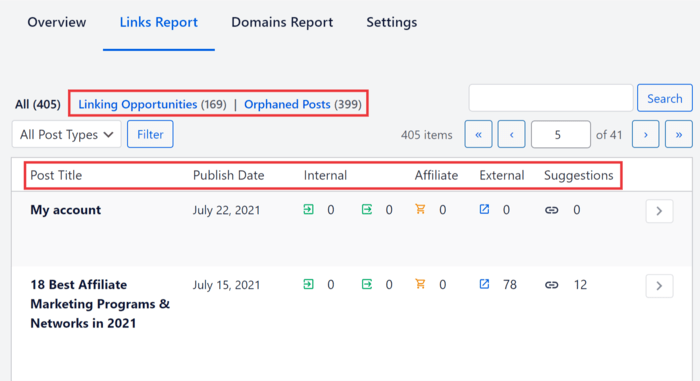
Here are some tools to verify your website’s domain authority now that you know how to raise it.
1.DA PA Checker Tool By GUESTPOSTLINKS
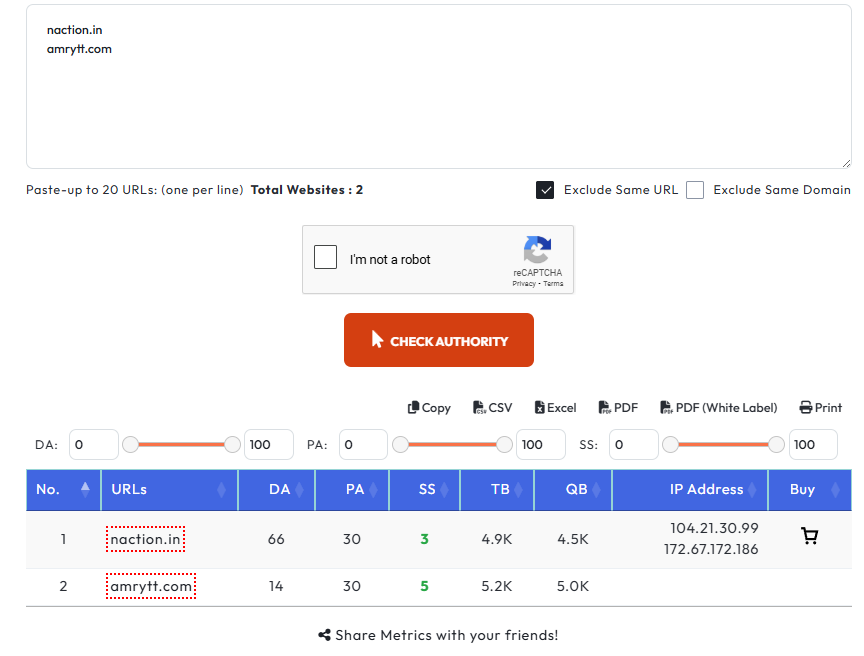
Website DA PA Checker by GUESTPOSTLINKS is a free online tool that helps you check important SEO metrics for multiple websites at once. It’s especially useful for SEO experts, bloggers, marketers, and webmasters who want to know how strong a website is for ranking in search engines. This tool uses accurate data from Moz to check the Domain Authority (DA), Page Authority (PA), Spam Score, and backlinks of websites all in bulk.
Key Features
- Check Up to 20 URLs at Once: Save time by checking SEO stats for many websites in a single go.
- Domain Authority (DA): Shows how powerful a website is and how well it can rank in search results.
- Page Authority (PA): Tells how strong a specific page is in terms of ranking potential.
- Spam Score: Helps you know if a website looks spammy or risky.
- Backlink Data: See both total backlinks and high-quality (dofollow) backlinks pointing to each site.
- Free and Easy to Use: The tool is completely free and doesn’t require any sign-up.
- Export Results: Download your results as CSV, Excel, or PDF files for future use.
How to Use
- Go to the Tool: Visit Website DA PA Checker GUESTPOSTLINKS.
- Paste URLs: Enter up to 20 website URLs into the input box. One URL per line.
- Click “Check Authority”: Hit the button and wait a few seconds while the tool checks the stats.
- View & Download Results: You’ll see the DA, PA, Spam Score, and backlinks for each site. You can also download the results in your preferred format.
2. Moz Link Explorer
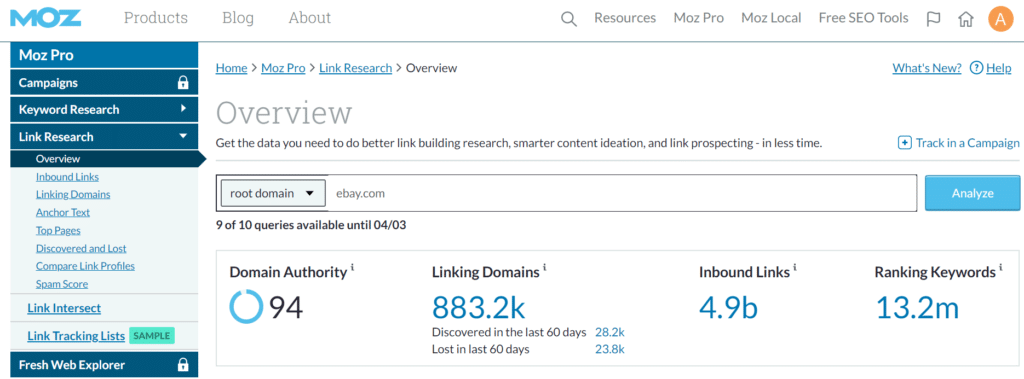
You can use Moz Link Explorer to examine the domain authority of any website. Enter the URL of your website or a competitor’s website to see the domain authority. The tool also shows the amount of unique backlinks to root domains and the number of keywords that rank for a certain domain. More information, such as the most followed links to this site, the most popular pages, the most popular anchor text, and more, are available if you scroll down.
3. Ahrefs
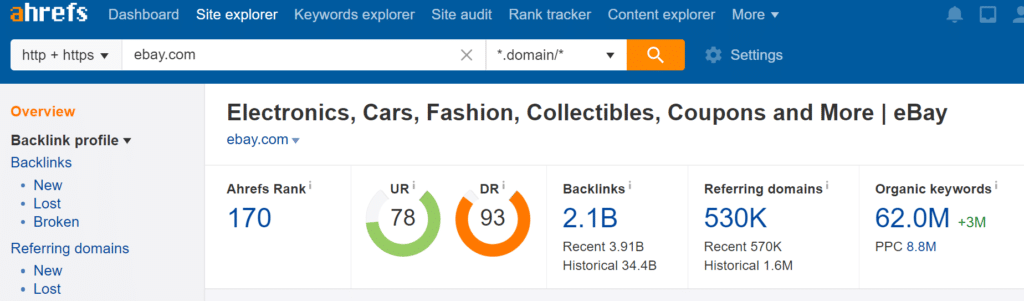
Another domain authority checker that you may use to determine a website’s DA is Ahrefs, which is one of the top SEO tools on the market. It’s worth noting that Ahrefs refers to it as Domain Rating, although it’s the same thing. Another thing to keep in mind is that it calculates the DA using its own algorithm and factors. If you compare it to Moz or any other tool, you can notice a difference in scores.
4. SEMrush
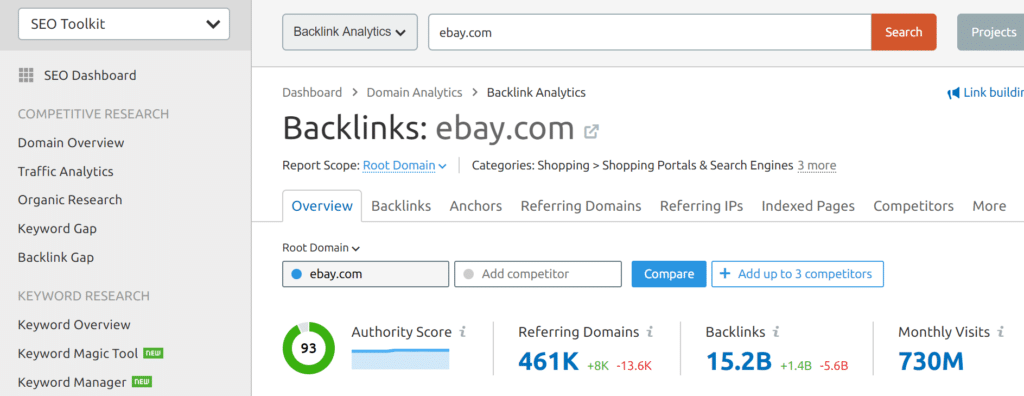
SEMrush is a tool that is widely used by a variety of SEO specialists, and it also offers information regarding the domain authority of a particular website. Backlinks Analytics is the section of SEMrush that you need to go to in order to examine the DA of your website or the websites of your competitors. You are able to see your Authority Score by clicking on the Overview tab (which is domain authority). You have now successfully completed all of the steps in this guide. So, how long does it take until you start to see a rise in your DA?
To summarise, then, your domain authority (DA) is a very important factor in the success of your SEO activities, and vice versa. Building a great online reputation takes time and effort, but it’s always a good idea to make sure you’re putting in the work even though part of it will come to you naturally.
It is important to keep in mind that you do not have any control over the domain authority of your website. Your only option is to arrange the pieces in the correct configuration such that your DA score continues to rise. It is also important to keep in mind that increasing the domain authority is not an overnight process; rather, it needs some time and effort. Therefore, develop a plan with a long-term focus and make use of the suggestions we’ve provided in order to boost your DA. We really hope you enjoyed reading our essay about domain authority, in which we explained what it is and how it may be increased.




I truly like the sort of themes you post here. is in order for sharing us an incredible data that is really useful. Great time
Thanks for nice comments, keep reading and sharing