
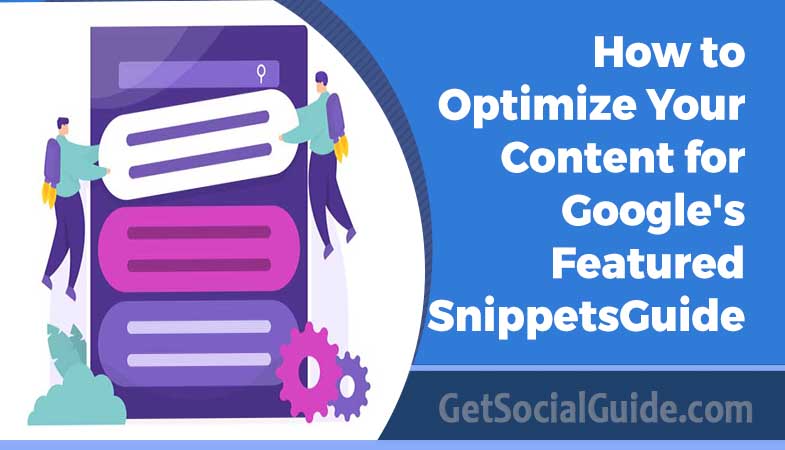
How to Optimize Your Content for Google’s Featured Snippets?
Most of the websites available in the webspace compete to be on the first page of Google. It’s how these sites can generate organic traffic to their website. Still, getting the #1 spot is by no means a piece of cake.
Featured snippets by Google were just an experiment almost ten years ago. To a large extent, these features have become a vital part of Google’s SERPs as they appear for numerous queries. Actually, featured snippets are at present regarded as the first organic position which makes them a part of any SEO strategy.
Featured snippets are those attractive answer boxes that come at the foremost part of the first page of Google’s results. They fulfill the needs of searchers who want quick answers and solutions.
Does not this imply fewer clicks on your website? Occasionally.
So why would you care about optimizing for featured snippets? The thing is grabbing a featured snippet can drastically increase your visibility, create traffic with more clickers that are curious about you, and give your brand the look of the smartest one in the room.
Featured snippets or ‘Position Zero’ are the brief, direct and simplest form of answers to users’ queries, which are given at the very top of the Search Engine Results Page (SERP). When you carry out activities aimed at realizing featured snippets, the objective is to get a spot in that portion of the SERP. This substantially can enhance both the visibility and authority of your brand. Just as one way of showing embedded videos on your WordPress website, video snippets are simply like displaying embedded videos on your WordPress website. In the same manner, content on one platform becomes more visible to the users of another platform. For example, video snippets for YouTube will lead to more users landing on your YouTube channel.
You should not stop one moment to constantly work on your SEO strategies and marketing tactics. And, what if we told you that there was an easy way to be in a position to outrank the number one position even though you were not at the top yourself?
Would you like to know how you could do that?
Well, the answer simply put is by producing a featured snippet which is basically a piece of information that is ranked at position #0.
What Are Featured Snippets?
Google picks selected search results and displays it when someone types in a search query to answer the user’s question right away.
Featured snippets are concise portions of text that are elevated to the top of Google’s organic search results (located just below ads and AI Overviews). They are sometimes called position zero. Featured snippets give quick answers to the user’s question and are the predominant type of feature for informational searches. If you click on a link that is located beneath the featured snippet, you will be directed to the section of the page that contains that particular answer.
To be featured means to rank at the top of organic search results. When a searcher is logged into Google and searching from the United States, the newly launched AI overviews come before featured snippets.
Featured snippets are a Google search feature whereby your listing or position is featured at the top of organic results before a link to the page, unlike the standard format. In essence, featured snippets are aimed at providing the searcher’s question with the fastest possible answer directly in the search results, thus not requiring the user to visit the website.
They are especially important for Google’s voice search as they are frequently the direct answers that the voice assistants read out. Meant for brevity and being to the point, these snippets are perfect for voice search queries that need a quick and simple answer. Consequently, apart from enhancing your content’s visibility in the regular searches, being optimized for featured snippets will also help your content be more visible in the fast-growing voice search sector, thus giving your site the advantage of being the go-to source for information.
If you optimize for featured snippets, you can put your content straight in front of the eyes of people who are searching, thereby elevating the profile of your brand and increasing your website’s traffic. A snippet is the first thing that the user sees before other regular search results, and so it is the most appropriate place to attract the attention of people who are using the internet for search. Also, based on the query, Google displays different types of featured snippets, which we will explain further.
Maybe AI Overviews are taking some of the clicks that would have gone to featured snippets, but even with them being present, featured snippets still have much better visibility than the rest of the organic results.
Benefits of Featured Snippets
Having featured snippets can be great for your site for a couple of reasons. They allow you to:
Offer the right answers to your audience and get free brand exposure:
Google is returning more SERP features like featured snippets and a great number of SERPs are going Zero-Click. Capture those SERP features and keep your brand at the forefront of consumers’ minds. Users may not be clicking through to your site, but you are still relieving their pain points by giving them the answers they need when they ask.
Dominate the discussion about your brand:
Just think how big an opportunity it is to be the only one telling the story of your brand for branded searches. So for instance, a university might not want to highlight its graduation rate but by doing so, it gives an extra hand to a third-party site to rank for the featured snippet and thereby provide users with a wrong number.
Enhance website authority:
E-E-A-T, or Experience, Expertise, Authority, and Trustworthiness, has been a topic that has been discussed a lot in recent years, which reflects Google’s focus during certain algorithm updates. Google won’t give a featured snippet to a website that doesn’t have a good level of E-E-A-T.
Best Practices for Featured Snippet Optimization
You have the basics figured out, so let us move to some higher-level tactics that will help you to really increase your snippet game.
Keep Answers Concise
Paragraph snippets should be as short as possible. It is recommended to have 40-60 words that are very impactful. Here is a clever method: the most important information should be put in the first part of the answer. Google tends to like a good topic sentence, so give it your best one.
Solar eclipse is the event when the moon moves between Earth and the sun, thus blocking sunlight for some time. Depending on the moon’s position, the celestial event can be partial, total, or annular.
Use Question-Based Headers
Put yourself in the shoes of your audience. What questions would they ask? Use these questions as your H2 and H3 headers. Users and Google’s algorithms will find it very easy to navigate your site.
One suggestion: AnswerThePublic is a tool that can help you find the most frequently asked questions in your area of expertise. Take these points and create the outline of your content.
Implement FAQ Schema Markup
Helping Google understand your content can make you more visible. FAQ schema markup is the way to do this as it clearly specifies the questions and answers on your webpage. It’s like providing Google with a map to your content.
Once the changes were made, always verify your work using Google’s Structured Data Testing Tool. It is wise to find errors in the initial stage than to be confused about the reason why you are not getting featured.
Keep Content Fresh
Google prefers the latest information over older ones. Have a regular content audit and updating plan. It doesn’t necessarily mean that you have to rewrite all of your articles–quite often, just checking the facts and updating the date is sufficient.
For instance, a “Best Smartphones of 2024” article should be update continuously with new models, and the old information should be removed.
Optimize for Different Snippet Types
Do not only focus on one single snippet type. Your content should be diversified in a way that it would be able to be the answer for different snippet types.
List snippets: Write detailed, clear walking-through or bulleted lists of the key points.
Table snippets: Use properly tagged HTML tables to display the comparative data clearly and concisely.
Video snippets: Have a good, clear title, a description that represents the video content and use the timestamp feature for video content.
Give the most relevant and shortest answer to the user’s question in order to be the featured snippet. By implementing these best practices, you will not only be snippet friendly, but you will also create better content that is user centered, which is a win for everyone.
How to Rank for Google Featured Snippets
When you are aware of the typical types of featured snippets and the way to get keywords for optimization, you can begin creating your content. Think of these steps as a way of optimizing your content to get a featured snippet.
1. Review What is Currently Ranking
Competitor research is a strategic move that can offer a whole lot of different insights into how to create your content. Judging by their words, the length of the content in the featured snippet, and the specific facts they are giving, you come to know which one of the content pieces is the most valuable for Google to be ranked in the featured snippet position.
Such a study should not be considered as a task of duplication, but rather one of conceptualizing; it gives you an idea of the content type that the search algorithms are most likely to be handing down their verdict on. Therefore, don’t just imitate your competitors; instead, craft your content so that you surpass not only the snippet holder but also the requirements of Google.
2. Use Headings that Relate to the Question or Topic
After figuring out the format to write your content, you need to make sure that you have the correct information to satisfy the users’ needs. Although the use of a “what is” heading is not a feature snippet mandatory condition, it can facilitate Google to understand better the question and answer format by using the exact words of the question.
Remember that the Q&A format is not suitable for all cases, especially for your “how-to” or “step-by-step” articles. So, in these instances, you should use headings that clearly state the instructions or guidance.
3. Answer User Questions Directly
Identifying users’ questions and answering them is one of the major ways to obtain featured snippets and the most user-friendly way of presenting the answer is the next step after that.
Make sure the content you present is relevant and useful to the target audience, think about what they will probably ask and give the answer to their questions.
If you are particularly focusing on paragraph snippets, then you should aim at giving an immediate and direct response to your query within the first 2 sentences of your text.
For instance, if someone types “what does it mean to be deferred from a school,” the page that provides a brief and clear definition of a deferral is the one that gets the most featured snippet.
After the concise definition or answer, you ought to add more details, facts, graphs, etc. to complete the answer thoroughly and comprehensively.
4. Use the Right Format
By looking at the existing rankings, you can also figure out what format your content should take to be able to leverage your featured snippet.
Is your competitor ranked at the top of the page using a table? Follow suit and create a table with correct HTML markup to display your data.
Is the competitor ranking at the top making use of a numbered list of steps? You might think about duplicating this approach.
The competitor’s format—be it bullet points, a paragraph, or some other form— at the top of the ranking is a strong hint of what Google is looking for in that particular query. You should let this determine not only the structure of your content but also the way you present it, as being in line with these preferences can be a deciding factor for featured snippet status. This maneuvering is not only targeted at the search engine’s algorithm but also at user convenience, providing them with the information in the most user-friendly and accessible form.
Tools For Optimizing Content For Google’s Featured Snippets
To master featured snippet optimization, one should not hesitate to employ a variety of useful tools. Google Search Console is an absolute must; it shows the search queries that bring the most traffic to your site and, therefore, points out the potential areas where snippets can be used. In a case where you find a great number of clicks for a certain question, you may want to make your content so that it provides the direct answer to that question.
Moreover, keyword research tools should be regarded as one’s another indispensable resource. They uncover widely asked questions, track changes in snippet positions and provide insights into keywords. For instance, SEMrush or Ahrefs can be used to find question-based keywords. Lastly, the role of schema markup generators cannot be overstated. They enable you to equip your content with structured data which is helpful for Google in terms of snippet selection. By adding schema markup, you are essentially making it more probable that your content will be the one presented in rich snippets.
Types of Featured Snippets (With Optimization Tips)
1: Paragraph Snippet
Paragraph snippet is the precise answer to the query of the user (searcher). When you enter any question on Google and see the exact para at the top of the page; that is the formatted version of the snippet.
It is the most popular form of snippets that encompasses more than 50% of results. These kinds of snippets answer questions like when, what, and where and plays an important role in ranking if you optimize it correctly. Also, Google includes a source text along with the answer.
2: Table Snippet
This kind of snippet considers a comparison chart or table. It shows content that is created in tabular form. If the content is created with different years and price list, then Google values the structure of the written tabular form.
It also takes into consideration different kinds of numerical data. The best part about the snippet is Google optimizes it for the query.
So, you don’t have to manually optimize it for the snippet. There isn’t a particular way to optimize for table snippet apart from creating the data in a tabular form. You can also start with a great heading to make it more engaging.
3: List Snippet
List content appears in numbers or bulleted form that answers a searcher’s query. It shows up in a step-by-step or process-driven intend. Most recipes fall under this category.
It is a common type of snippet that encompasses more than 37% of the snippet results. If you type rules or any content related to it, you’ll get to see a list of rules displayed at the top.
Numbered featured snippet is more organized, and most DIY queries fall under this category.
Bullet featured snippet is used to optimize specific content pages on your website. For optimizing such type of content, you need to include a question in the heading and summarize it in a list form.
4: Accordion Snippet
These kinds of snippets appear in hidden tabs. You need to click on this to retrieve the content. It provides answers to the searcher’s query and is presented with additional information. The user can choose to expand the option to get more details about the topic searched for.
5: Video Snippet
Videos have become a popular form of featured snippet today. Most search results show videos at the top of the page. They always show up at position zero. The reach of videos has grown as most people prefer watching a video than reading a text.
When you optimize a video for ranking in SERP, it will also help to boost traffic on your website. When a user searches for a query on Google, it searches for all the relevant clips and displays at the top of the search results.
A video could also be a possible answer to the searcher’s query. For optimizing video, you need to upload the relevant scripts. You also need to add a description along with long-tail keywords.
6: Answer (Rich) Snippet
Rich answer featured snippet is a short call out in which the possible answer is featured with added information. It offers a specific answer to the user’s query that is often highlighted in a bold font.
This possibly manifests for all the questions that have a metric based answer. Dictionary definitions are a common type of answer snippets. If you type any word for meaning, you’ll get the exact answer for the word. It also features other factual based questions that a user asks about miles or distance.
7: Tools Snippet
Tools provide output user specific answers to the searcher’s query. It often appears as a high level and concrete queries. The questions are related to calculators, conversions, weather, and time zones.
8: AI Overviews
Google uses AI Overviews when it decides that the best way to answer a query is through a generative response. It is very helpful in a situation where the user needs information that can be found in several web sources as well as in Google’s Knowledge Graph.
AI Overviews is the latest addition to the Google search experience. With this convenient feature, you no longer have to manually search through different websites and pages to find information. Instead, you get a factual summary of the query. So if we type ‘what is EmbedPress’ in the search box, we get a detailed answer as shown in the screenshot below. Besides, the references used in the creation of the answer are indicated on the right side.
Advanced Snippet Strategy: Leveraging E‑E‑A‑T
Google’s E‑E‑A‑T (Experience, Expertise, Authoritativeness, Trustworthiness) framework is crucial for snippet selection. To signal expertise:
- Include author bios with credentials and links to professional profiles.
- Cite authoritative sources (academic papers, government data, industry leaders).
- Regularly update content to reflect the latest information.
- Earn backlinks from reputable websites in your niche.
Without strong E‑E‑A‑T, even perfectly formatted answers may never be chosen for position zero.
Competitor Gap Analysis for Featured Snippets
To outperform existing snippet holders:
- Identify snippet pages: Use tools like Ahrefs, SEMrush, or Moz to find which keywords trigger featured snippets and which pages currently own them.
- Analyze structure: Note the heading, answer length, and format (paragraph, list, table).
- Add missing value: Include updated statistics, clearer examples, or a more comprehensive explanation.
- Improve readability: Use shorter sentences, active voice, and bullet points where appropriate.
Even if you can’t outrank the snippet owner, you can still target related “People Also Ask” questions to appear in expanded boxes.
Structured Data and Featured Snippets: What Really Works
Although schema markup does not guarantee a featured snippet, it helps Google understand your content’s structure. Implement the following:
- FAQPage schema for Q&A sections.
- HowTo schema for step-by-step guides.
- QAPage schema for question-and-answer content.
- Table schema for tabular data.
Use Google’s Rich Results Test to validate your markup.
Voice Search Optimization & Featured Snippets
With the rise of voice assistants (Google Assistant, Siri, Alexa), featured snippets are often the source of spoken answers. To optimize for voice:
- Use conversational language and long‑tail question phrases.
- Keep answers between 30–50 words (ideal for voice response).
- Structure content with clear, simple sentences.
- Target “near me” and “how to” queries with local intent.
According to Perficient, 20% of all mobile searches are voice queries, and those answers are overwhelmingly drawn from featured snippets.
Measuring and Monitoring Your Snippet Performance
Once you’ve optimized, track your progress:
- Google Search Console: Filter queries by position “1–3” and look for increased impressions. Use the “Search Appearance” filter for “Featured snippet” to see which queries trigger snippets for your site.
- Third‑party rank trackers: Tools like SEMrush, Ahrefs, or AccuRanker allow you to monitor snippet wins and losses over time.
- Click‑through rate (CTR): Compare CTR before and after snippet acquisition; a featured snippet can increase CTR by 8–10% on average.
If a snippet disappears, re‑audit your content to see if a competitor has provided a better answer, and refresh your page accordingly.
F.A.Q
🔍 Featured Snippet Fundamentals (The Basics)
| Question | Answer |
|---|---|
| What is a Featured Snippet? | A search result box that appears above the standard organic results (sometimes called “Position Zero”) that provides a direct, concise answer to the user’s query. |
| How is a Snippet different from a regular search result? | A regular result is a standard blue link and description. A Snippet is a larger block of content—often text, a list, or a table—extracted and formatted by Google to answer the query immediately. |
| Where does Google get the content? | Google automatically selects content from a web page that it already ranks on the first page of search results (positions 1–10) and determines is the clearest, most authoritative answer. |
| Why is earning a Snippet important? | It drastically increases visibility, improves Click-Through Rate (CTR), and positions your content as the immediate authority on the topic. |
| What is the “People Also Ask” (PAA) box? | The PAA box displays related questions users commonly search for. Optimizing for these questions often overlaps with Featured Snippet opportunities. |
📝 Content Formatting & Structure (Optimization Strategy)
| Question | Answer |
|---|---|
| What are the three main Snippet formats? |
|
| What is the ideal length for a Paragraph Snippet? | A concise answer between 40–60 words (around 300 characters), which aligns with Google’s typical extraction length. |
| How should I structure the answer on the page? | Use a clear H2 or H3 heading that asks the question, followed immediately by a direct and focused answer paragraph. |
| How do I optimize for a List Snippet? | Use proper HTML list tags. Ordered lists (<ol>) work best for steps, while unordered lists (<ul>) are ideal for grouped items. |
| How can I make my tables Snippet-friendly? | Keep tables simple with clear headers, logical structure, and key data placed early for easier extraction. |
🎯 Keyword & Targeting Tactics
| Question | Answer |
|---|---|
| Which types of queries are best for Snippets? | Informational queries with question-based modifiers such as How to, What is, Why is, When is, Best, Cost, Definition, Steps, and Comparison. |
| Should I target keywords I already rank well for? | Yes. Pages ranking in positions 2–5 have the strongest chance of being promoted to Position Zero. |
| How should I phrase the answer keyword? | Use the exact long-tail query as a heading and naturally include the main keyword in the opening sentence. |
| Does site speed matter? | Yes. Faster load times and mobile-friendly pages are more likely to be selected for Featured Snippets. |
🛠 Technical & Maintenance
| Question | Answer |
|---|---|
| Should I use Schema Markup for Snippets? | Yes. FAQ and HowTo Schema help Google better understand and validate your structured answers, though they don’t guarantee a Snippet. |
| Can I “opt-out” of Featured Snippets? | Yes, by using the nosnippet meta tag. However, this removes all snippets, including standard descriptions, which is usually not recommended. |
| How often should I check for Snippets? | Snippets can change frequently. Monitor target keywords regularly, especially after updating content. |
| What should I do if my competitor has the Snippet? | Review their formatting, answer length, and key points, then publish a clearer, more precise version on your page. |
Summary
Featured snippets are the search world’s golden tickets, offering a fast track to visibility and authority. By knowing the types of snippets, strategically optimizing your content, and adhering to best practices, you can place your site in a position to be the one to claim these coveted spots.
By optimizing the target question-based queries, you can make your content eligible for featured snippets. It is not necessary to use schema for that. You have to organise the structure of your content by concentrating more on the para, headings, and tags.
Use one definitive style for all the non-question-based keywords. If it is relevant, do not forget to include the problem-solving steps.
The content must be accurate and should be of a vibrant nature. While you are backlinking, do not forget that you still have to complete the other tasks of optimization if you want to rank higher.
However, snippet optimization is not a one-time thing. It is an ongoing effort that requires the user to be alert, flexible, and have a good understanding of the user’s needs. The difficulties are there, but so are the benefits.
It is time to move beyond theory and start working on it. First, you should look at your content and see if there are any opportunities for snippets. Which of your pages could be restructured to better answer common queries? Use the tools we’ve talked about to find keywords with the highest potential and to learn from the strategies your competitors are using.
Slowly start putting these optimization techniques into practice and, at the same time, keep an eye on your results. Every snippet you get is a success, and each failure is a chance to learn.
Key Takeaways: Your Featured Snippet Optimization Checklist
- Understand snippet types: paragraph, list, table, video, accordion, tools, and AI overviews.
- Target question‑based keywords that already show snippets in the SERP.
- Format answers concisely: 40–60 words for paragraphs; use HTML lists and tables.
- Use question headers (H2/H3) that mirror the user’s query.
- Implement FAQ/HowTo schema to reinforce structure.
- Update content regularly to maintain freshness and accuracy.
- Monitor performance with Google Search Console and third‑party rank trackers.
- Optimize for voice search by using conversational language and short answers.
- Build E‑E‑A‑T through author credentials, backlinks, and citations.
By systematically applying these tactics, you’ll increase your chances of appearing in position zero, capturing more organic traffic, and establishing your brand as the go‑to authority.
Thanks for giving important information.
Thanks keep reading and sharing
Superb blog!
[…] Seek for a restaurant and also you’re prone to discover a information panel full of rankings, hours of operation, location and high dishes with the restaurant’s precise URL buried someplace close to the underside of the featured snippet. […]
[…] Search for a restaurant and you’re likely to find a knowledge panel packed with ratings, hours of operation, location and top dishes with the restaurant’s actual URL buried somewhere near the bottom of the featured snippet. […]